
- Download Issue 65 (US Letter, 7,8 mb) Buy as Book on Demand here (US) and here (DE)

by Mirsad Sijarić
Visions from the Past
An undoubtedly positive development is that concrete steps have finally been taken toward the realization of the Ars Aevi Contemporary Art Museum in Sarajevo and the clustering of the three museums into a central cultural axis. However, skepticism and caution must remain regarding the ability of the Sarajevo Canton authorities to sustain the project's goals. This view stems from past experience with the relationship between the authorities and existing museum institutions, which have been far from positive. In addition to common issues such as irregular financing and the lack of legal frameworks, particular emphasis has been placed on the absence of a clear vision for managing and steering cultural strategies in a socially beneficial direction, often at the expense of private and semi-private initiatives and ad hoc solutions.
The proposed concept for the "museum zone or quarter," a planned area encompassing three museums — the National Museum of Bosnia and Herzegovina, the Historical Museum of Bosnia and Herzegovina, and the Ars Aevi Museum of Contemporary Art — aims to connect these museums via a green belt and pedestrian paths. However, a significant threat to this concept is the fact that local authorities have not abandoned their plans to build a road connection between the National Museum and the other two museums, which could endanger the integrity of Wilson’s Promenade. This road project could destroy the unity of the area and undermine its potential as a space for creative interaction. The proposed road connection not only threatens the museums' physical structures but also jeopardizes their status as National Monuments of Bosnia and Herzegovina.
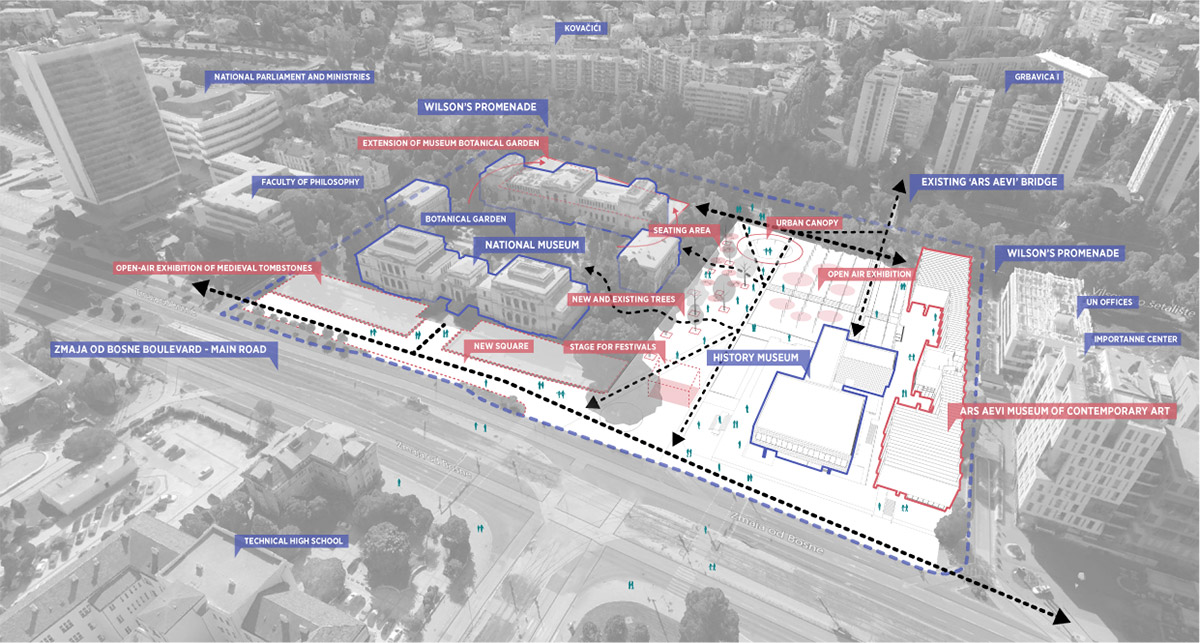
Spatial view of Sarajevo’s future Museum quarter by Nermina Zagora/Senka Ibrišimbegović
For these reasons, it is worth reconsidering the previous solutions for the operation of museum institutions, which in the past had a clearly defined social role and legal framework that facilitated effective oversight. The current situation, where many museum institutions operate without a clear vision and struggle to secure basic resources, should be emphasized as a major problem. The lack of direction, coupled with subjective weaknesses, contributes to a decline in standards and leads to compromises that negatively affect both professional expertise and the dignity of these institutions.
Finally, strong support should be given to the idea that cultural professionals must take proactive steps not only to promote the values of cultural institutions to the public but also to engage with political figures who may either fail to understand the importance of these institutions or remain unaware of them.
Mirsad Sijarić was born in 1970 in Sarajevo, Bosnia and Herzegovina, where he completed elementary and secondary education. After obtaining a university diploma as a Professor of history in Sarajevo, he enrolled in postgraduate school at University of Zagreb (Croatia), where he firstly obtained a master of science degree, followed by doctoral thesis in 2013, entitled “Cold-steel weapons from Bosnia and Herzegovina in the archaeology of the High and Late Mediaeval periods”. From 1996, he has been permanently employed as a curator archaeologist for the Late Medieval period at the National Museum of Bosnia and Herzegovina in Sarajevo. In the period between 2010 and 2015 he acted as Head of the Archaeology Department, while he was Acting Director of NMB&H between 2015 - 2025. During the last ten years his main preoccupation was mainly conservation and revitalization of the Museum’s buildings, as well as general management in cultural heritage.
During the course of his career, he published numerous scientific articles and books, exhibition catalogues and school textbooks. In addition to scientific work, he is also a published author within the literature field, with several poetry books and novels.
He is also an avid cyclist, amateur gardener and vinyl collector and the winner of the Chevalier de l’Ordre des Arts et Lettres de la République française in 2018.