
- Download Issue 65 (US Letter, 7,8 mb) Buy as Book on Demand here (US) and here (DE)

by Ştefan Rusu
Socialist Architecture as a Common Value and Public Space as a Heritage
The main resource of my interventions in the urban context is socialist architecture and via this I’m questioning the role and significance it plays in contemporary society. In reality, there is often a lack of social awareness of the historic significance and value of socialist architecture as heritage. In spite of the temporal distance of the epoch, the strong semantic layer of the constructivist, socialist-realist and modernist architecture causes that it is generally associated with the repressive communist era. The legitimacy of preserving or even perceiving these buildings as valuable is still questioned in post-soviet societies.
The relation to the cultural heritage of the immediate past in the case of modernist aesthetics is directly connected with the present and future time, given the vitality and presence of recent urban developments, be it in Chisinau, in Tbilisi or in Baku. The preservation of modernist heritage in the current socio-economic situation and urban context is problematic, in some cases even dramatic. In response, we as cultural workers have to deal with it and transform it for the benefit of the people that inhabit mass housing buildings.
My practice is transdisciplinary, it is based on research and collaboration with collectives and citizens actively engaged in defending public spaces, and in the protection of architectural heritage. Most of the urban interventions developed between the years 2009-2024 spread across various European and Asian cities, and these have been conceived in collaboration with artistic initiatives and civil society organizations involved in situations of conflict between citizens and authorities, or in situations where the local administrations appropriated vacant spaces and territories, abandoned buildings, parks or green areas in collaboration with real estate developers, thus acting against public interest.
One of the longest-lasting projects I ever produced was Apartmentul Deschis/Flat Space, developed in collaboration with Oberliht Young Artist Association and installed in Chisinau (2009). After it was installed, the space became a venue for exhibitions, conferences, concerts, screenings of video art and films, poetry readings, meetings with foreign students, second-hand and barter markets, demonstrations, a signature collection point, a meeting point for sightseers, writing workshops, and cooking courses followed by dinners, barbecues or mămăligă (traditional cornbread) tastings.
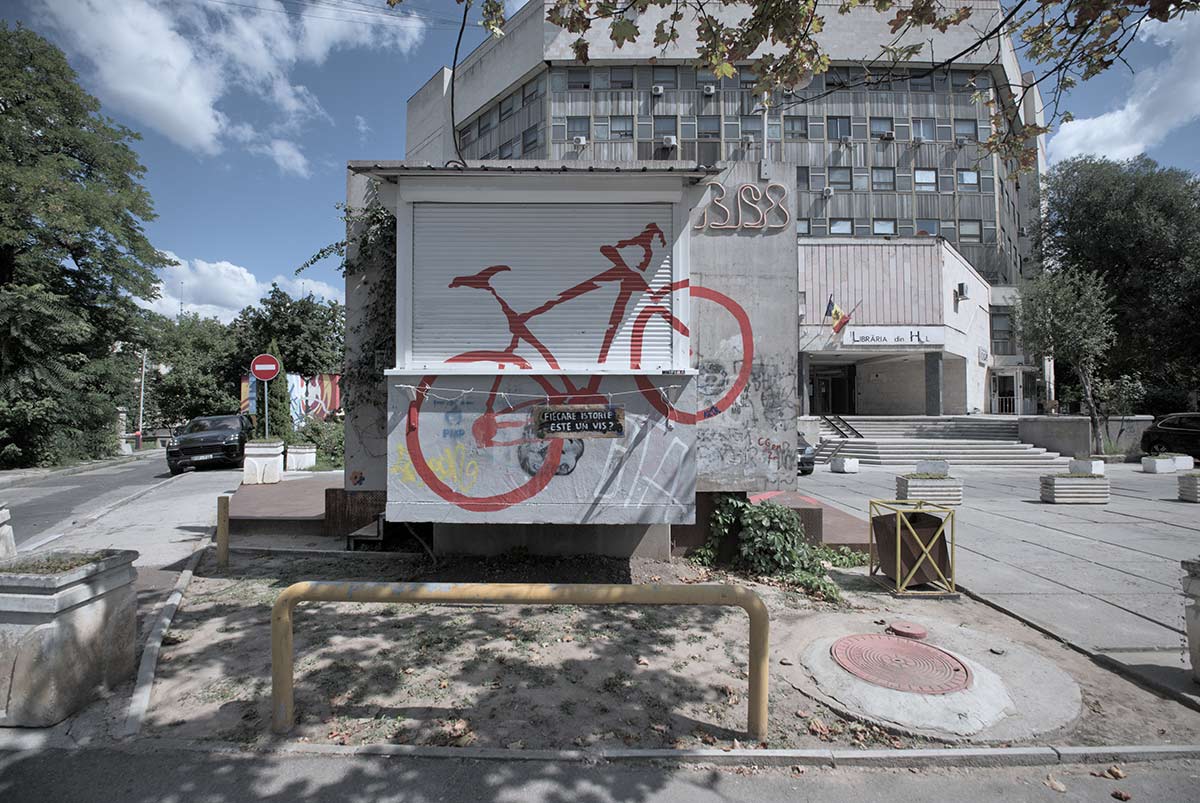
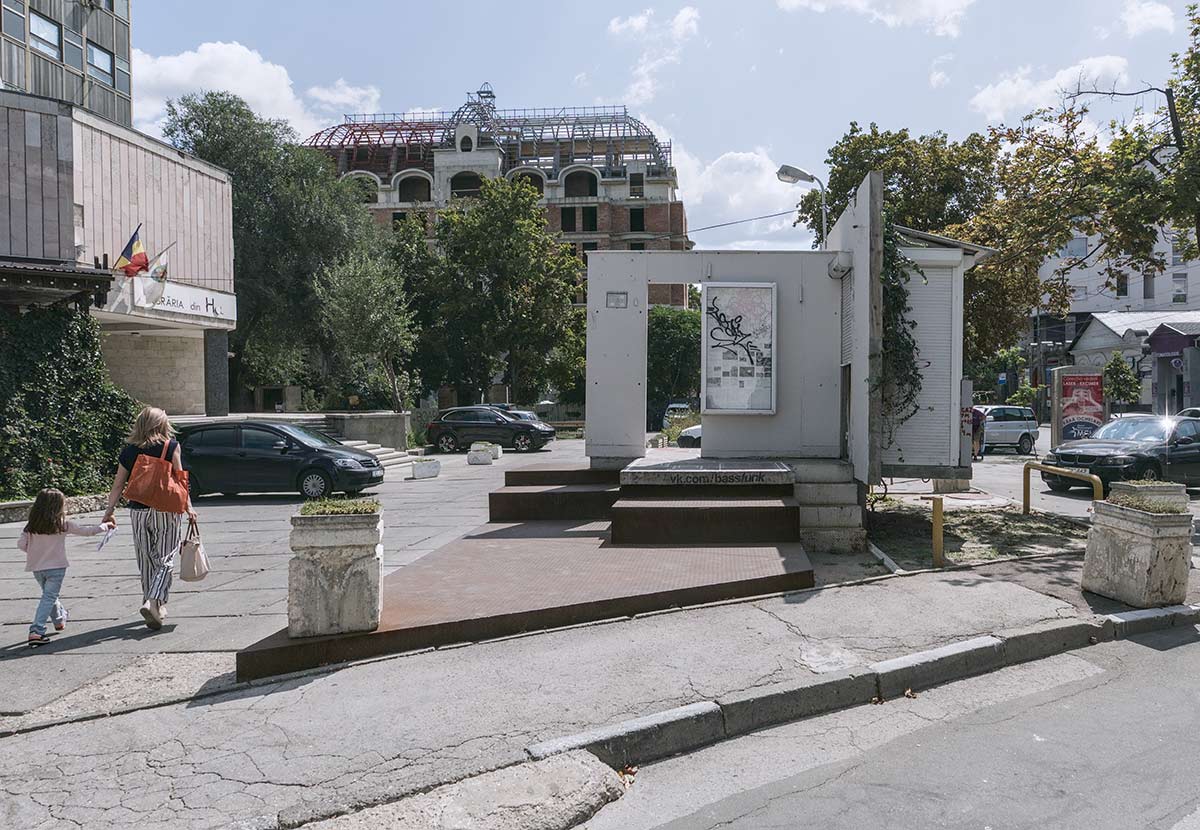
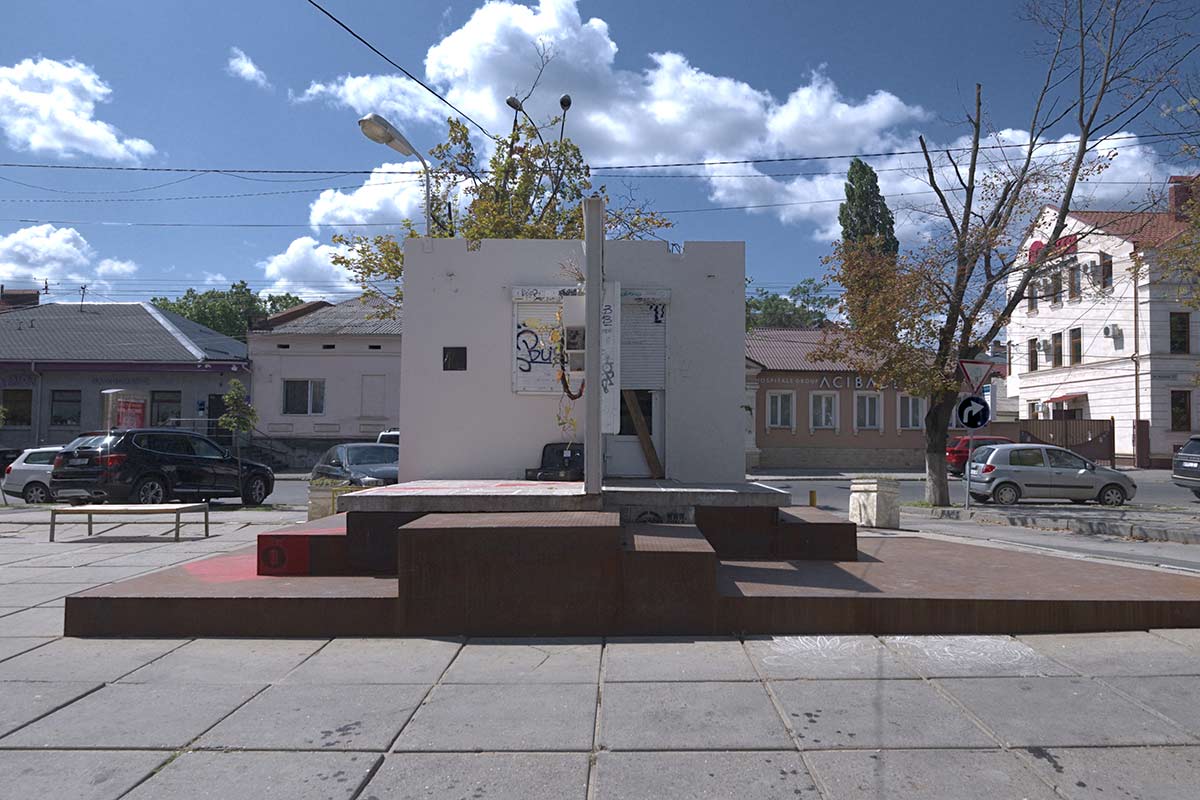
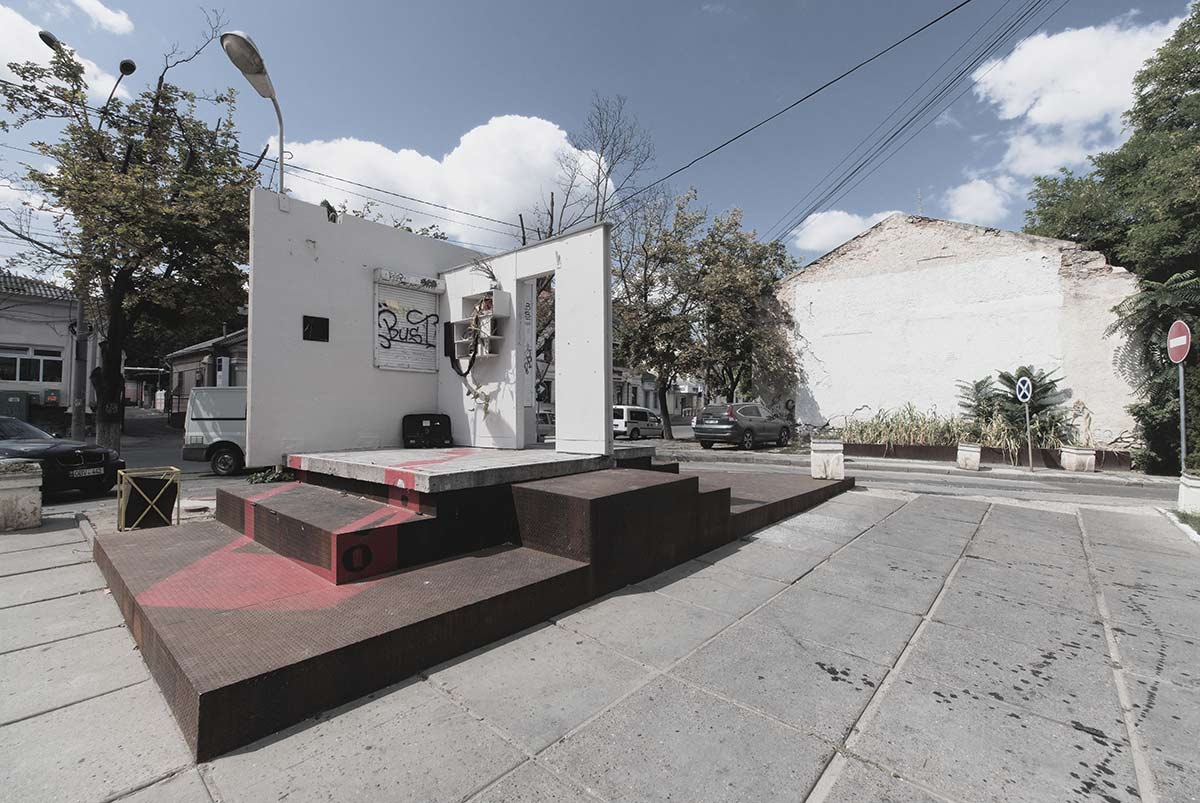
Apartamentul Deschis/Flat Space. Designed by Ștefan Rusu for KIOSK project produced by Oberliht Association, Chisinau, 2009. Images courtesy of Stefan Rusu
The interventions I have done in urban space are performative structures that usually feature elements of residential architecture, inspired by the concrete experiences of living in each urban environment, and look for new meaning within the apartment, the street, the neighborhood and the city in different political and economic contexts.
Another example of such interventions is Block89, installed in Georgia in the courtyard of a housing block as part of the Tbilisi Architecture Biennale (2018). On a practical level, the logic of this project was the reuse of existing prefabricated concrete elements, in this case a replica of the entrance into a socialist flat building that explores the facets of a soviet modernist house from Gldani district, Tbilisi (1970’s). The intervention of Block89 was motivated by several factors: a lack of maintenance of prefabricated panel buildings, a lack of conservation policy of built heritage from soviet era and consequently, a growing negative perception towards standard mass housing. What I intend is to reverse this common attitude towards the phenomena of socialist architecture and maintain positive and constructive views on this complex issue, by looking for appropriate technical solutions to preserve it as heritage.
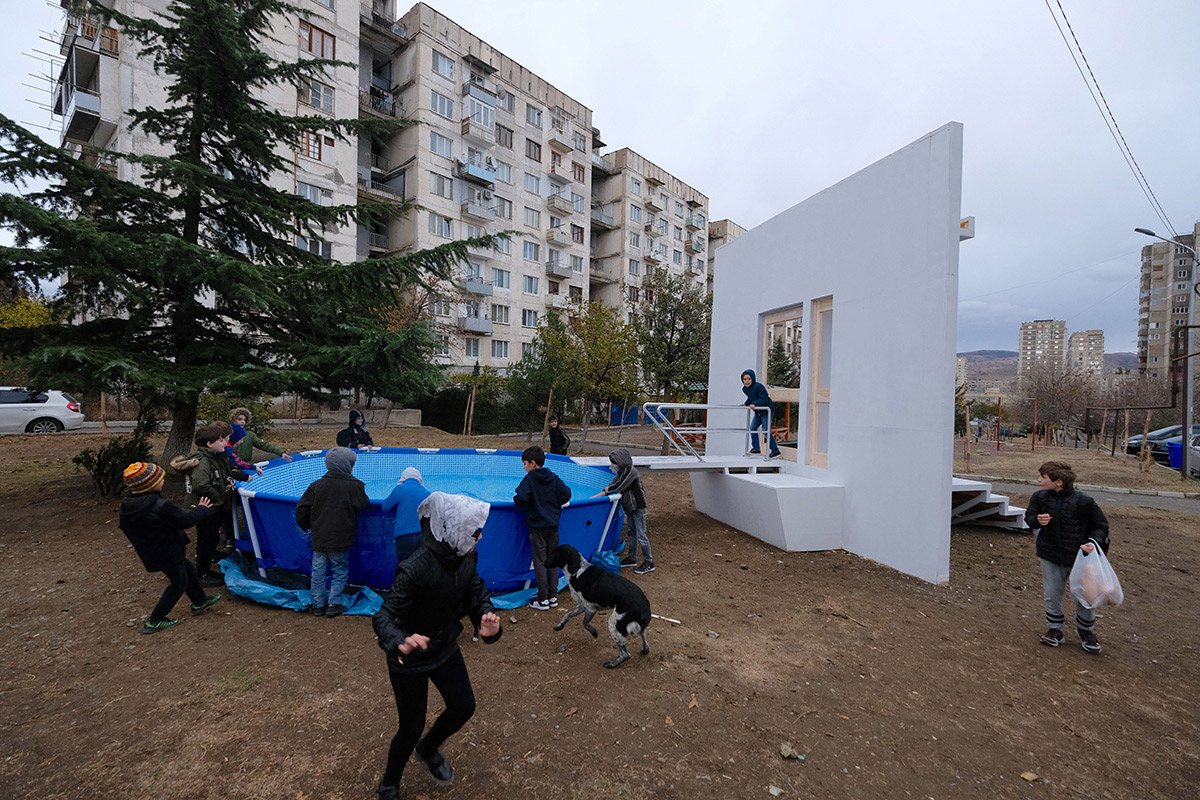
Block 89, site-specific installation. Produced in the frame of Tbilisi Architecture Biennale – “Buildings are not enough”, 2018. Image courtesy of Stefan Rusu
Once an artist decides to do an intervention in public space, there is an assumed responsibility for the gesture, and the way it will be received by the residents of specific neighborhoods and the public. I recall a project by Nada Prlja who installed her "peace wall", that resulted in blocked traffic in Kreuzberg during Berlin Biennale 7th edition (curated by Joanna Warsza and Artur Żmijewski).
Her intervention was not a reference to the Berlin Wall, but to the social segregation present in this area today. Such a project provoked a response from the residents and the public from the start, and this is what happened instantly. The very location of Prlja’s wall represented a space where certain communities lost their ability to influence the decision-making process, which made concrete the necessity to fight for their rights. With this civic metaphor, the installations call for shared spaces that are free of political control and economic barriers, where citizens can learn about and openly debate issues of concern.
Nada Prlja "peace wall” was a particular case, but I would like to expand on the aspects of my practice where there are of course successful and failed experiences.
Specifically aimed at young people, Apartmentul Deschis/Flat Space sought to manifest a meeting place, a space that would generate activities and promote citizen activity from the ground up. It was a way of challenging the powers-that-be by calling for collective use of a derelict space and placing it at the service of art and culture. Perhaps this is the reason that it is still active (2009-2025) and continues to serve the initial purpose. The reactions from the public and passersby range from appreciation to rejection, manifested by cultural operators who rent spaces in the Municipal Department of Culture, next to which the Apartmentul Deschis/Flat Space is installed. They perceive the square as a commodity, as a parking lot for their cars, and the installation with its angular shape causes only inconvenience. Furthermore, some representatives of the cultural elite nicknamed it “Balcony”, ridiculing its position in and importance for the art community.
One of the failed examples happened in Baku during the “Urban Olum” Public Art Festival organized by the Pillə, an urbanist initiative from Azerbaijan. My installation “Communal Loggia”, freshly installed in the Bayil district, did not survive and was destroyed overnight by locals. Was it feedback from the locals or it was an accident? The organizers of the urban festival could not discover what happened, and we have to learn from such cases too.
Consequently, those urban interventions are not just part of an art collection inserted in public space as pieces of urban decor, but an ongoing effort to look for answers and solutions for communities in a bind and for spaces adrift - be it the community of young artists from Chisinau who lack work spaces and exhibition venues, or the inhabitants of Bayil district from Baku, caught in the spiral of gentrification and neglected by the authorities.
In summary, some of the models that I find relevant and important when approaching issues of public space; collective work as a principle in art production, commonality (a former principle of collective ownership) needs to be resurrected, cross disciplinarity of art production – especially when working in public space with expansive complexities. Finally, connecting public and private interest in protecting socialist architecture as a common value and public space as heritage.
Ştefan Rusu (b. 1964 in Kâietu, Moldova) is an artist, curator, and urban researcher working between Chisinau, Republic of Moldova and Bucharest, Romania, and is currently based in Apia, Samoa Islands/South Pacific. His artistic and curatorial agenda follows a transdisciplinary approach, dealing with exhibition design, publishing, film production, educational platforms and cultural activism, urban research and the protection of tangible and intangible heritage. Since the 1990’s, his practice is geared towards the social and political changes in Eastern European societies after the fall of the Berlin Wall and the dissolution of the Soviet Union. From 2000 onward, he is involved in the evolution of KSAK Center, Chisinau, and later in 2005-2006 he completed the Curatorial Training Program at De Appel, Amsterdam. Towards the end of 2012, he moved to Tajikistan, where he collaborated with the Dushanbe Art Ground center. After relocating to Kyrgyzstan in 2016, he initiated a research platform “Insular Modernities” – that explores urban contexts and architectural heritage, mapping the status of public space and the actors of urban activism in Central Asia and Eastern Europe.