
- Download Issue 65 (US Letter, 7,8 mb) Buy as Book on Demand here (US) and here (DE)

by Mojca Puncer
Participatory Art as an Act of Care
As a theorist of philosophical provenance and as an art critic and curator in the field of contemporary art, I have been trying to understand and interpret various aspects of participatory art for more than a decade. During this time I have also been involved in curating participatory art projects: In collaboration with the Art Society of Celje (SI) and Goethe-Institut Prague I curated BLOKI: Architecture of Human Relations (2013–2015); I also co-curated the following exhibition WE MEET AT SIX: Proposals for Communal Practices and Green Areas in Celje (Center for Contemporary Arts Celje, 2015).[1] The insight into various art projects and artistic research methods informed and stimulated my own research and theoretical work. I investigated the “paradoxes of the politics of aestheticsˮ using the example of “artistic striving for community,ˮ[2] the “avant-garde sourcesˮ and a “sense of discomfort in art criticismˮ using the example of participatory art,[3] “artistic participation and the failure of democracyˮ using the example of Slovenia,[4] “interspaces of art and social lifeˮ as “challenges for contemporary aestheticsˮ[5] and “new public art as an emancipatory manifestation of local cultural identity,ˮ[6] to name just the most representative topics. My approach is to undertake a broader analysis of the social context, including philosophical, cultural and socio-political theories, while attempting to critically reflect on this phenomenon of participatory art and evaluate its artistic, aesthetic, ethical and broader social significance. I drew inspiration from philosophers, cultural theorists and curators such as Jacques Rancière, Nicolas Bourriaud, Claire Bishop, James Thompson and Elke Krasny, to name but a few. Initially, I focused on discourses and concepts such as Bourriaud's “relational aesthetics,ˮ[7] followed by Bishop's critique.[8] Her well-known theory of participatory art (with the definition of participation in which “people constitute the central artistic medium and materialˮ)[9] is complex, historically, practically, and theoretically (even philosophically) grounded, but it also brings some problems. For me, it is important to note that Bishop rejects most of the aesthetic and ethical dimensions of participatory art, or that she only advocates a certain kind of aesthetics of rupture, over-identification, dissensus (in line with Rancière's philosophical aesthetics).

Andreja Džakušič with coworkers, Hanging Gardens, 2015, installation in Gallery of Contemporary Art, exhibition of Andreja Džakušič, Daniela Krajčova, Simon Macuh, Estela Žutič & Gilles Duvivier: WE MEET AT SIX. Proposals for Communal Practices and Green Areas in Celje. Zavod CELEIA Celje – Center sodobnih umetnosti (Center for Contemporary Arts). Photo Tomaž Černej.
Although I still consider the turn to participation in art relevant, the field of participatory art and the discourse around it have changed in the years since the publication of my earlier texts on this topic,[10] including the general influence of neoliberalism on the cultural field. Therefore, I argue that there is a need to rethink participatory art and reassess the extent to which it can fulfill its main objectives in pursuing (democratic) change not only in the art world but in society in general. The potential of participatory art for non-hierarchical intersubjective relations and collaborations is undeniable, but only if it is conceived as part of long-term processes embedded in communities and not as experimental events in the specialized context of an art institution.[11] Although the results of participatory art can be documented, the most important thing is the artist-initiated activity of the “audience,ˮ which is constitutive of the artwork itself. I am interested in the processes within this activity and in the effects or outcomes of different participatory art projects. Here I must mention the post-Marxist analysis of artistic labor in neoliberal capitalism – I am also sensitized to this aspect, as well as to the aspects of the instrumentalization of this kind of art by European cultural policy.
As far as the conditions of production are concerned, participatory art is very much tied to the local context. Otherwise, participatory art is well represented in the post-socialist context of Slovenia: Until the early 1990s, community-oriented art had moved from the periphery of the art world to the center. There are internationally recognized artists who deal with community and participation, such as Marjetica Potrč, Apolonija Šušteršič and Polonca Lovšin. There are also projects such as Beyond a Construction Site (community garden on a dormant construction site, KUD Obrat, Ljubljana, 2010–2022),[12] which I have written about several times, and events such as the Admission Free festival (a project of the Art Society of Celje since 1999)[13] and related projects, in which I have also been involved as a researcher and curator.
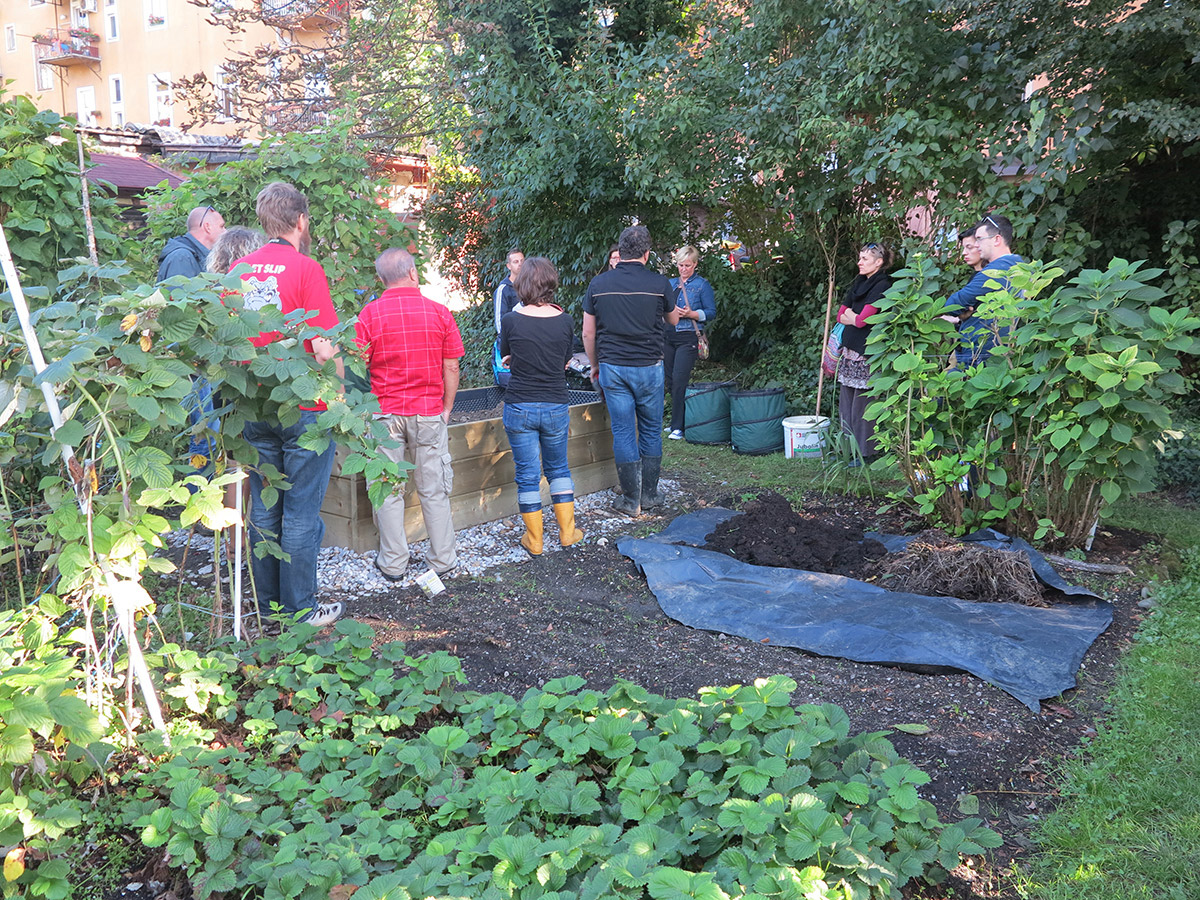
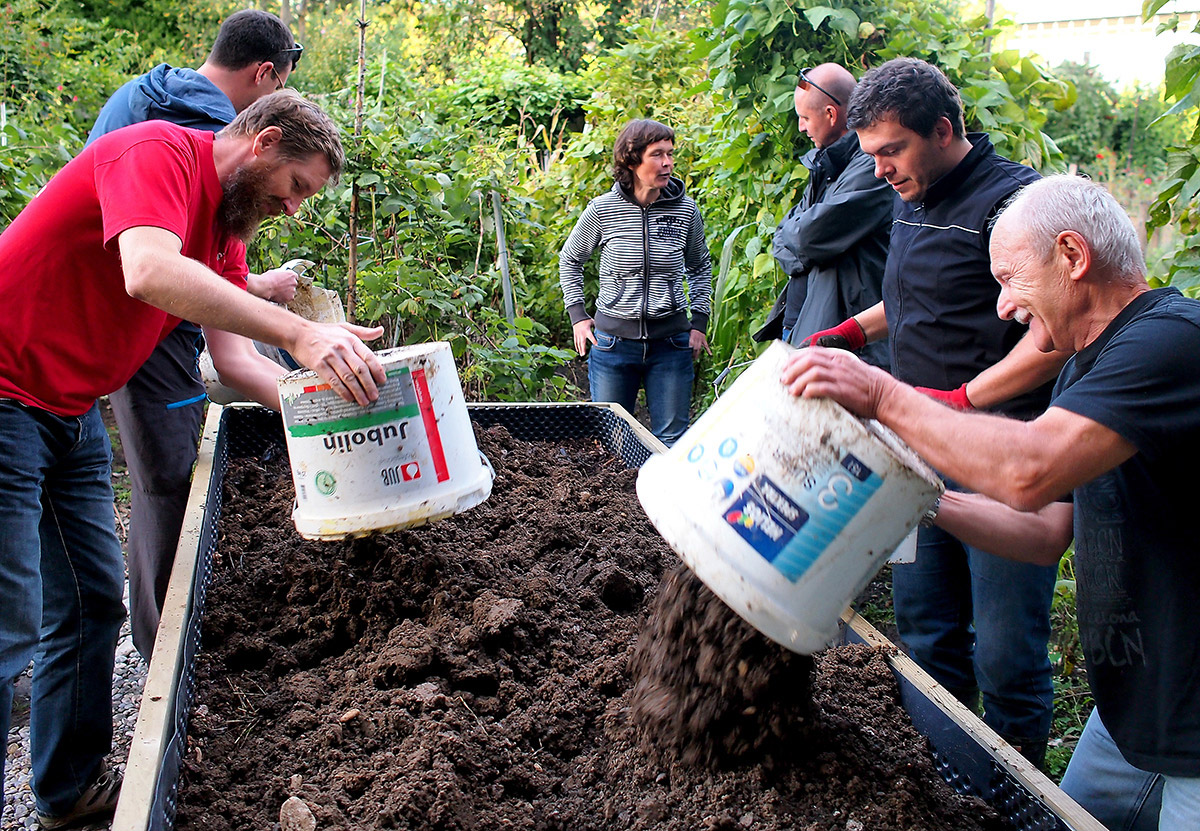
Andreja Džakušič with coworkers, Hanging Gardens, 2015, project Architecture of Human Relations, open atelje, Kare 9, Celje, setting of a raised bed. © DLUC (Društvo likovnih umetnikov Celje / Association of Fine Artists of Celje).
Recently, I have paid particular attention to the primacy of social and ethical values over aesthetic and formal dimensions in participatory art (this emphasis has been criticized by Rancière and Bishop, for example), in the context of a supposed care for public/social space (e. g. in the sense of including the invisible, marginalized, neglected “otherˮ) within a limited project duration in a given context.
The problem of the relationship between aesthetics and ethics has been addressed in various academic and artistic contexts, but I would like to emphasize that some related questions about the aesthetic and artistic criteria for the evaluation of participatory art are still unresolved. There is an interesting position of some analytically oriented aestheticians and philosophers of art who argue for a critical evaluation of the aesthetic value of participatory art as artistic (e.g. Carroll's functional account of art criticism that makes artistic value dependent on the artist's intentions, etc.).[14] At this point, I would like to refer to Kuball's project if walls could tell and its utopian political claim to a “truly uncontrolled, decolonized public spaceˮ.[15] The artist is understood here less as an individual producer of discrete objects, but rather as a collaborator and producer of situations or conditions for open-ended participation in the sense of a cultural exchange between different urban contexts.
I found Krasny's[16] discussion of the concept of care in art and the emergence of so-called care aesthetics by James Thompson[17] particularly interesting. According to him, care is an important source of ethics in human relations, which can also be understood as an embodied or sensory practice, i.e. in aesthetic terms. In this understanding, care aesthetics is part of a history of socially engaged art practice and scholarship. If I take Kuball's project as an example of an artistic intervention in an architectural and urban context, it could be seen as a case that shows the importance of care for the field of socially engaged art, especially those that involve participatory processes. I agree with Thopson that it is important to also pay attention to an aesthetics of care in art projects to show how many art processes demonstrate that care is realized through the activity of making and participating in art practices. This is about the integration of processes so that art making is also an act of caretaking. Art based on care aesthetics is therefore process- and relationship-oriented, and the aesthetic value lies in the activity of the participants, detached from the specific artifacts designed by the artists, and not in a specific representation or outcome.
Mojca Puncer received her PhD in philosophy from the University of Ljubljana, Slovenia. She is an associate professor of philosophy at the University of Maribor. She teaches at the Department of Fine Arts, Faculty of Education, as well as at the Faculty of Design and AMEU ISH in Ljubljana. She also works as a freelance curator, critic, and theorist in contemporary art. She is a member of the editorial board of the fine arts magazine Artwords and serves on the executive committee of the Slovenian Society of Aesthetics. Her work has been published in numerous publications in Slovenia and abroad. She is the author of the books Contemporary Art and Aesthetics (2010) and Interspaces of Art (2018). She conducts research in the philosophy of art and culture, aesthetics, art theory, fine art, visual culture, and new media theory. Her main interests include artistic research, participation, performativity, the body, space, art in social space, new media art, and the relationship between art and science. She recently published scientific papers in journals such as Philosophies and FKW: Zeitschrift für Geschlechterforschung und visuelle Kultur.
Notes
[1] See: “Andreja Džakušič, Daniela Krajčová, Simon Macuh, Estela Žutič & Gilles Duvivier WE MEET AT SIX. Proposals for communal practices and green areas in Celje,ˮ 11.9. –18.10. 2015, Gallery of Contemporary Art, Pokrajinski muzej Celje © 2025, accessed December 2025, https://csu.si/en/exhibition/we-meet-at-six-proposals-for-communal-practices-and-green-areas-in-celje
[2] Mojca Puncer, “Paradoxes of the politics of aesthetics: artistic striving for community,ˮ The aesthetic regime of art: dimensions of Rancière’s theory, International Conference, Ljubljana, 27.–28. November, 2015 (Conference Schedule and Abstracts, 15–16), accessed December 2025, https://www.sde.si/files/2015/07/International-conference-Ranciere.pdf
[3] Mojca Puncer, “The politics of aesthetics of contemporary art in Slovenia and its avant-garde sources,ˮ Filozofski vestnik 37, no. 1 (2016): 133–156, https://ojs.zrc-sazu.si/filozofski-vestnik/article/view/4857; Mojca Puncer, “Participatory art, philosophy and criticism,ˮ Filozofski vestnik 40, no. 3 (2019): 241–260, https://ojs.zrc-sazu.si/filozofski-vestnik/article/view/8132/7523
[4] Mojca Puncer, “Artistic participation and the failure of democracy: the case of Slovenia,ˮ Art and democracy: Symposium 8.–9. Juni 2018 (Programm), Akademie der bildenden Künste Wien © 2025, accessed December 2025, https://webportal-preproduction.akbild.ac.at/de/institute/kunstlerisches-lehramt/veranstaltungen/aktuelles/2018/art-and-democracy/SubEvent
[5] Mojca Puncer, “Interspaces of art – challenges for contemporary aesthetics,ˮ Art + media 19 (September 2019): 1–13, https://doi.org/10.25038/am.v0i19.313
[6] Mojca Puncer, “New public art as an emancipatory manifestation of local cultural identity,ˮ 8th Mediterranean Congress of Aesthetics: Aesthetics of Everyday Life in Contemporary Cities, 9.–11. September 2021, webinar (Book of Abstracts, 132–133), accessed December 2025, https://www.yumpu.com/en/document/read/65840775/book-of-abstracts/132
[7] Nicolas Bourriaud, Relational aesthetics (Paris: Les Presses du réel, 2002).
[8] Claire Bishop, “Antagonism and Relational Aesthetics,ˮ October 11 (Fall 2004): 51–79.
[9] Claire Bishop, Artificial hells: participatory art and the politics of spectatorship. (London: Verso, 2012), 2.
[10] Mojca Puncer, “Community-based (artistic) practices as a new spatial ecology in Celje,ˮ in We Meet at Six: Proposals for Communal Practices and Green Areas in Celje, ed. Irena Čerčnik (Celje: Zavod Celeia, Center sodobnih umetnosti; Ljubljana: KUD Mreža, Galerija Alkatraz, 2015), 5–10.
[11] I agree here with Milevska – see Suzana Milevska, Participatory Art: A Paradigm Shift from Object to Subject (Skopje: ZG Kontrapunkt, 2023), https://kontrapunkt-mk.org/wp-content/uploads/2024/07/suzana-milevska-ang-za-web.pdf
[12] Obrat, “Beyond a Construction Site,ˮ 18. 10. 2022, accessed December 2025, https://obrat.org/en/projects/2022/beyond-a-construction-site
[13] “Admission Free Festival,ˮ CULTURE.SI, Ministry of Culture of Republic of Slovenia, updated July 28, 2025, accessed December 2025, https://www.culture.si/en/Admission_Free_Festival
[14] See e.g. Matilde Carrasco-Barranco, “Artistic Aesthetic Value in Participatory Art,ˮ Philosophies 10, no. 2 (2025), https://doi.org/10.3390/philosophies10020029
[15] Zoran Erić, E-mail message to author, April 1, 2025.
[16] Elke Krasny, “Architecture and Care,ˮ in Critical Care: Architecture and Urbanism for a Broken Planet, eds. Angelika Fitz & Elke Krasny (Vienna: Architekturzentrum Wien & The MIT Press, 2019), 33–41; Elke Krasny, “Care,ˮ AA Files, 76 (2019): 38–39; Elke Krasny, “Scales of Concern: Feminist Spatial Practices,ˮ in Empowerment. Art and Feminism, eds. Andreas Beitin, Katharina Koch, and Uta Ruhkamp (Wolsburg: Kunstmuseum Wolfsburg, 2022), 184–186; Elke Krasny, Living with an Infected Planet: COVID-19, Feminism, and the Global Frontline of Care (Bielefeld: transcript Verlag, 2023); Elke Krasny & Lara Perry, “Introduction,ˮ in Curating with Care, eds. Elke Krasny & Lara Perry (London: Routledge), 1–10.
[17] James Thompson, Care Aesthetics: For Artful Care and Careful Art (London: Routledge, 2023).