
- Download Issue 65 (US Letter, 7,8 mb) Buy as Book on Demand here (US) and here (DE)

by Lina Franko and Andi Slawinski
if walls could tell: On Site-Specific Publicness and Collective Articulation
When the project if walls could tell was realized in April 2025 in collaboration with the art association RIZOM [ K ] in the atrium of Frankopan Castle in Kraljevica, it encountered a topography shaped by remarkable historical depth and complex contemporary dynamics. Kraljevica—once a renowned spa town under the Habsburg monarchy, later home to one of the oldest shipyards on the Adriatic coast—today exemplifies the post-industrial tensions that characterize many peripheral European cities: marked by economic ruptures, social hybridity, and an urban public sphere in the process of reconfiguration.
It is precisely within such constellations that our long-term European project 3RD-SPC./RP has been situated since 2019. Together with local and international partners, we develop formats that understand contemporary art as a transversal practice—a medium that operates on the margins and opens up in-between spaces. The collaboration with if walls could tell was not merely a cooperation, but a rhizomatic expansion of our curatorial and artistic approach: conceptually open, structurally permeable, politically clear in its stance.
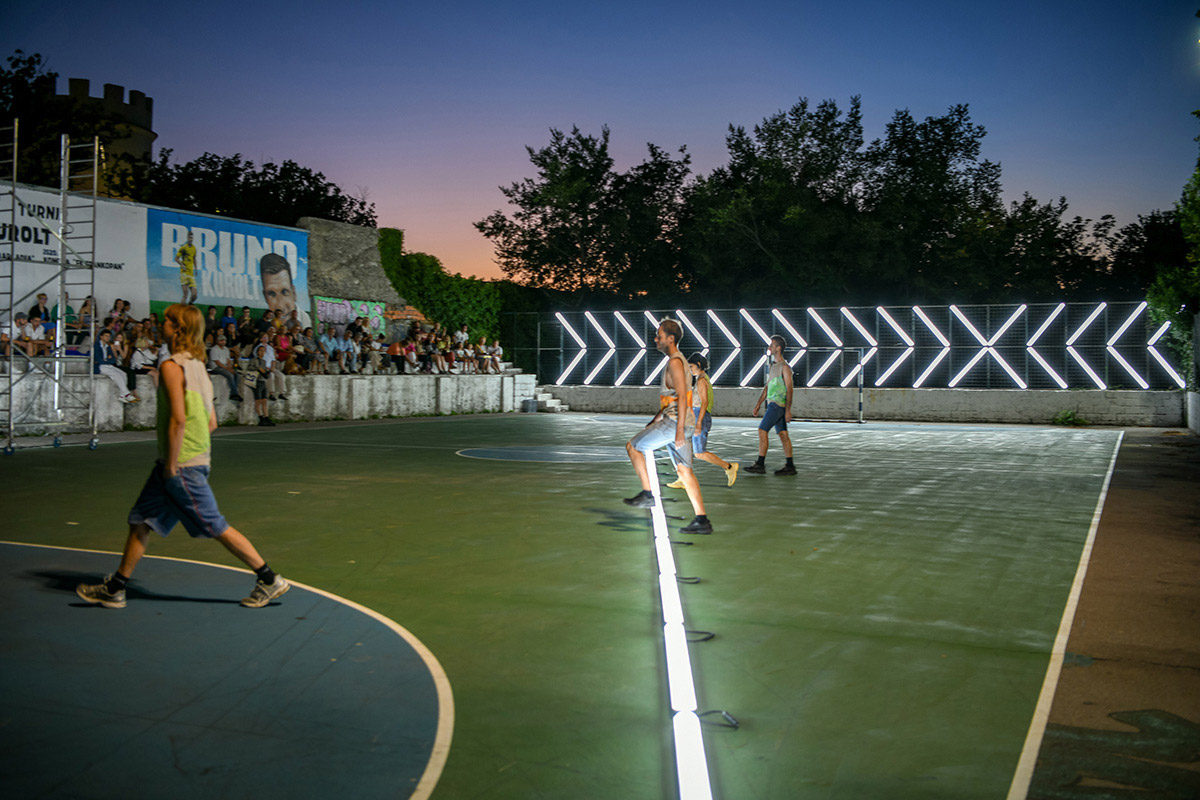
3RD-SPC./RP – no. 4, Time Dilation and EU/rope – a Matter of Perspective, THE HALF THROUGH, choreography by Daniela Georgieva, installation by Martin Pfeifle, with Christoph Speit, Snorre Elvin and David Kummer, Football Field Marakana, Kraljevica, 2023. Photo: Juraj Vuglač.
Mischa Kuball’s intervention—consisting of three mobile white walls, each split into two segments and precisely aligned with the historical colonnade of the atrium—activated the space not as a site of representation, but as a matrix of expression. In a short time, the atrium of the castle transformed into a vibrant forum: a space of remembering, questioning, writing, and drawing—together with local residents, tourists, teenagers, and students from the APU RI Academy in Rijeka.
The responses were spontaneous, polyphonic, translingual. People wrote, drew, and commented in Croatian, German, Italian, and English. The walls were not treated as neutral surfaces, but as resonant membranes of collective articulation. The invitation to participate was not verbally issued—it was embedded in the spatial configuration, in the material, in the gesture itself. If walls could tell thus became a social and aesthetic dispositif—ephemeral, porous, open to contingency.
Within the framework of 3RD-SPC./RP, the local population has long been involved through Interdisciplinary exhibitions, performances, discursive formats, and artistic residencies, that have established a familiar framework since 2019. Yet if walls could tell marked a new dimension of participatory openness—one in which the boundaries between authorship and reception dissolve, and every participant becomes an active subject of the unfolding process. The walls turned into performative archives: drawings, political messages, personal memories, and linguistic traces formed a polyphonic image of the present.
![3RD-SPC./RP – no. 4, Time Dilation and EU/rope – a Matter of Perspective, panel discussion, Art Association RIZOM [ K ], Frankopan Castle, Kraljevica, 2023. Photo: Juraj Vuglacˇ.](/files/oc/dateiverwaltung/issue65/3RD-SPC-RP_No4_PanelDiscussion_RIZOMK_Kraljevica_JurajVuglac.jpg)
3RD-SPC./RP – no. 4, Time Dilation and EU/rope – a Matter of Perspective, panel discussion, Art Association RIZOM [ K ], Frankopan Castle, Kraljevica, 2023. Photo: Juraj Vuglač.
In the accompanying panel discussion, we reflected on the fragility, potential, and contradictions of participatory artistic practices. What kinds of shared spaces can be temporarily created without being instrumentalized or narrowed by affirmative agendas? What responsibilities arise for artists, institutions, and curators when authorship is shared?
The art association RIZOM [ K ] embraced the opportunity to present if walls could tell as a paradigmatic instance of participatory art – not as a methodological instrument, but as a relational praxis: a space of productive uncertainty, negotiation, and aesthetic-political counter-narratives against hegemonic logics of representation. In this sense, if walls could tell constituted a socio-aesthetic event – one that created space for rethinking the very notion of publicness and collective articulation.
Lina Franko and Andi Slawinski, artistic–curatorial duo, are founders and artistic directors of the transdisciplinary project 3RD-SPC./RP (3rd Space – European Research and Practice), which they have been jointly developing since 2019 . Building on the partner associations RHIZOM [D] and RIZOM [K], they are shaping a long-term European programme that interweaves exhibitions, film-based works, performances, residencies and site-specific interventions. Their practice moves between curatorial research, installation, moving image, spatial dramaturgy and collaborations with local communities. Working between Germany and Croatia, they focus on decentralised exhibition formats, international residency programmes and site-specific interventions realised with MMSU Rijeka, NMMU Zagreb, Kunsthaus NRW Kornelimünster and further partners in North Rhine-Westphalia. As founder of RIZOM [K], Franko defines the project’s curatorial direction with a focus on visual arts and, together with Slawinski, has developed key exhibition sequences including Δ. A Tipping Point (2025), Tišina vjetra – The Poetry of Multilingualism (2024), Time Dilation and EU/rope – a Matter of Perspective (2023), I.D.entity and EU/ropa – wer ist das ICH das spricht (2022) and An opening without events – A European artifice in coronatimes (2021). Slawinski, founder of RHIZOM [D], contributes a focus on film, video and performance, combining visual, performative and collaborative strategies. Since 2020 Franko and Slawinski have also worked as an artistic duo, presenting their work internationally. They are currently developing the sixth project phase, 3RD-SPC./RP – Još ne. – In Absence of a Map, to be realised in 2026 with Kunsthaus NRW Kornelimünster, further advancing the project’s dialogical approach to artistic research and contemporary exhibition practice.