
- Download Issue 65 (US Letter, 7,8 mb) Buy as Book on Demand here (US) and here (DE)

by Bojan Djordjev
Contested Public Space
In the local, Serbian context, there is a lack of consensus on the purpose of the public space in general. Public space is increasingly commercialised and privatised as a direct attack on and dismantling of the socialist / social welfare / common goods heritage.
There is forthright destruction and vandalism of monuments – for years the busts of the People’s heroes of Yugoslavia’s graves at the Kalemegdan park (Đaković, Ribar, Milutinović, Pijade) were vandalised persistently. In 2023 – Shoes no 43, a monument to Vjeran Miladinović Merlinka (the first openly trans person in Serbia, sex worker and film/media personality 1958-2003) placed near the Belgrade bus station, was destroyed 3 days after its inauguration. There are many more examples like this.
Artistic interventions in public space unmistakably capture the atmosphere of these unofficial, mini civil wars. Branislav Nikolić’s sculpture Infinite column (2019) in Čačak, made up of 11 toilet bowls – as the artist’s nod to Duchamp, Buñuel and Brȃncuşi – was damaged weeks after its installation. It seems that “plumbing objects” hit the very heart of the petit bourgeoisie’s sense of propriety. The artistic statement in the public space became a provocation. The public responded radically to the provocation – with destruction.
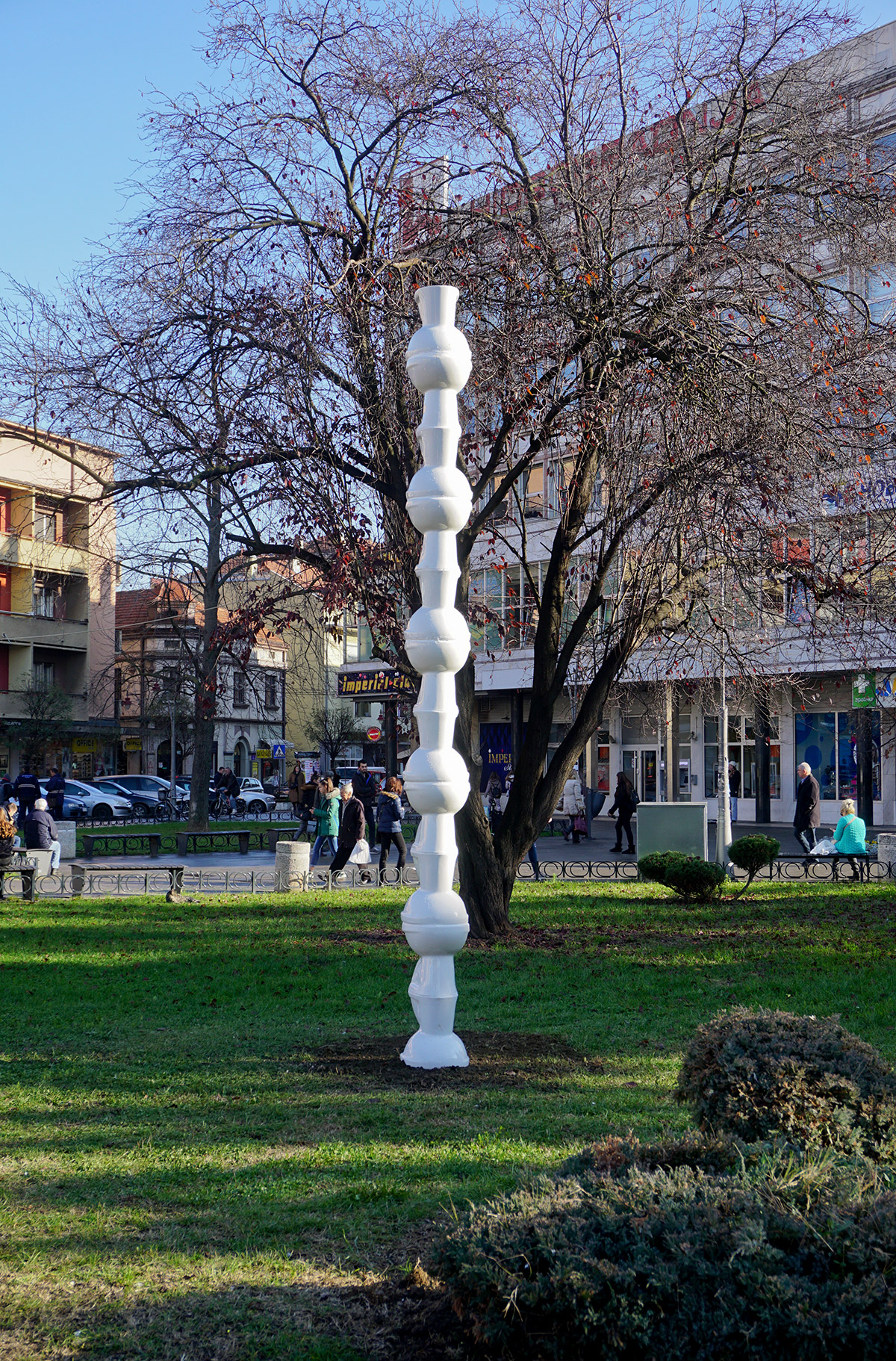
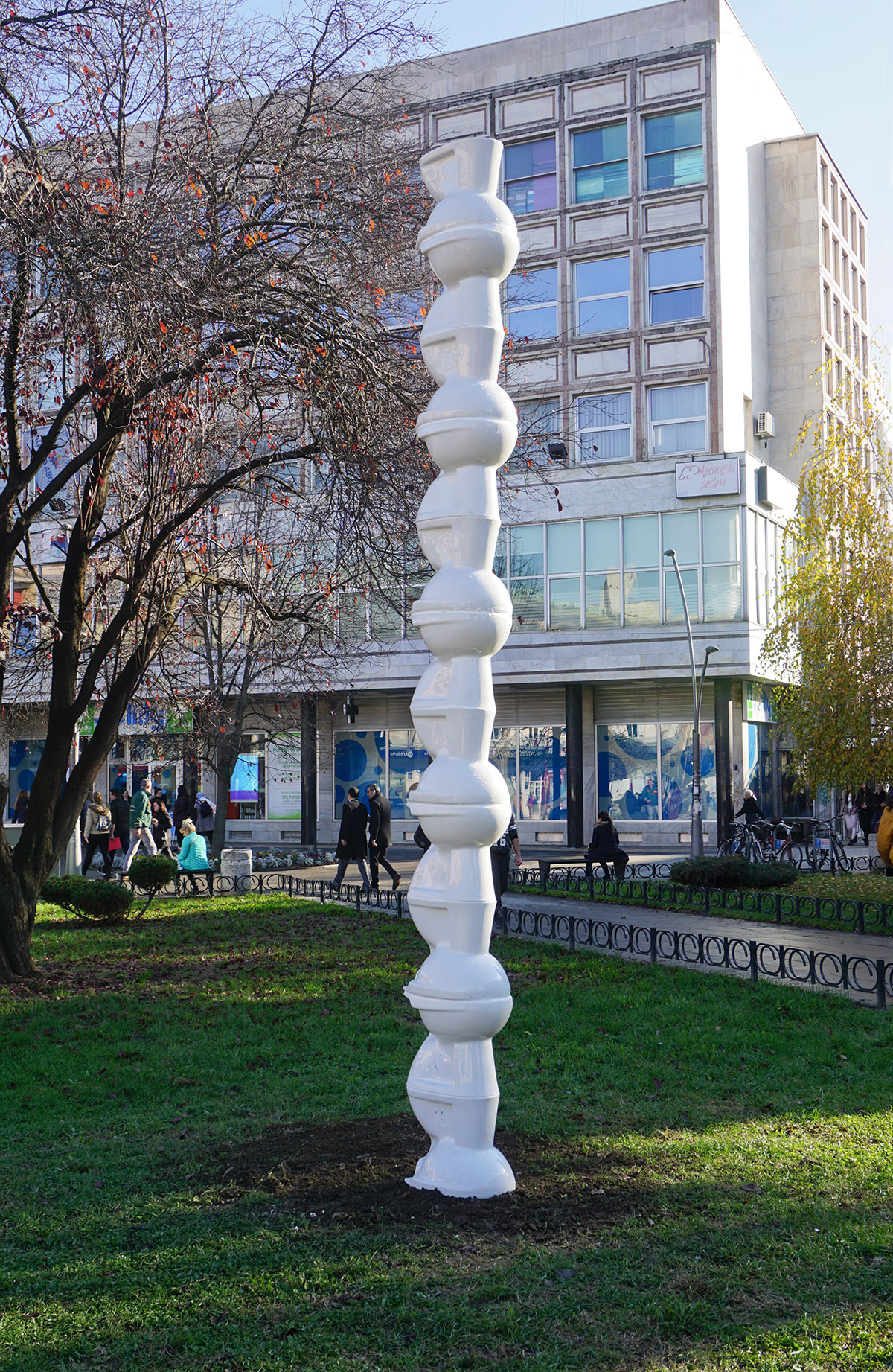
Branislav Nikolić, Endless Column, 2019, ceramics, 440x46x36 cm Photo credits: Branislav Nikolić, The work was realized as part of the joint exhibition of Žolt Kovač and Branislav Nikolić Surviving the work, winner of the audience award at the 27th Nadežda Petrović Memorial in 2014.
There are also more discreet interventions and dialogues initiated by artists in public space. Another example from Čačak is a work by Katarina Popović Don’t forget to breathe (2022) – manifested via the planting of 10 Paulownia elongata on an unused plot in the centre of the city. After only two and a half years this tiny plot has become a new city forest providing shade and oxygen and a different protocol of dialogue on commons and public good between artist, public institutions and citizens.
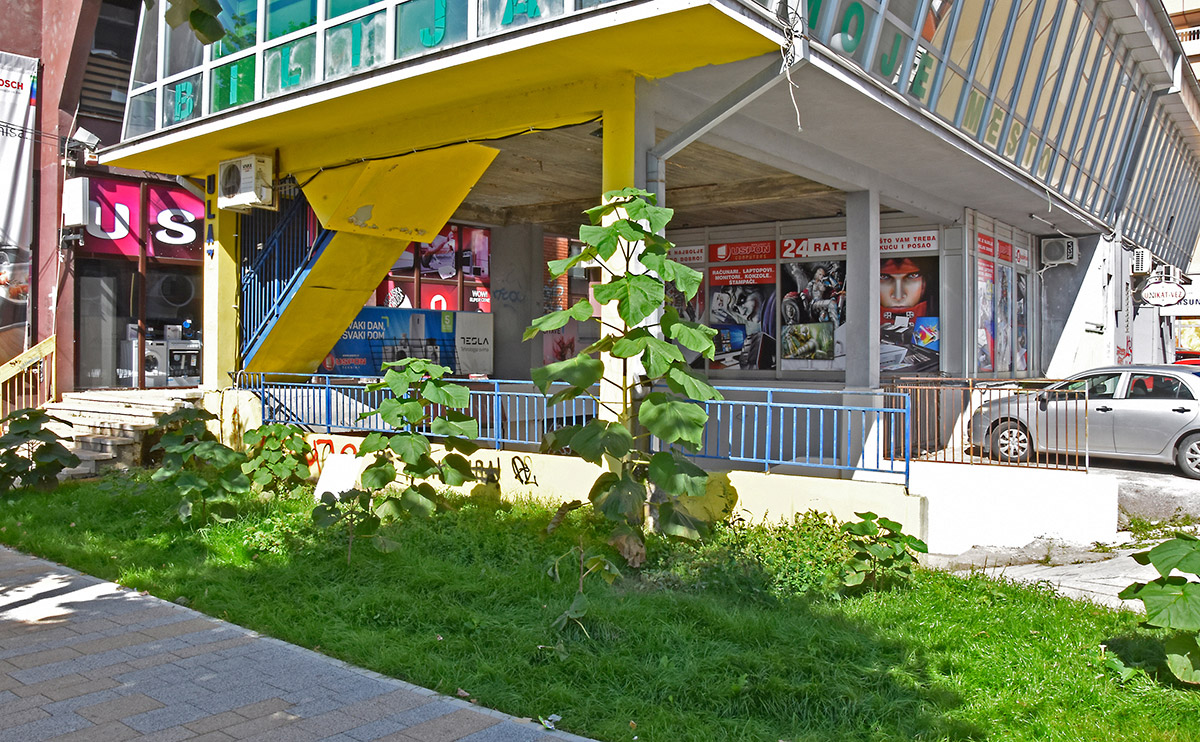
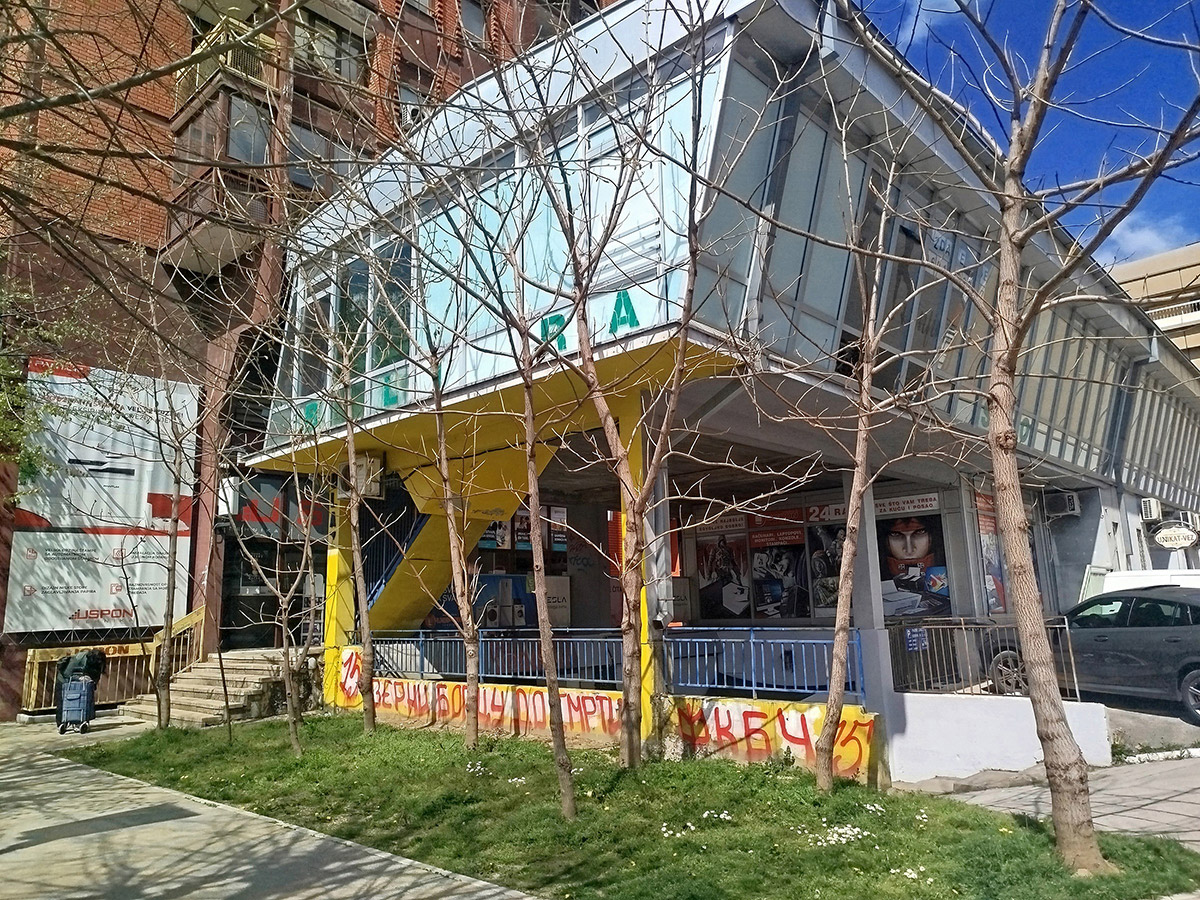
Katarina Popović, Don’t Forget to Breathe, since 2022. 31st Nadežda Petrović Memorial, 2022. Photographies: Milenko Savović and Predrag Predrag Živković.
A tragic accident – the structural collapse of a canopy in the recently renovated railway station in Novi Sad - took 16 lives in November of 2024. With the student protests initiating a wider social movement asking for an official investigation and justice in this case of negligence and corruption, the dissensus on public space became even more pronounced. The right to mourn, commemorate and protest was contested by violent verbal and physical outbursts, condoned and organized in most cases by the ruling party. As I write these notes (June 2025), there are two encampments occupying Belgrade’s public space within one square kilometre distance from each other and both in front of government buildings; the one is sponsored by the government objecting to the student protests; and the other protests new legislature that destroys the universities’ autonomy.
The success of students mobilising a very large portion of society for support and self-organisation is due to the re-invention of public space and through more or less deliberate reference to the tactics of 1970’s performance art. Long commemorative collective silences materialised where around 110 000 people joined a protest in December 2024 and spent 15 minutes in absolute silence on Slavija square in Belgrade. The period from January-March was marked by students and citizens walking across Serbia, crossing several hundreds of kilometres in something that bears resemblance to the endurance art performances of the 1970’s.
The moment that if walls could tell arrived to Serbia, political or ideological dissensus was especially amplified, and by simply offering empty gallery walls, the work offered a particularly potent field for materialising this dissensus in writing, responding, and painting over different messages. It is interesting to analyse the choreography of civic movements triggered by this opportunity for communication – what is the importance of leaving a message, of replying to one, and what new, specific moments has this massive self-organisation of students and other citizens brought to the concept, the Čačak iteration of if walls could tell.
Bojan Djordjev (1977) is performance maker from Belgrade, educated in theatre directing and art theory in Belgrade at the Faculty of Drama/University of Arts and Amsterdam at DasArts. His artistic interests include contemporary playwrights and interdisciplinary research projects. His research deals with issues of artistic and cultural heritage of socialism in Yugoslavia and elsewhere, capitalist economy and finding artistic and theatrical public formats for Marxist thought. Apart from Belgrade, his works have been presented in Berlin, Brussels, Amsterdam, New York, Vienna, Graz, Shanghai, Zurich, Zagreb, Rijeka, Ljubljana. at festivals such as Europalia; ImpulsTanz, Steirischer Herbst, Mladi Levi, BITEF, Kondenz, Sterijino Pozorje, etc. He is a co-founder of TkH – Teorija koja hoda (Walking Theory) platform and TkH Journal for Performing Arts Theory – 2000-2017. With Siniša Ilić and Maja Mirković he co-curated Scene work ahead – Serbian exhibition for the Prague Quadrennial of Performance design and space 2019. With Siniša Ilić he co-curated Gestures, signs of life 31. Nadežda Petrović Memorial, a biennial of contemporary art in Čačak, Serbia in 2022; and co-curated Liquid Becomings, an ECF European Pavilion 2024 Belgrade/Rotterdam/Lisbon.