
- Download Issue 65 (US Letter, 7,8 mb) Buy as Book on Demand here (US) and here (DE)

by Vladimir Us
Connecting the Dots
Open public spaces constitute the democratic infrastructure of any society, while accessible public spaces for independent cultural initiatives (and citizens initiatives in general) in post-socialist cities could represent an important indicator characterising the society's overall democratic nature.
Although seemingly accessible today, it was not always the case, especially if we look back to when public space in Moldova was governed by authoritarian regimes. Nowadays, it still lacks proper regulation that could prevent any misuse and offer a protective status, and which would encourage different civic initiatives to make better use of it for cultural and educational purposes alike. Considering this, the public spaces in Chișinău are still fragile as constructions, remaining vulnerable to economic exploitation and overcommercialization due to private interests prevailing over public ones, as well as being exposed to various forms of control from public authorities that could impose restrictions over them at any given moment.
Oberliht Association has been trying to address some of these challenges over the years by not only initiating pivotal events, but also through long term programs organized in collaboration with artists, architects, sociologists, historians, researchers and activists, assembling in time a community of cultural workers and other professionals interested in urban transformations. Together, and by making use of public spaces, we have developed certain methodologies in order to open wider public infrastructure to citizens' initiatives.
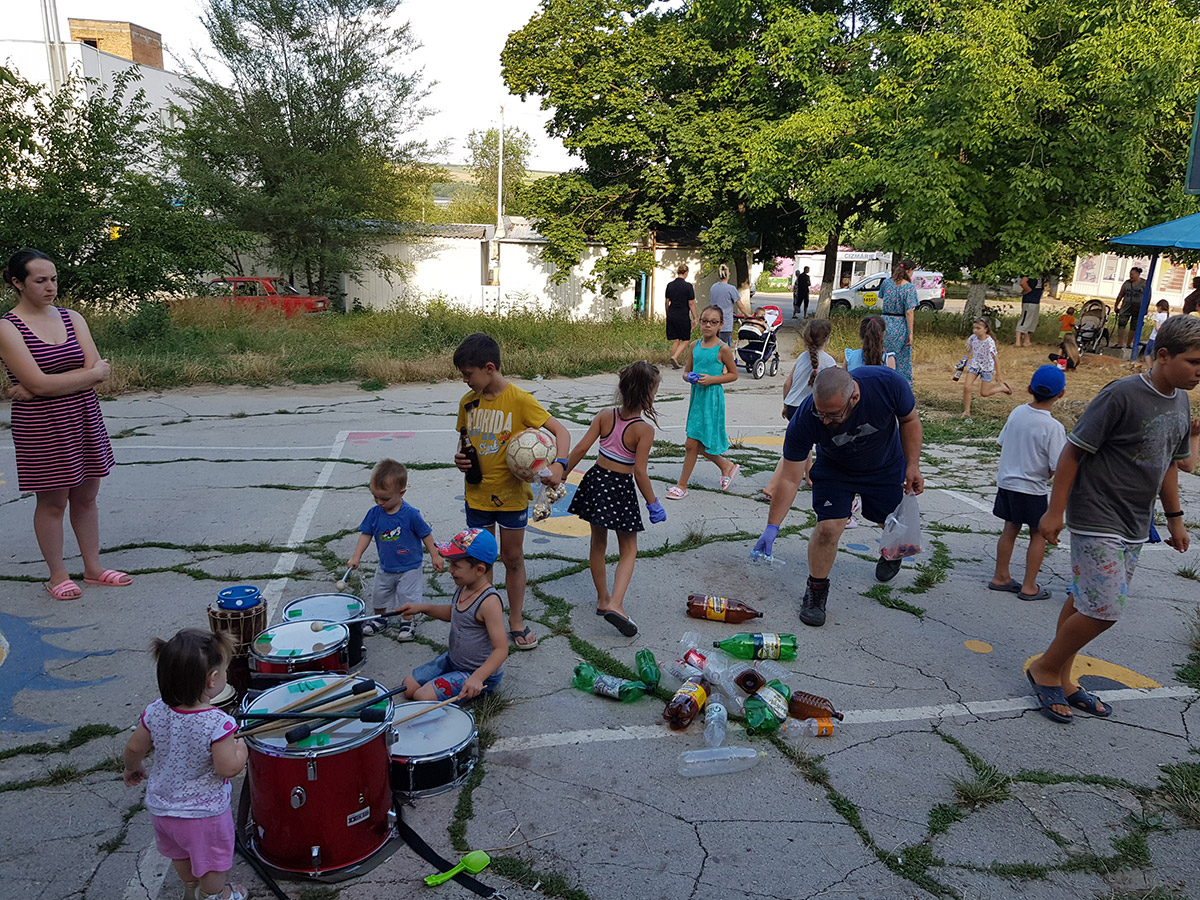
Public Facades, Maria Dragan neighborhood in Ciocana district, Chișinău (July 22-29, 2019). Percussion workshop facilitated by Ana Popa and Thomas Wood
From the outset, as a group of art students at the Painting Faculty, we felt the need to self-organize in order to get access to exhibition spaces that belonged to public cultural institutions and to overcome the feeling of isolation that we faced in the field of the arts and culture in Moldova. Once graduated from the Art Academy, we shifted our focus from the usual studio practice towards engaging with the topic of public space, by making use of our classical art training in an experimental way. We proceeded by focusing our attention on the external urban and social conditions and by documenting via the means of photography, the ongoing urban transformations and gradually rebuilding our relationship with the city and its ever changing environment through a series of ephemeral interventions in the public spaces of Chișinău and its suburbs.
Establishing the Flat Space as a cultural platform for public participation followed shortly after, creating better conditions for further development of the experimental art practice related to the topic of urban transformations. Reclaiming a public pedestrian square from illegally parked cars through arts and culture made us engage more actively in the process of rethinking the urban policies themselves. Furthermore, the establishment of an online mailing list and a paper based magazine helped us make our activities visible both on the local and international levels, leading to new collaborations with partners from former socialist republics and central and western European cities.
These efforts were complemented by the establishment of the Public Space Library - an important resource for self-education in relation to public space. Conceived initially as a virtual space, with a preliminary selection of a hundred titles, it expanded as a physical space currently containing over 400 titles about art in public space, architecture and urbanism, community development, urban economy and urban theory in general, meant to extend the discourse on various processes that shape the city and its public spaces both locally and elsewhere. The activities carried out in its frame adopted the format of reading groups, mapping workshops, multiple series of talks and conferences on the topic of the city and culture, as well as a distributed newsletter relating cultural and activist practices every second or third month.
The theoretical approach combined with the field trips, site-specific art interventions and community engaged activities led to the creation of a new vision for a network of interconnected public spaces with squares and parks, pedestrian areas, spaces for culture, sport and leisure activities. These were created and projected over the historical part of Chișinău as an alternative topology not dominated by state ideology or excessive commercialization.
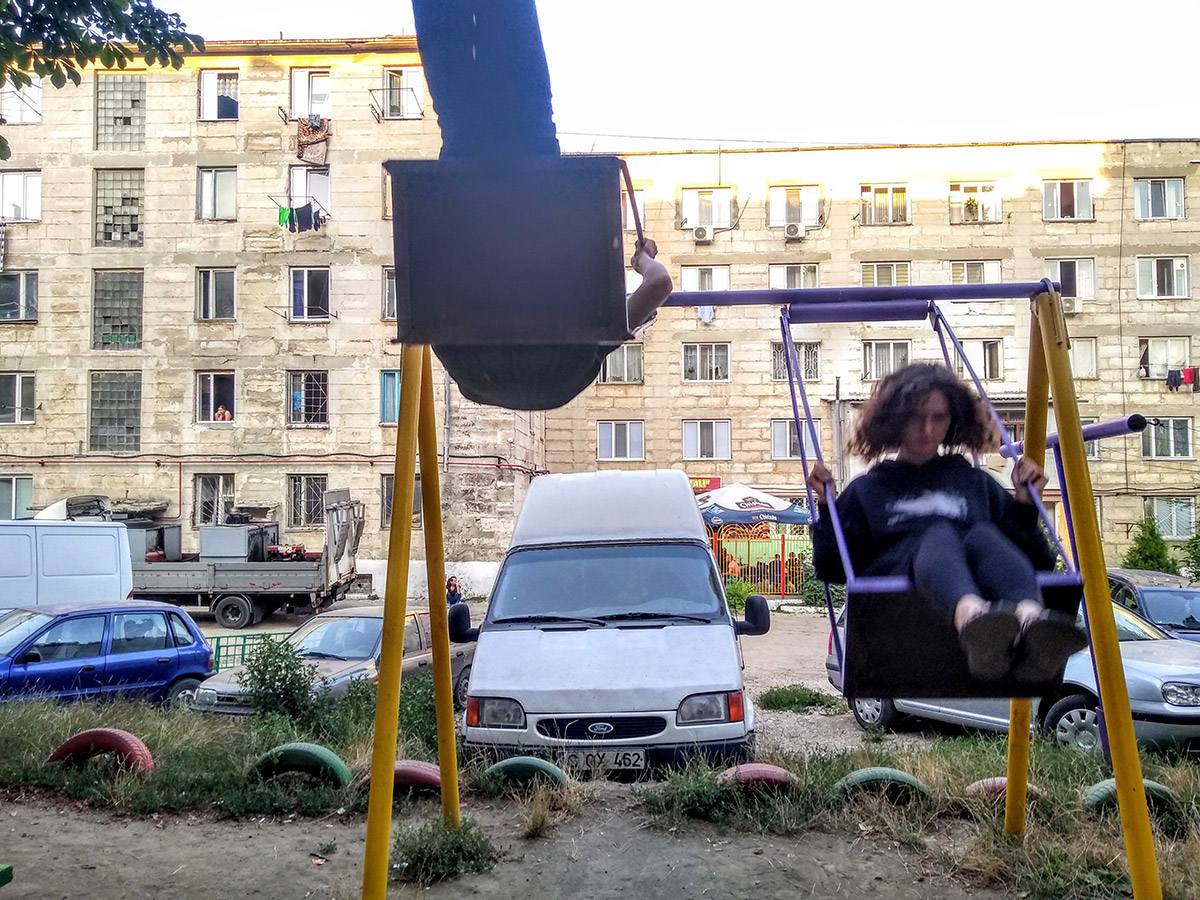
Public Facades, Maria Dragan neighborhood in Ciocana district, Chișinău (July 22-29, 2019). Swing by Clara Abdullah
A similar participatory approach was used during our work within residential areas, aiming to reach the inhabitants from specific neighborhoods and involve them in the process of rearranging the inner courtyard's open spaces. Between 2014-2017, a program of cultural events framed as Public Space Days was organized in different areas of the city, connecting both local and international initiatives dealing with the topic of public space. It was complemented by the Public Facades - a project for mapping residential neighborhoods built after the Second World War and their consequent activation through community building and cultural animation methods in partnership with local public institutions. The project developed across two different residential areas of Chisinau; in Teilor street, situated in Botanica district - a more established neighborhood designed and built in the 1960s, and in Maria Drăgan, street situated in Ciocana Veche (Old Ciocana) - one of the outlying districts and home to many economically marginalized inhabitants formerly employed in the now defunct industrial area of the city.
Many residential neighborhoods were significantly affected during the radical economic transformations of the 1990s and early 2000s, when numerous cultural spaces and social infrastructures were either privatized or demolished. The problems worsened when the industry stopped functioning and many of the inhabitants lost their jobs.
Many of our colleagues (artists, architects, researchers etc.) from Minsk, Kiev, Tbilisi and Yerevan, and also from Central and Western European cities like Bucharest, Iași, Budapest, Kosice, Brno, Warsaw, Madrid or Barcelona with whom we connected during the research visits organized in the past, were using similar approaches to the ones described above. In fact, some of their approaches were tested in Chisinau during the joint collaborations, allowing us to share the accumulated experiences with each other and led to the creation of a specific working methodology within the public domain that could possibly be replicated in other contexts.
One of the important remaining questions to be answered is the following: How do we maintain and preserve, and/or develop the already established platforms, so that they are regularly used by the local communities and are integrated within the plans of the public authorities in order to be supported on a more regular basis for long-term sustainability?
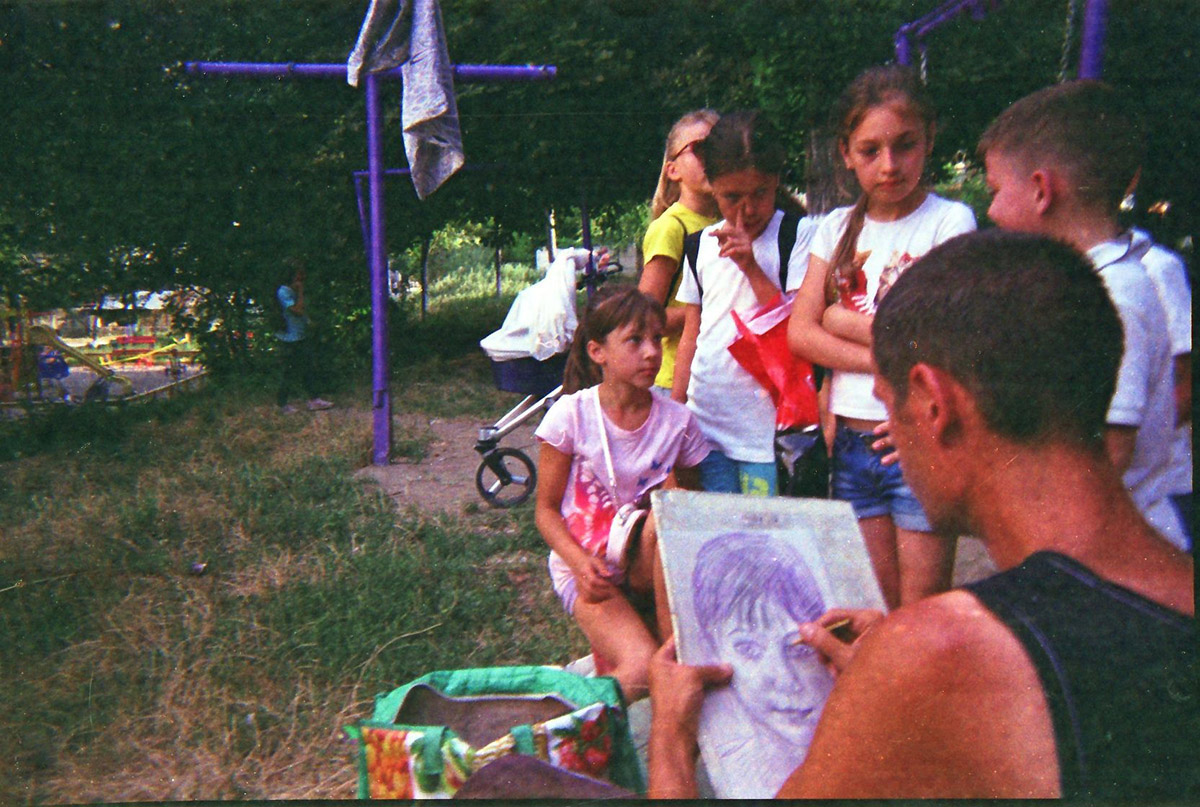
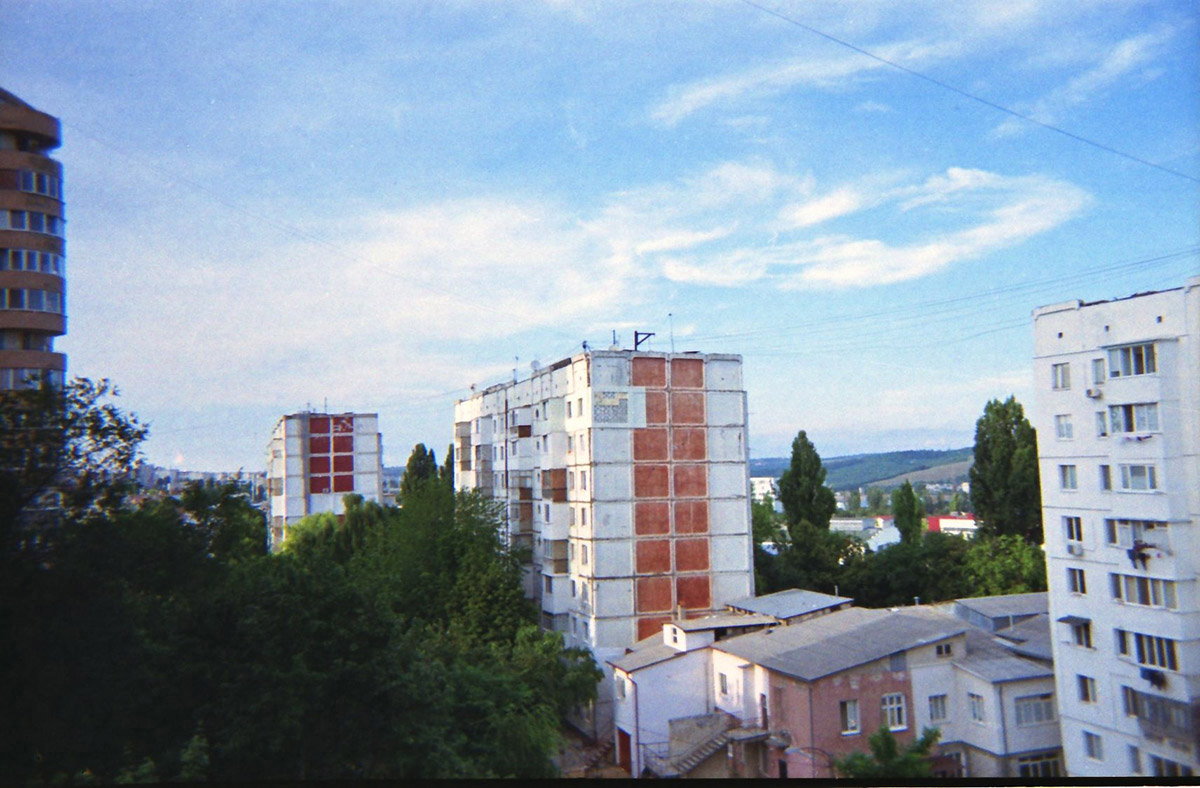
Public Facades, Maria Dragan neighborhood in Ciocana district, Chișinău (July 22-29, 2019). Analogue photography workshop. Photos by Anna Bantiuc.
It seems that establishing programs like Public Space Days or Alternative Cultural Spaces that could connect different initiatives and provide them with a frame for interacting with each other, alongside formats like Open Studios or other formats taking place regularly at Casa Zemstvei (an alternative cultural center that aims to provide artistic autonomy to its users), is not enough. This is evident, considering that the project logic that currently dominates our activities is a rather unsustainable one, and perpetuates the precarious conditions in which we all currently work.
The project logic merely provides a temporary possibility to activate, where a more permanent solution is needed. This, in turn, also affects the question of audience development, as it seems that only publicly funded institutions with regular support have the privilege to work and develop audiences on regular bases. Compared to these institutions, independent cultural initiatives can possibly form temporary communities by finding ways to transform a passer-by into an active member of the audience. This could happen by inviting them to join an ongoing activity, first by attracting their attention, making them stop and wonder, and then start questioning the situation that is developing in front of their eyes before they engage in a dialogic process that could potentially lead to a meaningful exchange within the participatory process.
Until we find ways to establish our own structures and popularize our experimental art practice, we will continue acting from the margins of a cultural system that was traditionally dominated by state ideology and is gradually instrumentalized by private interests represented through creative industries.
Vladimir Us (b. 1980) is an artist and curator based in Chișinău, Moldova, and a founding member of the Oberliht Young Artists Association (oberliht.org). He studied art, curating, cultural management, and cultural policy in Chișinău, Grenoble, and Belgrade. Since 2000, under the umbrella of the Oberliht Association, he has initiated several cultural platforms and publications in collaboration with artists and cultural workers from across the region, including the [oberlist] mailing list, Postbox Magazine – literature, art & attitude, Kiosk AIR (an artist-in-residence program), Zpace (an independent arts and culture space in Moldova), among other projects.
Through his curatorial work, he aims to increase access to socially engaged art in Moldova, stressing the need for spatial justice and for an inclusive urban environment in Chișinău and other post-Soviet cities. His cultural activism focuses on the development of public spaces as the city’s democratic infrastructure, as well as on improving higher education art curricula through the introduction of various artistic practices and theoretical modules, and on building a resilient independent cultural scene in Moldova and the wider region.
As a long-distance cyclist, he has been passionate about bike culture, actively supporting the growth of the cycling movement as a form of alternative (non-motorized) transportation both within urban areas and across the country.