
- Download Issue 64 (US Letter, 8,6 mb) Buy as Book on Demand here (US) and here (DE)

by Wang Yiquan
Pearls in the Digital Sea: Salvaging a Collection of Short Videos
A decade ago I began consciously collecting what I call the “little videos” — short videos that ceaselessly surface on social media and flicker across the mobile screen. In comparison with professionally and meticulously produced classics of longer duration, such as short and feature films, television news clips, TV commercials, Vlogs, etc., they appear paltry. They seem trivial because their production is unrefined, and their contents often lack narrative technique.
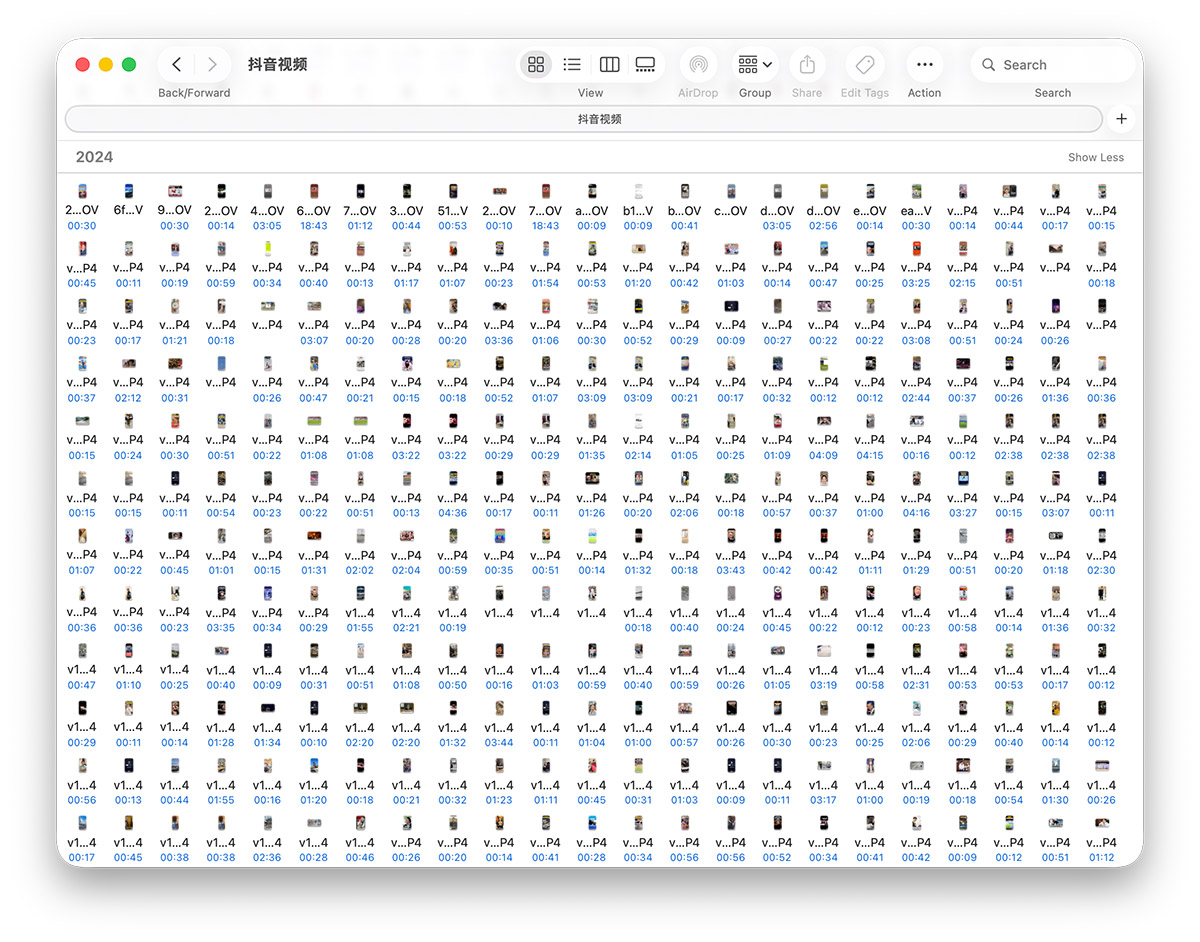
Wang Yiquan, Little Videos, 2016–ongoing. A private collection of short videos downloaded from social media platforms. Screenshot of the artist’s Finder on macOS Tahoe. © Wang Yiquan.
Typically, these videos last only a few seconds, at most a few minutes [1]. The vast majority are independently produced by individual users with virtually no production budget, and shot and lightly edited on personal phones. In terms of quality, the file size is small — ranging from several hundred kilobytes to tens of megabytes and the image resolution is low-definition. In terms of content, the earliest short videos I encountered were mostly records of everyday life, where a large portion were entertainment-oriented and unserious, while some were even violent or erotic.
I was drawn to these short videos for their counter-tradition in aesthetic, their low-bit-rate poetics in production, and their anti-canonical stance in narrative. I became increasingly interested in the inevitability of encountering them within the quotidian experience of online surfing. Thus, I initiated the project Little Videos (2016–present) as a private collection of short videos saved from social media platforms via my phone. To date, this project has not been publicly exhibited.
1. The Unbearable Littleness
Since the mid-1990s, the Internet in China has surged, developing a distinctive aesthetic system shaped by Chinese vernacular aesthetics and East Asian kawaii and popular culture. Chinese internet companies and users habitually grant colloquial and anthropomorphic nicknames to emergent internet phenomena. For example, Tencent’s instant-messaging product “WeChat” denotes “micro-messages”; Baidu’s AI assistant “Xiaodu” connotes a cute, diminutive Baidu. For the short video content on mobile screens, Chinese users habitually refer to them as “little videos” (in Chinese as小视频).
At a technical level, this designation also resonates with the five-year cycle (2011–2016) that saw a startup boom and fierce market competition among Chinese short-video companies: Kuaishou’s 2012 shift from GIFs to a short-video community; Sina Weibo’s launch of the “Miaopai” function in 2013; WeChat’s introduction of a feature explicitly named “Sight” in English and in Chinese as小视频in version 5.5 in 2014; and the founding of “Douyin” in 2016 (TikTok’s mainland Chinese sibling). Together they catalyzed an unstoppable torrent of short videos.
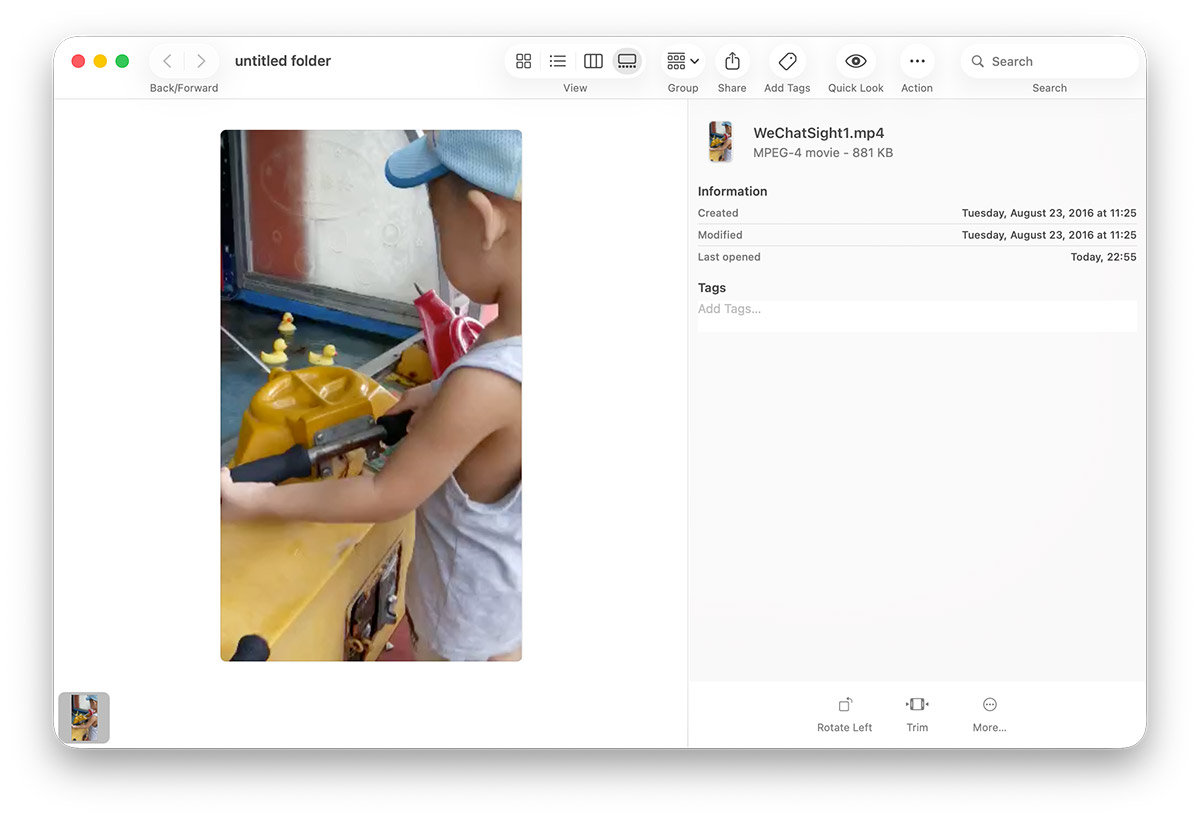
Screenshot of the artist’s Finder on macOS Tahoe. © Wang Yiquan.
One day, while organizing and previewing this collection of short videos on a desktop computer, I scrolled folders of files through a masonry layout, switching ceaselessly between items as time slipped by. From these short-duration, low-resolution, small footprint files, I experienced a profound shock of contemporaneity: an exceptionally manifold and highly fragmented drift in visual culture.
I recognized that an era of radically abbreviated attention is intensifying globally. Indeed, the most recent decade has been the most prolific in human history for video production. On TikTok alone, over 500 million[2] videos were reportedly removed in 2024 for violating platform rules. Even without counting total uploads, that figure already far exceeds the total number of films produced since cinema’s invention[3]. Even more astonishingly, in 2024 TikTok saw an estimated 16,000 videos uploaded per minute[4], for a yearly total in the region of 8.4 billion videos. There is little doubt that these numbers continue to rise.
Imagine a person who spends an entire lifetime watching short videos on social media — how long would it take them to finish? The answer: they would never finish. Using the 2024 global average life expectancy of 73 years as a baseline, a single person could, at most, watch around 150 million videos of 15 seconds each in a lifetime. Humanity invented the little video, yet we cannot endure their endless littleness.
In this sense, my Little Videos collection is merely a miniature island within the vast digital sea.
2. Content Creation
For users of China’s mobile internet, WeChat is the most frequently used application in daily life[5]. This is also why I began my collecting in WeChat groups. I downloaded videos shared by group members and, without permission, “saved as” the private videos of my WeChat contacts from their Moments. Despite the dual risks — both ethical and legal — my collecting actions for the Little Videos project nevertheless continued.
During this period, these videos bore a pronounced UGC (User-Generated Content) character. Often, they were made by users on social networks and circulated point-to-point or point-to-group. Their content mostly comprised records of the everyday.
Subsequently, I expanded my collecting to popular Chinese platforms such as Kuaishou and Douyin, and gradually added internationally popular short-video social media such as Instagram and TikTok. To better execute the collecting, I set my various platform accounts to private or anonymous and never posted content; instead, I used them only to browse and receive platform “for you” (recommendations). Consequently, the videos I downloaded were, to a considerable extent, saturated with randomness, leaping beyond my personal social circle into a broader public sphere.
The ongoing practice of collecting those short videos is simultaneously a process of generating content for the collection itself. Through continuous archiving, I observed a noteworthy shift: the platformization of social media has driven an evolution in regimes of video production.
Initially, I collected clips of long-form videos, short versions of professionally produced works, and UGC (User-Generated Content). Gradually, with the explosive growth of daily active users and the maturation of monetization models, vast numbers of users poured into short-video social media, and PUGC (Professional User-Generated Content) entered the fray. This, in turn, spurred traditional professional video-production institutions to participate in short-form production. The resulting competition elevated both the quality of production and the richness of content.
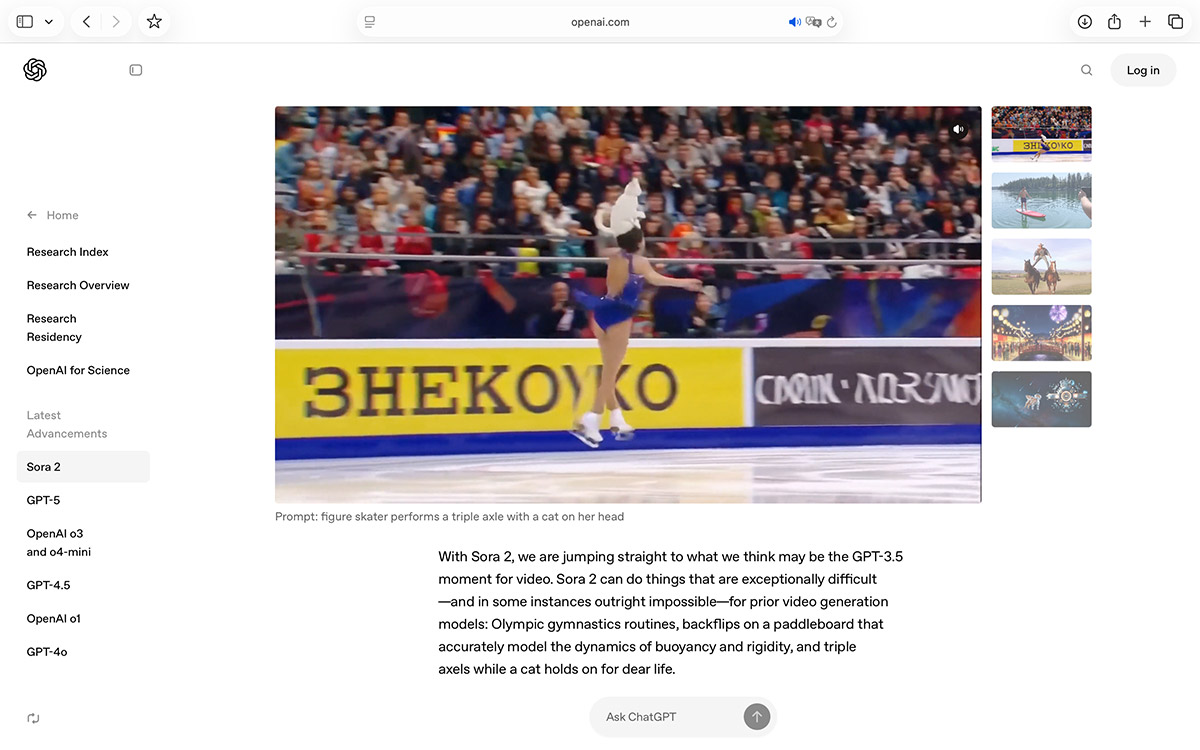
A screenshot of OpenAI’s official site showing the latest version of the video-generation model, Sora 2.
The latest phenomenon is an “involution” of competition. Nonhuman agents have joined the short-video battlefield where AIGC (Artificial Intelligence–Generated Content) has begun to trend. In fact, since late September 2025, when OpenAI released the latest version of the video-generation model Sora 2, AIGC videos have markedly increased on both Chinese and international short-video platforms, and the visual quality gap between machine-generated and human-made videos has grown increasingly difficult to discern. Over the past ten years, the modes of content creation for short videos have iterated, and their artistic lexicon have become more capacious.
3. Video Turn and its Challenges
I first accessed the World Wide Web (WWW) from Beijing in 1998. Since then I have witnessed the metamorphosis from dial-up to mobile internet, experiencing a vertiginous acceleration from 56 Kbps to today’s 1,000 Mbps. Remarkably, this transformation took only about twenty years, across which the speed differential multiplied by 17,857. The past decade, during which I have collected these short videos, coincides with a structural and media shift in China’s internet: from a desktop-based mode of personal computer access to a tablet-based mobile internet; from image-and-text–centric websites and webpages to today’s app- and influencer-centered video ecosystems.
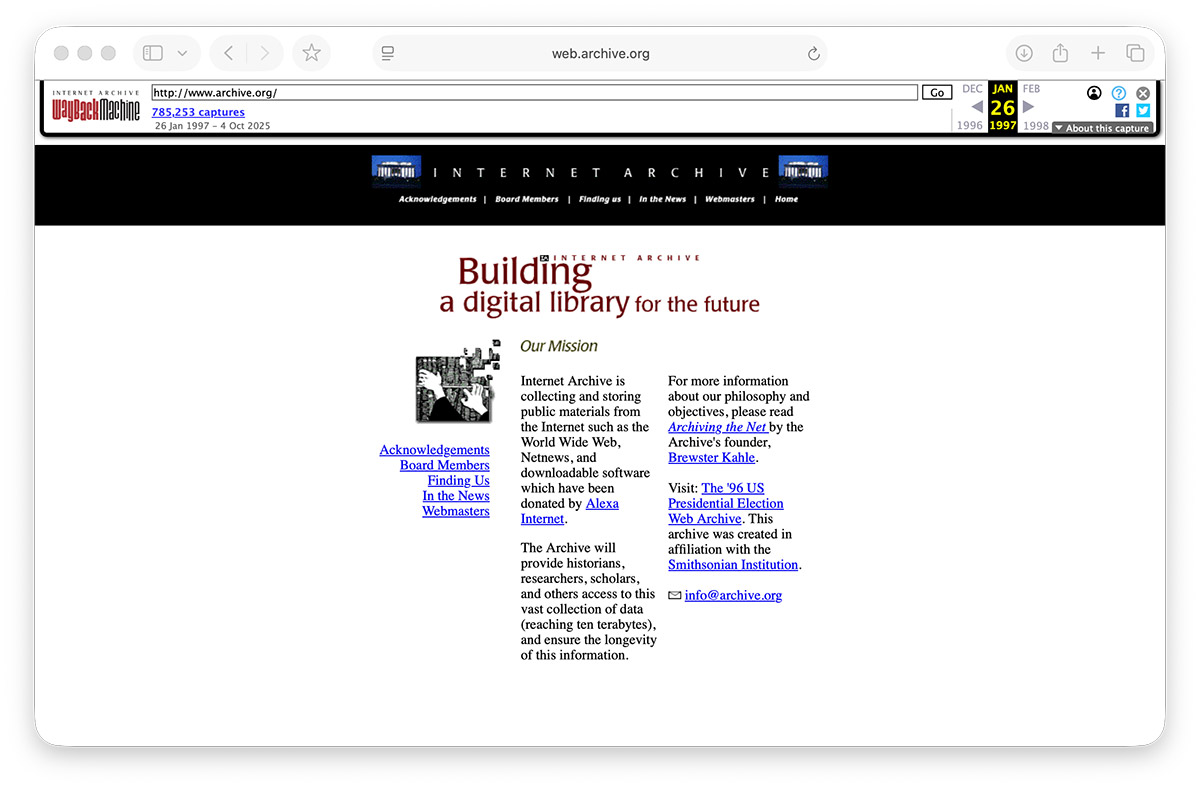
A screenshot of the Internet Archive (archive.org) showing the Wayback Machine’s first capture of its own homepage in 1997.
Previouslyinfluenced and inspired by the Internet Archive (archive.org) — a non-profit digital library — in recent years, I shifted my attention to digital objects from webpages and video. Initially, my target was short videos that I considered imbued with performativity, continuing my longstanding interest in performance art. As my collection grew, I realized that the attributes of these videos exceeded the narrow sense of staged performance before the camera and exceeded the already established parameters of performance art. These short videos expanded my purview from a small domain into a larger discursive field that I term “great performance”: a human activity predicated on free expression, performance, and the video medium — one in which everybody, from political elites to ordinary citizens, can participate, anywhere and at any time.
To date, my Little Videos collection has surpassed 20,000 items. On average, over the past ten years, I have collected 150–200 short videos per month. The contents span entertainment, humor, art, news, politics, social hotspots, livestreams, private footage, historical records, documentary fragments, film excerpts, and meme culture. Although a large portion of my sampling comes from Chinese short-video communities, the extensive range of the collection already positions it to become an archive of video art in the age of social media — if we accept short videos as video works.
The mobile internet, augmented by the “video turn,” is shaping new life patterns and cultural preferences. This poses profound challenges to museums and libraries — institutions traditionally grounded in physical objects — and to their modes of collecting. Experiences and knowledge once furnished by museums and libraries are now displaced by short-video platforms. Today, the new generation, which has shifted from passive audience to active user, does not necessarily seek knowledge in museums or libraries, nor even via traditional search engines and knowledge databases, but turns instead to video content as a learning substrate. An emergent trend is the preference for AI search engines and for knowledge and visual culture obtained from AIGC videos[6].
This practical challenge, at a minimum, prompts museums and libraries — as repositories of visual culture and knowledge — to urgently rethink how to engage new generational audiences. Simultaneously, cultural institutions and their collections need to reconceive and research short videos as digital objects and media, along with their latent potentials.
4. Private Collection as Method
How to respond to these challenges inevitably involves value judgments, and strategies will vary across institutions, communities, and individuals. From an institutional standpoint, decision-making is complex, even protracted, budget-consuming, and entangled with the public interest. From an individual standpoint — especially that of the artist, curator, or researcher — understanding, interpreting, and reflecting upon short videos can, like conceptual art, be a matter of a single decision and can be executed immediately.
In my case, my basic thinking centers on the fragility of short videos and the resistance to their disappearance as I have found that at least three major forces, emerging from the transformation of internet infrastructure and artificial intelligence, shape the ecology of short video. First, due to legal frameworks, censorship policies, and platform community guidelines, many short videos are cleared after uploading. Second, at the level of content, as visual culture evolves and the culture-capital market selects, content must continuously adapt and iterate; materials that fall out of alignment with contemporary preferences face elimination and cancellation, just as the commercialization of cinema marginalizes experimental and essay films (Steyerl, 2009)[7]. Third, there is the risk of account erasure caused by cyberattacks, accidental system failures, the finite lifespans and shifting interest of human users, and other force majeure — resulting in the compelled disappearance of massive quantities of previously uploaded video. Without archival management, many videos become inaccessible as accounts mutate or close. Such occurrences are no longer rare.
Based on the above, I understand the Little Videos as a defensive private collection oriented towards the ecology of short video. The execution of this collection is autoethnographic in character, and thus many practical dilemmas surrounding collecting can be addressed pragmatically. More concretely, I do not aspire to elevate my personalized collection to an institutional standard. For instance, my Little Videos archive is not professionalized like archive.org; it does not operate with institutional archival policy and standards, clear taxonomies and hyperlinks, or targeted global crawling via bots. Nor is it open access for user self-upload.
My private collection is finite, coextensive with the limits of my embodied use. On the one hand, its scope is indexed to my time on mobile phone and to the durational persistence of my research interests. On the other hand, I do not enforce a set of legal prescriptions or moral codes as curatorial guidelines. In a private collection, the “I” is crucial. I therefore enjoy the agility of personal action in contrast to cultural institutions. My project is ongoing, practice-based, and deeply tethered to personal preference — indeed, somewhat obsessive — dependent upon my online hours and screen time.
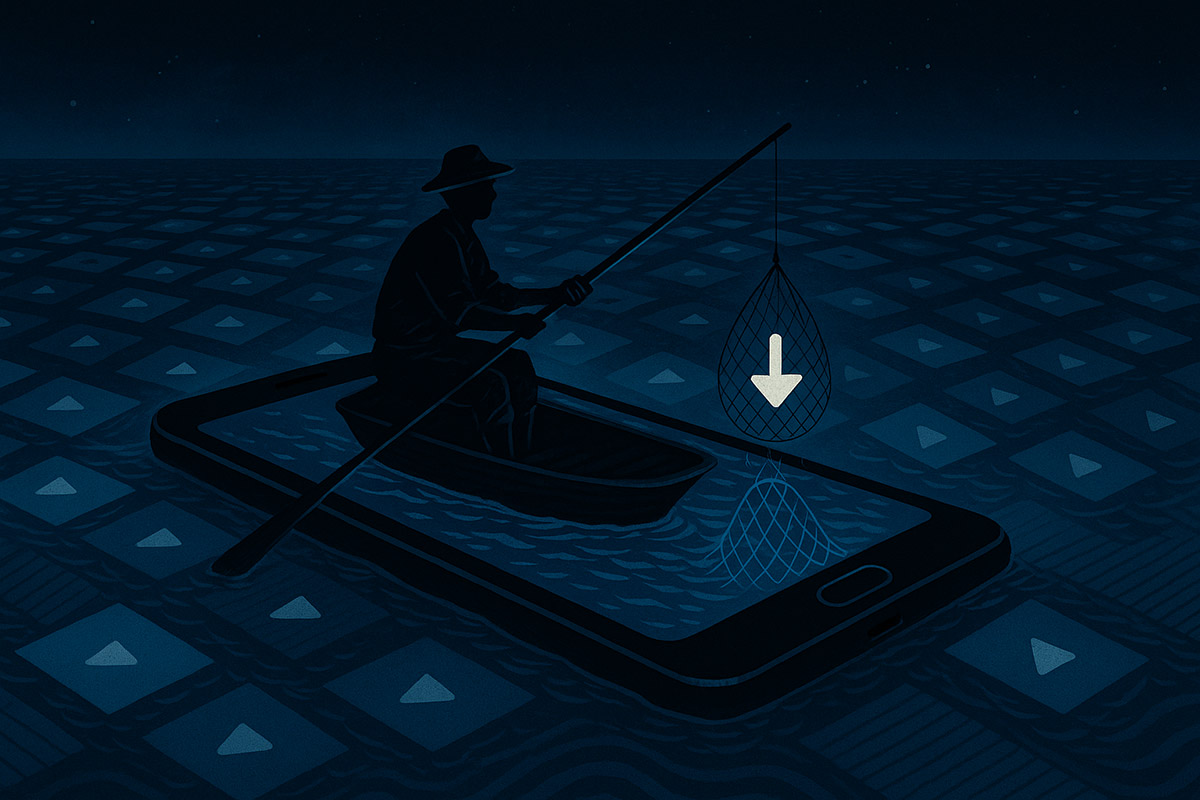
Wang Yiquan, The Fisher and the Digital Sea, 2025. Image generated with ChatGPT. © Wang Yiquan.
I also do not possess massive storage capacity. At present there is no need for cloud storage or large offline servers. I simply store downloaded video files on private electronic-mechanical disk drives at ordinary room temperatures. As an individual, I cannot afford to maintain a data center environment with strict temperature and humidity control, and with redundant power and networking. Data centers on the scale of TikTok’s “Project Texas” in the United States[8] or Apple’s “Cloud on Guizhou” (GCBD) in China[9] are impossible for an ordinary person to imagine. My data center is a desktop HDD.
My method of downloading is equally austere. I tap the in-app download icon with my finger to save files one by one. At times I screenshot user comments or record the screen to capture the entire viewing experience. This method endows my collecting behavior with the ethos of pre-automation agrarian labor. By analogy, my swiping through videos on the phone resembles piloting a small fishing boat under the impulse of interest to trawl for clips. Like an old-school fisher casting nets at sea: where one sails and where one casts determines the catch, and one takes whatever those waters yield. I am fully aware that my drop-in-the-ocean way of collecting can never keep pace with the platforms’ ever-accelerating upload curve.
5. Collector’s Note
Through ongoing collection and conceptual development, I have noticed something curious: at the outset I could, to a large degree, proactively select sources and save videos. Once I turned to short-video social media, although my interests continued to guide me, the videos I encountered were inevitably sourced via algorithmic recommendation. If the museum’s collection is scaffolded by curatorial judgment and acquisitions-committee decisions, then the collection of short videos on social media today is scaffolded predominantly by account habits, browsing histories, and algorithmic sorcery. This keeps me, as collector, alert.
I have also realized that my Little Videos project is accompanied by a ghostly editor continually issuing its editor’s choice. Alternatively, the entire project seems guided by an invisible curatorial hand, arranging what audiences (or I) are permitted to see and determining what content creators (or artists) may show and publish, thereby determining what enters my collection. In truth, users — simultaneously viewers and makers — are indisputably being fed and recommended by algorithms. The extent of user autonomy, then, becomes questionable. Such algorithmic power poses a pointed question to collectors of digital objects: within an almost infinite digital sea, how might one expand one’s horizon and grow one’s private collection autonomously?
I tend to adopt a collecting logic proper to the digital age — namely, taking the self as method. Through a lens of digital ethnography I retrospectively examine the Little Videos, recognizing that this database is engendered by these platforms and their creators, and that — by happenstance — I have carried its archivalization forward. I acknowledge this contingency while making clear that my goal is not to gratify private taste but to develop this personal act into a public medium. Over a more expanded horizon, I believe Little Videos will constitute a description and narrative of digitized life in the early twenty-first century. At some point in the future, should I make the entire archive open, it will become new fieldwork for subsequent researchers (and even artificial intelligence): an independently assembled collection of (short) video art in the age of social media by a Chinese user.
Wang Yiquan is an artist and curator. His practice has developed along multiple trajectories, with recent research focusing on transdisciplinary practices in art and culture, global urbanism, and China’s internet culture. As a curator, he advocates a ” approach. Recent curatorial works include 100 New Ideas for the City, addressing urgent questions of urbanization, A4 Art Museum, Chengdu (2024); Life, Work, and Style: Digital Nomads in Contemporary China, on new lifestyles shaped by mobile internet, Liangzhu Culture and Art Center, Hangzhou (2024); Tan Chui Mui: Just Because You Pressed the Shutter?, exploring artificial intelligence and image culture, Les Rencontres d’Arles, Arles, France (2023); and FELLOWS, examining a generation of Chinese artists born in the 1980s, SNAP, Shanghai (2022). As an artist, his projects emphasize participation and collective reflection on social issues. His work has been shown at institutions such as Centro Municipal de Arte Hélio Oiticica, Rio de Janeiro (2025); Art Center NEW, Yokohama (2025); M+ Museum, Hong Kong (2025); Centre for Heritage, Arts and Textile, Hong Kong (2022); Contemporary Art Museum, Kumamoto (2018); Power Station of Art, Shanghai (2016); and Ural Biennial, Yekaterinburg (2015). Wang is a founding partner of Acts and Pathways, a critical spatial practice based in Shanghai.
Notes
[1] Definitions of “short video” vary across platforms, countries, and research bodies. For example, YouTube stipulates that “any videos uploaded on or after October 15, 2024 with a square or vertical aspect ratio up to three minutes in length will be categorized as Shorts.” TikTok specifies that videos captured with the in-app camera can be up to 10 minutes long. The UK communications regulator Ofcom defines “short-form video” in its research/statistics as content under 10 minutes.
Sources:
https://support.google.com/youtube/answer/15424877
https://support.tiktok.com/en/using-tiktok/creating-videos/camera-tools
https://www.ofcom.org.uk/siteassets/resources/documents/research-and-data/multi-sector/media-nations/2023/media-nations-2023-uk?v=330012
[2] “Bringing even more transparency to how we protect our platform,” TikTok, last modified December 18, 2024, https://newsroom.tiktok.com/en-us/bringing-even-more-transparency。
[3] According to the World Intellectual Property Organization (WIPO), 2023 is the most recent year with recorded global film output, totaling 9,511 films. By contrast, the Internet Movie Database (IMDb) reports 727,132 items labeled as “movie” in its database.
Sources:
“IMDb Statistics,” IMDb Press Room, last modified September 2025: https://www.imdb.com/pressroom/stats/.
“Global Film Production Hits Historic High, Surpassing Pre-Pandemic Levels,” WIPO, last modified April 30, 2025: https://www.wipo.int/en/web/global-innovation-index/w/blogs/2025/global-film-production.
[4] Based on Statista’s estimation, as of December 2024 TikTok saw approximately 16,000 video uploads per minute. Since TikTok does not publish precise figures, this number should be treated as an order-of-magnitude estimate derived from publicly available statistics.
Source: “TikTok – statistics & facts,” Statista, published September 30, 2025, https://www.statista.com/topics/6077/tiktok/?srsltid=AfmBOooVgRSin6pBR30EeXMIjcN6-mYr1LsD9FPAntY79ZKJMUqG6HCb
[5] In its corporate overview, Tencent claims that WeChat is the most indispensable and highest daily user frequency service, with over 1.4 billion monthly active users as of June 30, 2025. “Tencent Corporate Overview: Second Quarter of 2025,”, Tencent, last opened on November 10, 2025, https://static.www.tencent.com/uploads/2025/11/05/3454372b79d12fd82a05d8
ac087bd37b.pdf
[6] As Pew Research Center survey shows, as of 2025, 34% of U.S. adults say they have ever used ChatGPT. That includes a 58% majority of adults under 30.
And, according to Reuters Institute’s Digital News Report 2025, across all 48 markets, dependence on social media and video networks for news is highest with younger demographics, with 44% of 18–24s saying these are their main source of news and 38% for 25–34s.
“34% of U.S. adults have used ChatGPT, about double the share in 2023,” Pew Research Center, accessed November 10, 2025, https://www.pewresearch.org/short-reads/2025/06/25/34-of-us-adults-have-used-chatgpt-about-double-the-share-in-2023.
“Overview and key findings of the 2025 Digital News Report,” Reuters Institute, University of Oxford, accessed November 10, 2025, https://reutersinstitute.politics.ox.ac.uk/digital-news-report/2025/dnr-executive-summary.
[7] Hito Steyerl, “In Defense of the Poor Image,” E-flux Journal, no. 10 (November 2009): 88, https://images-eflux.b-cdn.net/assets/f7f16420-5ec1-46ae-899e-7cdd096fb23b.
[8] “About Project Texas”, U.S. Data Security, TikTok, https://usds.tiktok.com/usds-about
[9] “iCloud operated by GCBD Terms and Conditions,” Apple, last revised: September 16, 2024, https://www.apple.com/legal/internet-services/icloud/en/gcbd-terms.html