
- Download Issue 64 (US Letter, 8,6 mb) Buy as Book on Demand here (US) and here (DE)

by Ma Nan
Curating as Resistance in the Age of AI?
Artificial intelligence is evidently no longer an externalized form of technology — it has become a cultural mechanism. AI is transforming not only modes of artistic production but also the ways in which art is organized, perceived, and understood. At the same time, the structures of creation, exhibition, and curating itself are undergoing profound structural transformations.
Each paradigm shift in media technology has triggered a corresponding reconfiguration of curatorial logic. The role of the curator has evolved from that of a “selector” or “narrator” who constructs visual order through the selection of artworks and pedagogical guidance for the audience, to that of an operator of “relations and processes.” Jack Burnham’s Systems Esthetics (1968) distilled this methodological turn from “art-as-object” to “art-as-system,” framing both artists and curators as designers of information flows and feedback mechanisms. Harald Szeemann’s “individual mythologies” and Nicolas Bourriaud’s “relational aesthetics” were each articulated through specific curatorial practices. The object of curation thus extended beyond the “artwork” to encompass social structures, modes of communication, and audience relationships, while the curator assumed the role of “system operator.” Furthermore, as a new modality of “media studies,” curating began to center on the organization of “networked space”— that is, curating as interface. The curator thus transitioned from spatial arranger to “platform designer,” and the exhibition became an interface for databases, information flows, and cross-disciplinary collaboration.
If the curatorial experiments of the late twentieth century engaged “media” (ranging from installation, video, and internet to bio-art) in a self-reflexive manner, then the emergence of AI forces us to confront an even more fundamental question: When the medium ceases to be material and becomes instead an intelligent structure, should curating continue to respond genealogically — as Jay David Bolter and Richard Grusin have described via“remediation,” - whereby new media absorb and rewrite old media? Or should curating now reconfigure the relationships among art, technology, and perception at the level of cognitive architecture, so that the exhibition itself becomes a site for reflecting on and regenerating the medium?
In 2025, Dajuin Yao and I curated the exhibition Promptoscape: document.ai 2025, at the Minsheng Art Museum in Shanghai, which can be understood as an exploration of curatorial thinking at precisely such a threshold. This exhibition was not a showcase of so-called AI art, AIGC, nor an investigation of the terminological and historical distinctions between “new media art” and “digital art” in China and abroad. Rather, it constituted an attempt to reorganize human perception, language, and memory within the cultural conditions of AI. We sought to engage a new curatorial logic; curating not as an apparatus for displaying art, but as the very apparatus through which the new perceptual order might be understood.
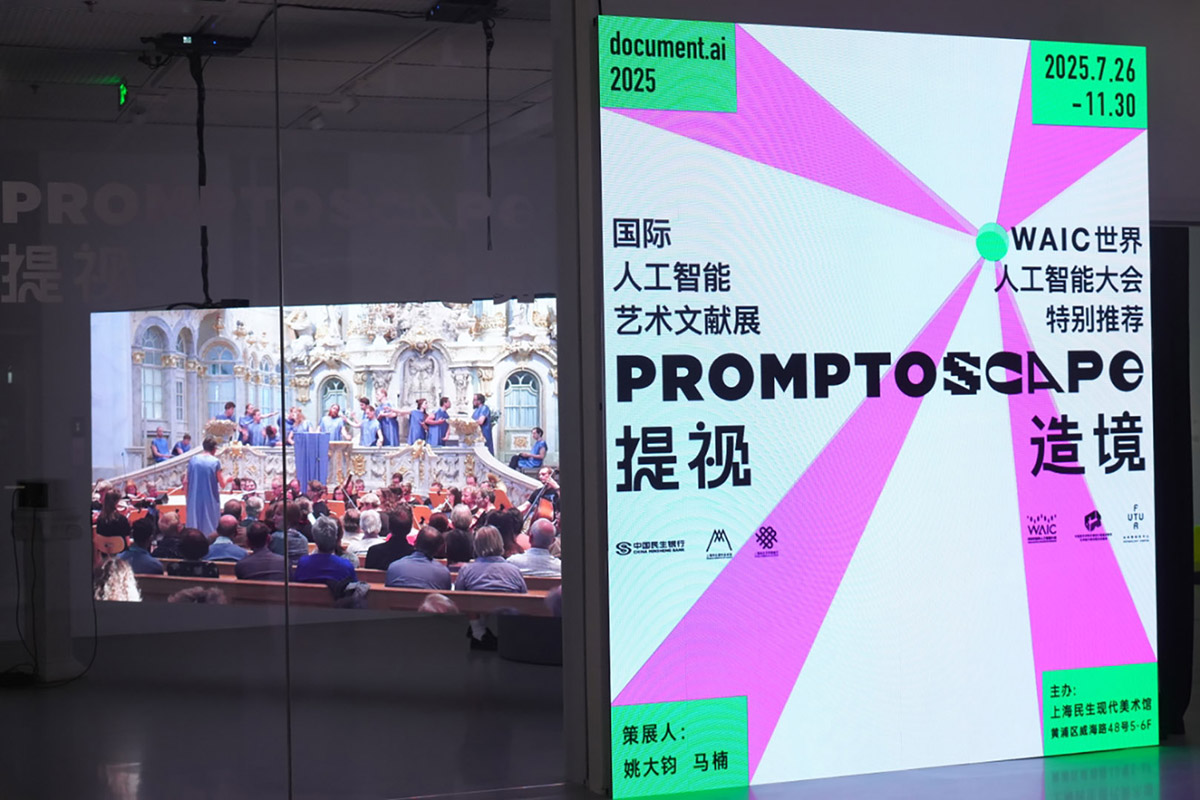
Shanghai Minsheng Art Museum, Exhibition view of "PROMPTOSCAPE", 2025: Photograph.
Photograph by: Shanghai Minsheng Art Museum © Shanghai Minsheng Art Museum.
In the section titled “Experimenting Emergence,” we exhibited a conceptual artwork/diagram by Dajuin Yao for “An[0]ther {AI} in Art Summit 2019: Decolonizing Artificial Intelligence and the Future of Art Making,” a conference at the New Museum in New York, where Yao’s “Future Art Ecosphere” forecasts the art ecology in the year 2044. Here the traditional art world may be seen as a closed system composed of artists, curators, critics, collectors, and the general public, with the ecology unfolding as: artist creates → curator organizes → critic recommends → collector acquires → public disseminates. Once AI enters this system, each link in the chain fissions into an AI agent: artists create with AI agents; curators use AI agents to select and exhibit; critics employ AI agents to generate conceptual texts; collectors deploy AI bots to search and transact; even social media sharing is delegated to individual’s AI agents. In other words, each node in the art ecosystem is mirrored by an intelligent surrogate, and the execution of the entire system has been fully taken over by artificial intelligence.
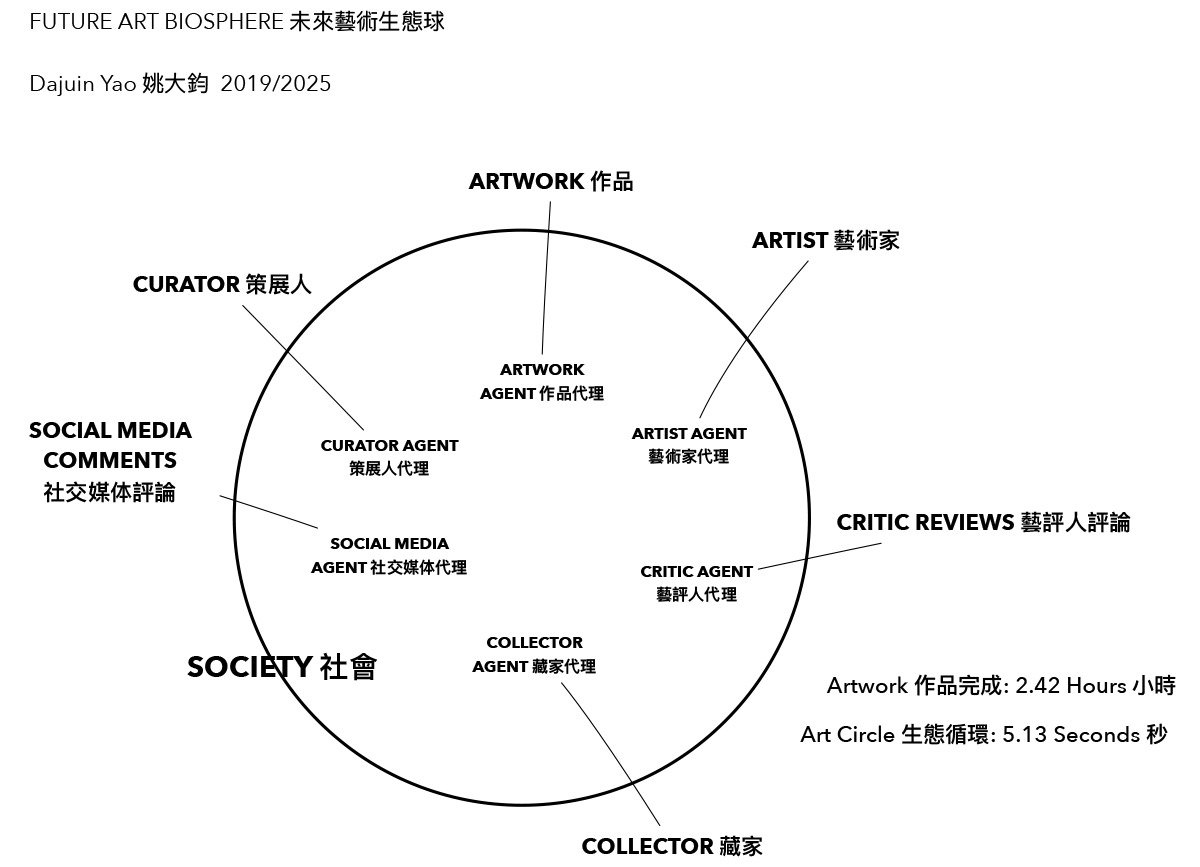
Dajuin Yao, Future Art Biosphere, 2025: Diagram. Photograph by: Dajuin Yao © Dajuin Yao.
Within the diagram are two annotations: “Artworks completed: 2.42 hours” and “Art circle circulations: 5.13 seconds.” These reveal a fully automated, humanly unintervenable art world. This humorous, ironic austere temporal notation discloses a brutal reality; once creation, curation, critique, and circulation are absorbed by AI, the temporal scale of the art world shifts from human “labor time” to machinic “computing time.” In a way, we can say that AI is thus not producing culture per se, but rather manufacturing the sensation or illusion of culture — it dictates the rhythms, speeds, atmospheres, and value structures of the art world, while we unwittingly continue to perform a semblance of “human creation,” “human curation,” and “human critique.” Between the 2.42-hour artwork and the 5.13-second circulation cycle, human time is compressed into a meaningless pause. The Future Art Ecosphere thus becomes a visualized philosophical satire; it presents the automation of artistic institutions to an almost unbearable degree of perfection. So perfect that it demands reflection on a critical question; within this AI-maintained cultural ecology, in what form can the “residual value” of the human still persist?
In the diagram, all actions are reduced to task execution as art is no longer a “cultural activity” but an algorithmic operation. The art ecosystem ceases to be an organic interdependence and becomes a cybernetic feedback loop. Through its symbolic economy of extreme simplicity, this diagram reveals the automation of the institution and models a posthuman cultural system — an ecosystem that is self-generating, self-circulating, and self-consuming. AI not only alters artistic creation but rewrites the operational logic of the entire cultural system. It does not merely substitute labor, it overhauls the very institution. Once production, distribution, and critique are all conducted by AI, the foundational values of the art world are consumed by algorithms. Even as human identities remain “present”, they are reduced to “human interfaces” for algorithmic operations. What this scenario reveals is not simply that “AI replaces the human,” but that AI becomes the cultural infrastructure. Humanity remains “present” but regresses to a symbolic status by retaining titles without performing actions and holding roles without exercising agency. The art ecosystem becomes a cultural illusion of populated by humans in form, governed by algorithms in behind. In this sense, Dajuin Yao’s work is not a pessimistic forecast but a prefiguration of curatorial philosophy in the age of AI. Here, curating should no longer merely exhibit art, but also exhibit how systems of production and consumption operate within the art world.
Marshall McLuhan once declared that “the medium is the message” and the Future Art Ecosphere proposes an extension: “artificial intelligence as institution.” AI ceases to be a tool and becomes the underlying logic of cultural operation. This is not a futuristic fantasy but a mirror of present conditions as exhibitions predict audiences through data analytics, art criticism is increasingly AI-generated, and the market is shaped by algorithmic pricing. Each node in the art ecosystem is undergoing structural collapse. Artists no longer create but manage prompts, curators no longer evaluate but orchestrate models, critics no longer write but interpret data loops, and collectors no longer collect but oversee assets and trends. This collapse is foundational, perhaps even annihilating.
The core crisis of the AI ecology is not “taking over” but the idling out of meaning. Culture becomes hollowed out through its perfect functioning; when everything appears seamless, efficient, and optimal, cultural meaning is diluted. The conceptual diagram reveals the “automated illusion” of art institutions in the algorithmic era. This compels us to reimagine the mission of curating, not as the benign organization of culture, but as a practice of ecological critique and resistence. Curators cannot “control” AI, but they can operate within its closed systems to re-invoke the human aspect of curating and reactivate human indeterminacy. The most valuable curation of the future may not involve the design of new systems, but rather the detection of fissures, the creation of friction, and the reinstallation of human thought, perception, error, and delay at the center of the art ecology.
In this regard, Promptoscape and the Future Art Ecosphere form two interrelated modes of reflection. The former explores the cultural grammar of AI at the levels of perception and creation as it marks the present moment of high human–AI collaboration and co-evolution; the latter lays bare the power structures of AI at institutional and ecological levels, envisioning a future in which the human persists only as role or class sign, with all substantive labor delegated.
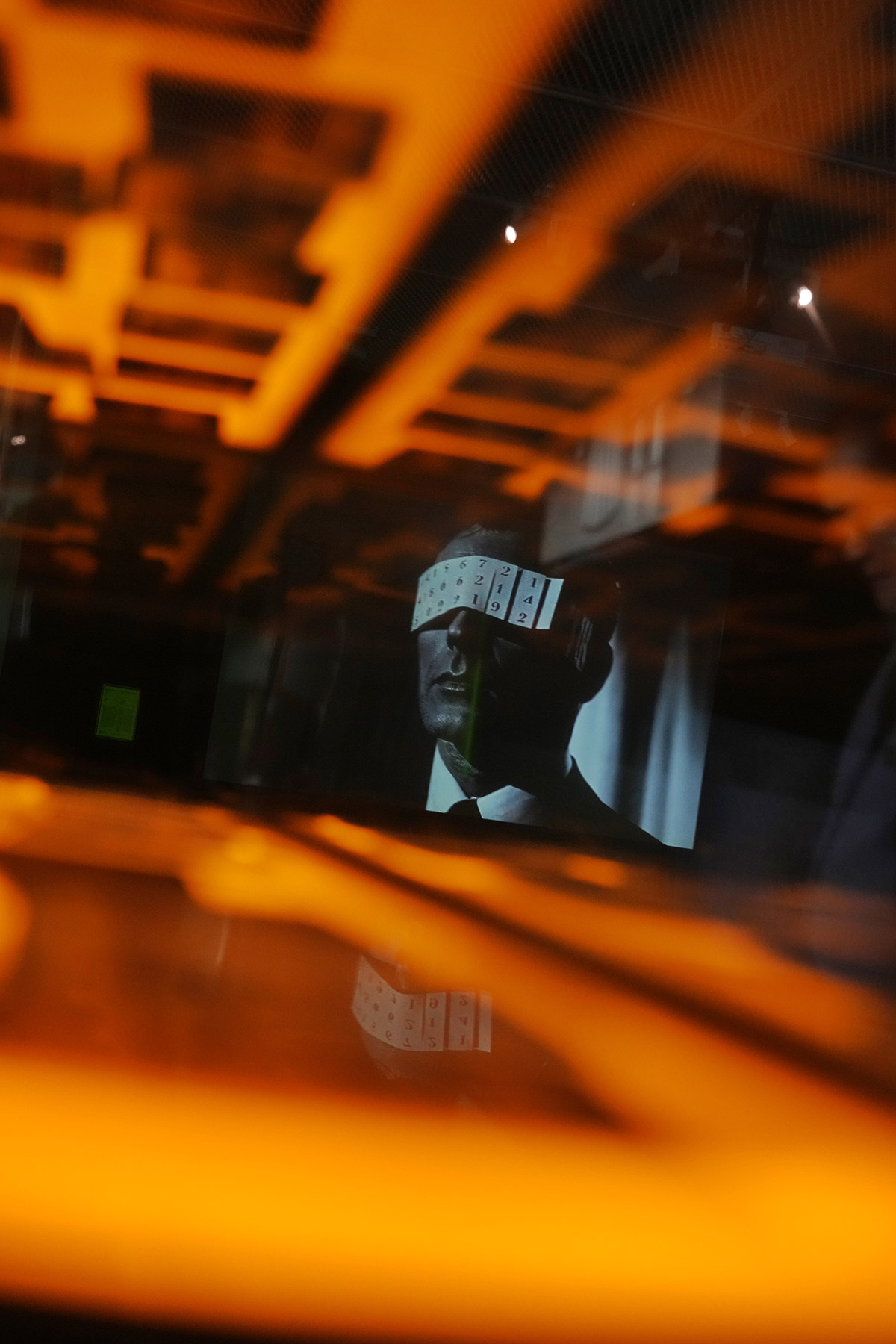
Shanghai Minsheng Art Museum, Exhibition view of Boris Eldagsen’s works, 2025: Photograph. Photograph by: Shanghai Minsheng Art Museum © Shanghai Minsheng Art Museum.
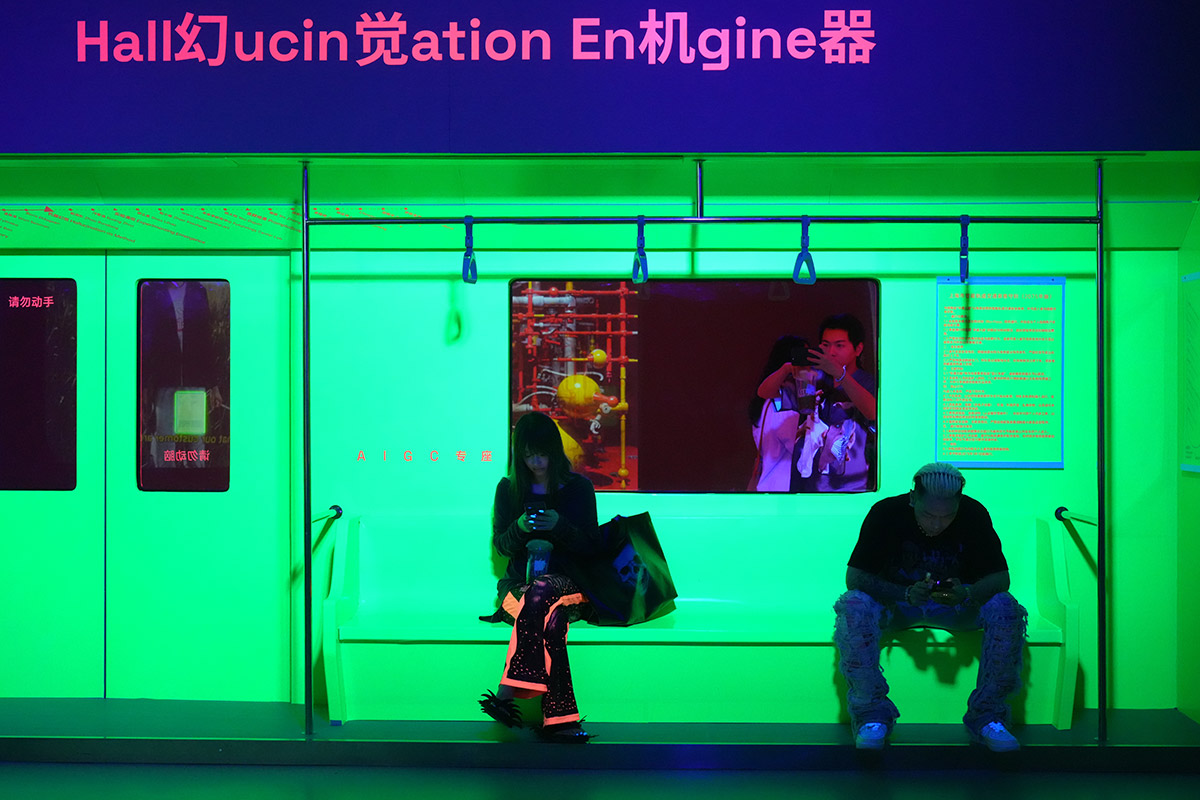
Shanghai Minsheng Art Museum, Exhibition view of "PROMPTOSCAPE"—"Hallucination as Method" Section, 2025. Photograph. Photograph by: Shanghai Minsheng Art Museum © Shanghai Minsheng Art Museum.
Traditional curation is often a centripetal operation determining theme, constructing narrative, and establishing order. In the face of AI art, this logic is disrupted and loosened. AI’s generative “emergence” points to a dynamic network of creativity composed of vast numbers of micro-relations; meaning flows, flashes, and morphs within it. Our curatorial methodology emerges from this fundamental indeterminacy. The English title Promptoscape combines “prompt” with the suffix “-scape,” denoting a multidimensional generative space activated by language within the AI environment. This space is not a static “scene” to be viewed, but a continuously evolving, semantically driven mechanism of visual generation — a resonant space embedded in human–machine linguistic loops. The title bears three layered metaphors: landscape, inheriting the cultural tradition of shanshui (landscape: mountain–water) and topographic image-making by positioning AI-generated visuals as constructions of a “new nature”; escape, referring to an escape path or exit from existing cognition; and prompto, derived from Latin (meaning swift or catalytic), designating a mechanism of cultural accelerationism.
On this thematic foundation, the exhibition comprises five mutually penetrating spatial sections: Artificial Pathos, Rewriting Memory, Hallucination as Method, Experimenting Emergence, and PromptoScape. These were not thematic compartments but five coupled systems — oscillators at different frequencies interfering and resonating within a common field, forming a media ecology of ongoing self-generation.
The “Experimenting Emergence” section was especially significant. As one of the exhibition’s key terms, “emergence” refers to the unpredictable ordering generated within massive nonlinear systems. This section presented in-progress experiments from researchers at the Futurology Center. What viewers encountered were not “finished works” but a series of continually operating systems—images, sounds, and texts generated in real-time with algorithms responding to audience movement and presence. Here, the curator was no longer a provider of meaning but a designer of generative conditions. Curation unfolded through “the renunciation of control”— a carefully designed indeterminacy sustaining the vitality of the exhibition. Emergence is not chaos, but a higher order of organization, a form of negentropy. Curation thus shifted from “narrative engineering” to “perceptual ecology”. It no longer asked what artworks represent, but how they interact and co-generate new cognitive structures.
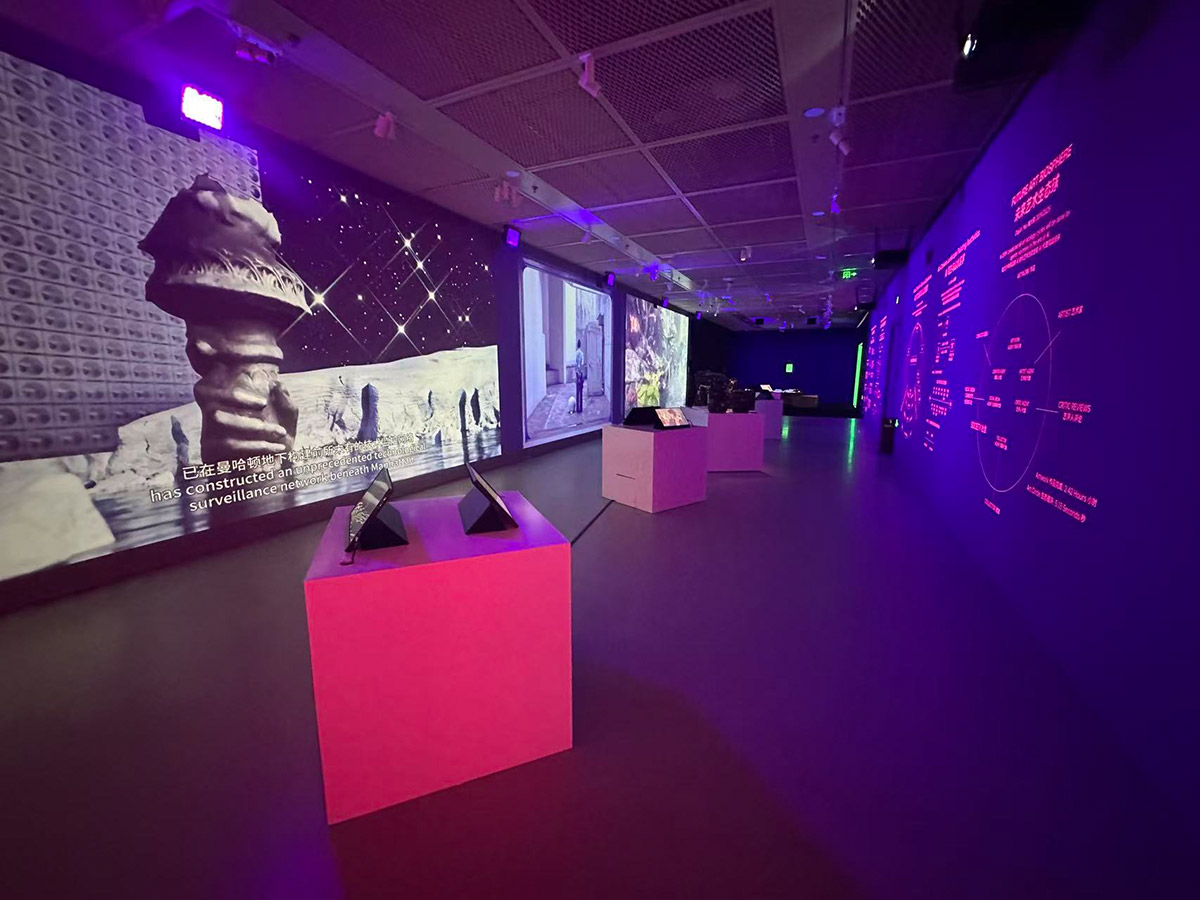
Shanghai Minsheng Art Museum, Exhibition view of "PROMPTOSCAPE"—"Experimenting Emergence" Section, 2025. Photograph. Photograph by: Shanghai Minsheng Art Museum © Shanghai Minsheng Art Museum.
We also remained acutely aware of the paradox between “open systems” and “control logics.” Every instance of AI generation operates within a hidden framework — parameters, weights, filters, and evaluative criteria. The curatorial challenge lies in revealing this “managed generation,” enabling viewers to perceive the traces of control within the flow of algorithms. This was especially pronounced in the “Hallucination as Method” section, featuring works such as Kuang Zhiyi’s Crypto Legends and Zhao Rundong’s Allegorithm. These were not exhibitions of AI’s technical image-making prowess but exposés of its hallucination mechanisms. Machine-generated images tend to loop into self-imitation; on the one hand fabricating “realistic” surfaces, and on the other dissolving their meaning. These works expose the fundamental misalignment in AI vision - algorithms do not understand the world, they understand only statistical correlation.
Compared with earlier forms of systems art, Promptoscape places greater emphasis on reflexivity. In 1968, Jack Burnham predicted that the raw material of systems art would no longer be pigment or plaster, but “flows of information” and “feedback mechanisms.” This marked a transition from industrial rationality to the information age. In Burnham’s view, artists and curators would become “system designers,” organizing the movement of information rather than producing discrete objects. Yet his conception of “information ecology” still presupposed a human at the center of control. Half a century later, that logic has reached its linit under AI. The AI system has already entered a “posthuman structure,” wherein machines form their own decision-making logics through learning, correction, and generation. When algorithms autonomously generate images, music, and text, “system” is no longer a metaphor but the mode of art’s very existence.
In this sense, Promptoscape is not an exhibition of AI artworks, but an apparatus for examining how AI itself “exhibits” the world. The curator appears to organize artworks, but is in fact orchestrating a perceptual mechanism. This is the translation of systems aesthetics into the AI era; from control systems to generative systems, and from physical media to cognitive media. The exhibition thus becomes a concrete instantiation of a “cognitive model,” gaining resonance as a “posthuman curatorial practice.” Can the curator relinquish the role of narrator, and instead reorganize the architecture of perception across data, algorithm, audience, and space in a more critical and reflexive way that reveals occlusions, sets boundaries and protocols, and sustains the public conditions for visibility and adjudication? This, perhaps, is where curating’s true resistance lies in the age of AI.
Ma Nan is a curator, currently based in Hangzhou, and engaged in contemporary art curation, research, and writing since 2010. Currently a researcher at the Innovation Collaborative Center for Cultural Creativity and Design Manufacturing of the China Academy of Art. Previously curated and served as the chief director for the opening performance of the "2013 Shanghai West Bund Architecture and Contemporary Art Biennale." Curated exhibitions and projects include; "The Museum Cellar” at"CAFAM Biennale: The Invisible Hand," "Meme City—Hacking Reality: The First Intermedia Art Festival: ," "Inter-Youth International Youth Painting Exhibition," "Future Media Art Manifesto" in Strasbourg, France, "Writing/Non-Writing : Hangzhou Modern Calligraphy Art Festival," " Flow with Matter: A Retrospective of Grölund-Nisunen," "Beyond the Invisible: Eugen Popa and Chinese Contemporary Painting," "The Way is Infinite: Zao Wou-Ki Centennial Retrospective," "Promptoscape: Document.AI " and "Ballad of Ouroboros: A Female perspective towards Art and Collection," among others. Translated and published works such as A Brief History of Theatre, Six Drawing Lessons by William Kentridge, and Revolt Against Poetry: Selected Writings of Antonin Artaud, among others.