
- Download Issue 63 (US Letter, 7 mb)
- Buy as Book on Demand here (US) and here (DE)

by Hauke Ohls
Virtual Worlds and Digital Ecology in the Exhibitionary Internet Complex: Jakob Kudsk Steensen’s Berl-Berl and Boreal Dreams
There are probably few people who despise the internet as much as Jonathan Crary. The American art historian and Professor of Modern Art and Theory at Columbia University in New York openly acknowledges that his book stands in the “tradition of social pamphleteering.”[1] Rather than offering a balanced analysis, he aims to express the “truth of shared understandings and experiences.”[2] Crary launches a broad attack on digital technologies such as “AI, robotics, neuroscience, augmented/virtual reality, autonomous vehicles, nanotechnology, genomics, and the Internet of Things (IoT).”[3] What ties all these technologies together, he argues, is their dependence on or enablement by the internet — a condition he summarizes with the term “the internet complex.” Over the course of the book, he outlines a growing list of consequences: the erosion of intersubjective exchange and community, the massive ecological footprint of digital technologies, the spread of surveillance, the suppression of decolonial movements, the loss of childhood experiences, and the overarching control of life through a digital protocol aimed at maximizing capital returns — serving the expansion of quasi-oligarchic power structures.[4]
To clarify his position, Crary turns to an analogy: “The internet is the digital counterpart of the vast, rapidly expanding garbage patch in the Pacific Ocean.”[5] For him, it is an accumulation of data waste that renders thinking, dialogue, and agency impossible. His assessment of creativity is no more optimistic — what we find on the internet, he claims, are at best “poems, but not poetry.”[6] At times, he distinguishes between individual technologies and emphasizes their harmful potentials. Yet he avoids the more nuanced argument that how these tools are used — depending on context and intention — can also yield constructive, even empowering, outcomes.
How can one respond to such polemical claims when analyzing artworks that are grounded in the internet or fundamentally engage with its logic — as is the case in this special issue on the paraverse? To reframe the question, if the exhibition of virtual worlds takes place within the internet complex, what does this mean in the context of the paraverse — especially when artworks are themselves conceived as digital environments of display? Crary certainly raises valid concerns. While it may be overly reductive to attribute the current polycrisis solely to the monetization of the internet by a powerful few, the concentration of control over what were once digital commons and the financialization of data do generate disruptive dynamics.[7] In contrast, a wide range of artist-activist projects fight for freedoms within the digital sphere — even if their victories are small or largely symbolic.[8] The internet is also a space where struggles for a better internet unfold.
The works by Jakob Kudsk Steensen analyzed in this text represent an alternative approach. Created through digital technologies embedded in the internet complex, they include the internet as one of their exhibition sites. Berl-Berl (2021) and Boreal Dreams (2025) would not exist without these very technologies and infrastructures. Both works engage with ecological questions, and Kudsk Steensen, together with his team and through field research, creates digitally immersive virtual worlds to explore them. These works offer viewers insights that would not be achievable without digital, internet-based technologies. They are speculative journeys through a resurrected past composed of present-day material, embedded in a mythical audio-visual assemblage, as in Berl-Berl. Or they are speculative visions of the future, whose narratives are grounded in current research, as in Boreal Dreams.
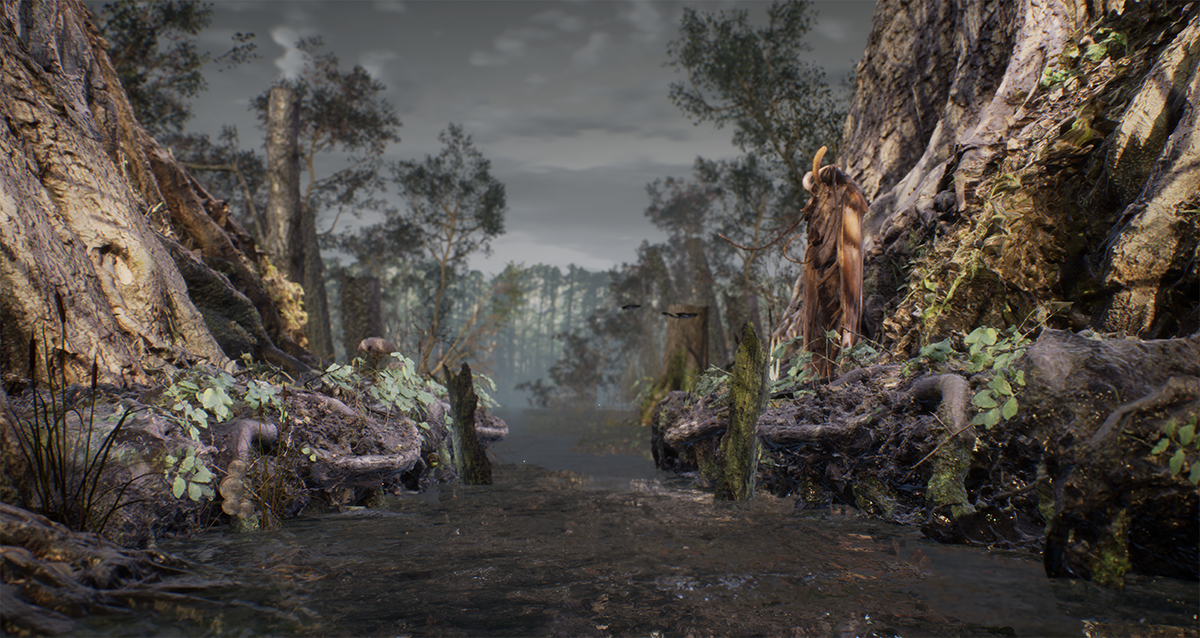
Jakob Kudsk Steensen, Berl-Berl, 2021: Live simulation (still). Commissioned by LAS Art Foundation. Courtesy the artist.
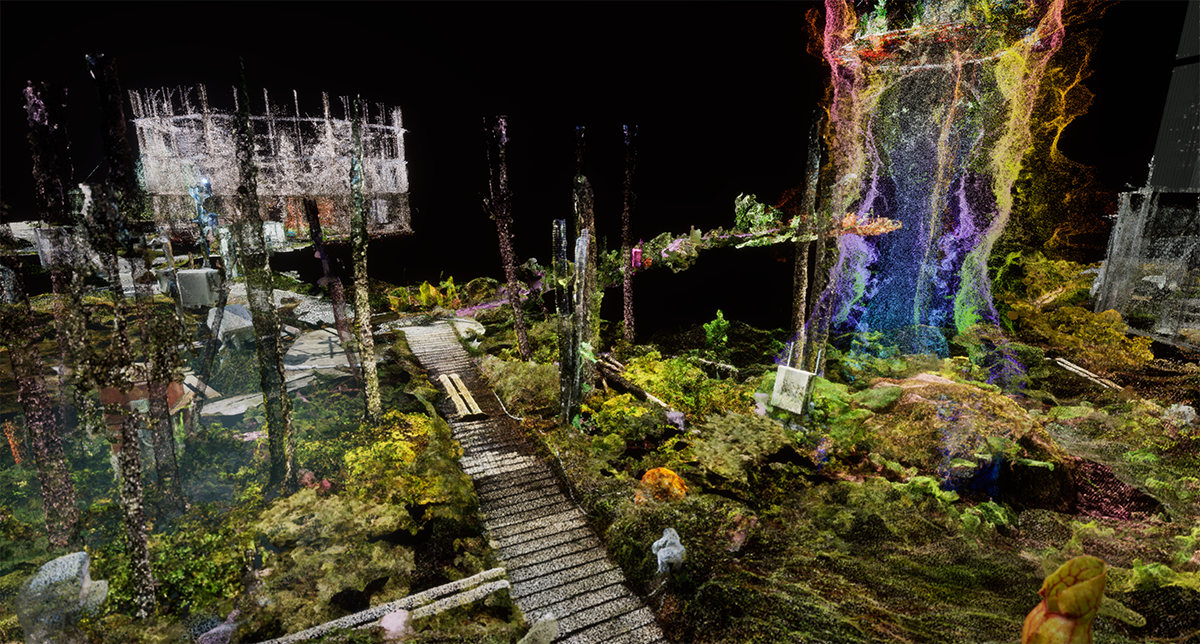
Jakob Kudsk Steensen, Boreal Dreams, 2024-25: Live simulation (still). Commissioned by the Fondation Beyeler, Riehen/Basel. Courtesy the artist.
Both artworks open up new perspectives on ecological processes by intertwining them with digital technologies embedded in the internet complex. Kudsk Steensen’s artistic practice invites us to perceive far-reaching ecological relationalities across non-linear temporalities, while simultaneously opening connections to the digital realm — without reinforcing the assumed dichotomy between ecological environments and technology.
The virtual worlds of Berl-Berl and Boreal Dreams
In both Berl-Berl and Boreal Dreams, Kudsk Steensen builds his virtual environments using the Unreal Engine platform, a tool originally designed for video game development. He fuses an aesthetic of gamification with ecological narratives, turning them into immersive explorations of digital environments.[9] In both works, he applies micro-photogrammetry and transforms the captured data into intricate 3D models using specialized software. These hyperrealistic digital landscapes are then enriched with an expanding array of visual and sonic elements. Real-time rendering techniques capture atmospheric conditions and generate a continuously evolving live simulation. Rather than relying on industry-standard templates, as is common in game development, Kudsk Steensen creates entirely original, virtual worlds — ones that prioritize sensory experience and ecological storytelling over playability or a final objective.[10]
The artworks take the form of three-dimensional spaces without predefined tasks — environments that viewers are invited to explore interactively. This is especially true in one of their modes of existence that is inherent to the works themselves: both can be accessed online as desktop experiences.[11] Another mode emerges in the context of exhibitions, where the works are presented as multi-screen installations integrated into physical spatial settings — that is, into analogue space. Depending on the reception context, the works function in fundamentally different ways. At home, seated in front of a personal computer with headphones on to enhance the sonic dimension, interaction takes on a more prominent role. Viewers can control the pace and sequence of their experience, which in turn facilitates a more individualized processing of information. In exhibition spaces — whether in a former industrial hall or a museum’s sculpture garden — the works produce an overwhelming aesthetic that unfolds within a spatially immersive environment. The multi-screen scenography engages the viewers’ bodily movement more directly, requiring physical navigation through the space. Each presentation format offers distinct modes of immersion into these virtual worlds, a point that will be explored further below. Given that this special issue focuses on the paraverse, the online versions of the works take precedence in my discussion.
Nonetheless, there are key differences between the two works: Berl-Berl concentrates on swamps, with a particular focus on the wetlands surrounding Berlin, Kudsk Steensen’s former place of residence. In Boreal Dreams, the focus shifts to the forests of the boreal climate zone and their climate resilience.
On the artist’s website, Berl-Berl is officially dated as “2021–ongoing” and described as a “live simulation and virtual performance stage.”[12] While 2021 marks the work’s initial completion, the designation “ongoing” is justified, as the simulation continuously regenerates in new and unpredictable ways through AI algorithms. The title reflects the artwork’s thematic focus: “Berl” is an old West Slavic and Sorbian term meaning “swamp,” and is likely the linguistic root of the city name Berlin.[13] Berl-Berl was commissioned by the Berlin-based LAS Art Foundation, an organization that funds exhibitions, projects, performances, artistic research, and educational initiatives at the interdisciplinary intersection of art, technology, and science. The work was first installed in the summer of 2021 in the Halle am Berghain in Berlin; it unfolded across a series of large-format screens arranged on multiple levels, accompanied by a site-specific sound installation and, in part, a black, reflective floor surface.[14]
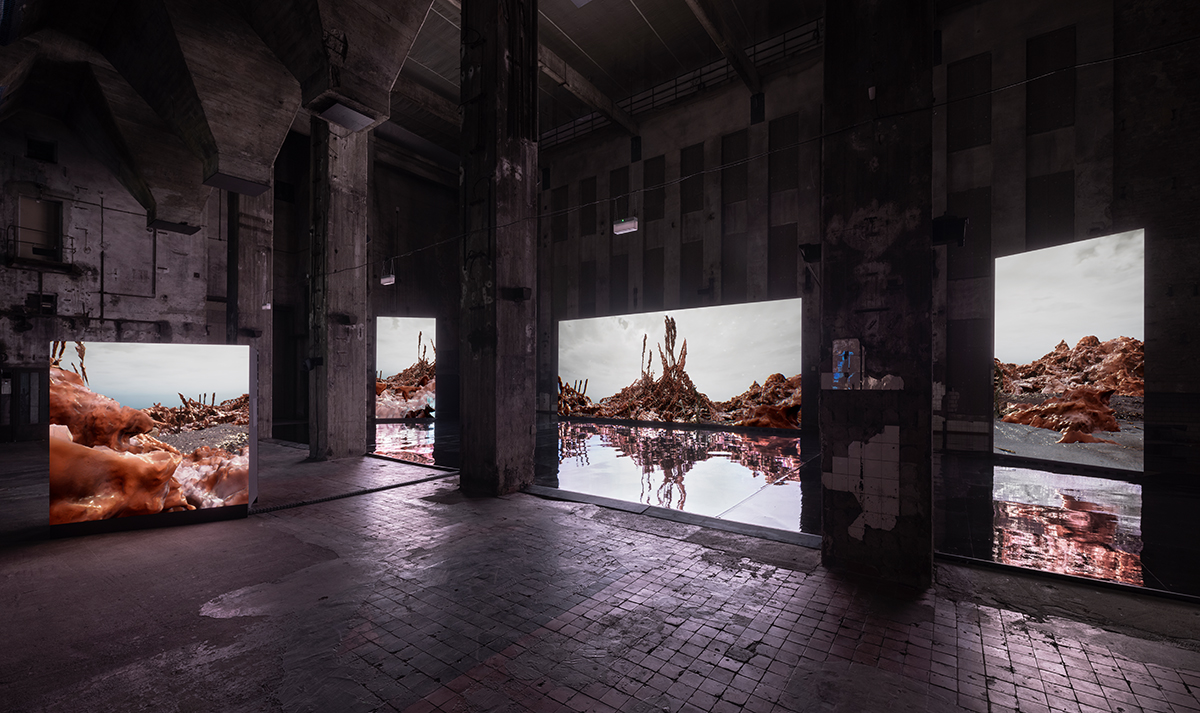
Jakob Kudsk Steensen, Berl-Berl, 2021: Live simulation. Commissioned by LAS Art Foundation. Installation view: Halle am Berghain, 2021. Photograph by: Timo Ohler. Courtesy the artist.
The accompanying publication of Berl-Berl provides extensive documentation, offering detailed insights into the artwork’s development and production process. For instance, Kudsk Steensen collaborated with the Museum für Naturkunde (Museum of Natural History) in Berlin and gained access to its collection of over 30 million specimens.[15] In a conversation with the museum’s director, Johannes Vogel, which opens the publication, the artist explains that he and his team worked with the museum’s animal sound archive to integrate frog calls into the live simulation using AI-driven algorithms: “We’re working with a local frog from Berlin, and the system can mix frog sounds over time periods in this region, modifying, slowing and connecting them to reflect an environment.”[16] In addition, the museum provided other natural specimens, which were 3D-scanned and incorporated into the newly created virtual world.[17]
Most of the material, however, was gathered by Kudsk Steensen and his team during field research in the swamps surrounding Berlin. Back in the studio, countless macro-detail photographs and field recordings are transformed into a digital speculation grounded in real-world references. Into this speculative world, the artist also weaves elements of Slavic mythology — most notably in the form of a Triglav.[18] In Berl-Berl, the deity appears as a three-headed tree, symbolizing the spheres of “heaven,” “earth,” and the “underworld.”[19]
One of the defining features of the online simulation of Berl-Berl is the viewer’s ability to actively navigate between different layers of the environment. We can dive into the swamp, zoom in on the root system of a tree, linger at the water’s edge, or gaze up into the sky. The aesthetic of Berl-Berl shifts depending on the point of view: at times, it reveals intricate detail; at others, it dissolves into colourful clouds of graphic points, giving the impression of entering the swamp’s molecular level. This visual dynamic in Berl-Berl (and Boreal Dreams) emerges from the deliberate inclusion of various stages in the technical transformation from photographic images to digital 3D objects in photogrammetry. After the photographs have been taken, the process begins with aligning the images using structure-from-motion algorithms, which identify shared visual features and calculate the relative camera positions. This generates a sparse point cloud, which is then densified to create a more detailed three-dimensional representation. From this dense point cloud, a polygon mesh is constructed to define the object’s surface. Finally, photographic textures are projected onto the mesh. By incorporating these successive stages into the final works, the artist creates a dynamic interplay that reveals past and present swamp entities — preserved and continually regenerated within the digital sphere.
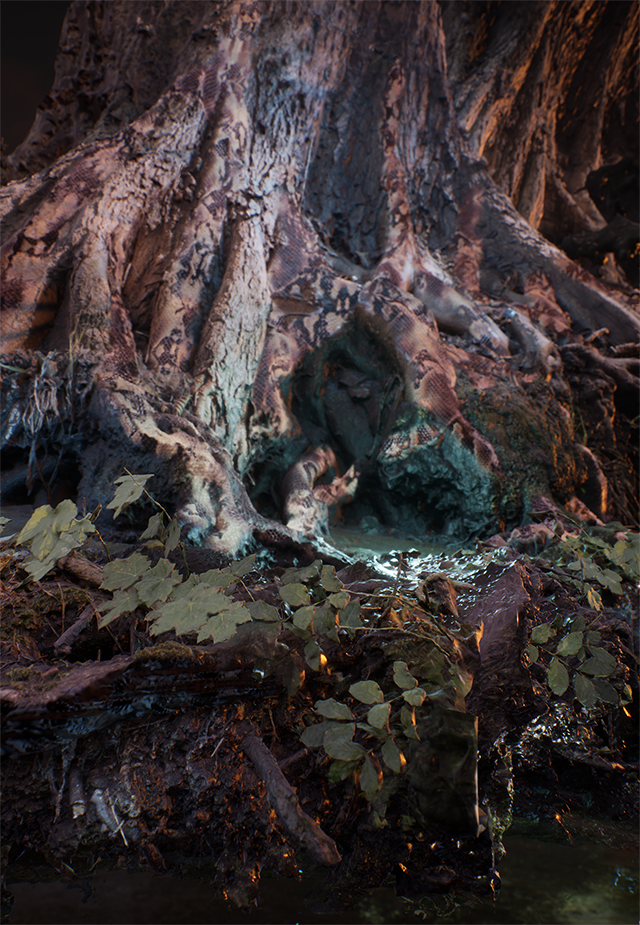
Jakob Kudsk Steensen, Berl-Berl, 2021: Live simulation (still). Commissioned by LAS Art Foundation. Courtesy the artist.
The complex auditory dimension of the artwork is just as essential to its virtual world as the real-time imagery. The soundscape is composed of archival recordings from the Museum für Naturkunde, field recordings from the swamps, and vocal contributions by singer Acra.[20] Sound artist Matt McCorkle wove these elements into a composition that continuously shifts through programmed algorithms.[21] The result is not a fixed soundtrack but a dynamic interplay of individual sounds that, depending on the viewer’s perspective and movement within Berl-Berl, generate an evolving sonic texture—one that feels like a distorted, sustained synthesis of natural environments and technological artifacts. It evokes a kind of speculative bioacoustics, aiming to make audible the sonic phenomena of a swamp, including frequencies that would otherwise escape the range of human hearing.
With Berl-Berl, Kudsk Steensen creates a virtual swamp that — through the interplay of its various dimensions and its continuous live simulation — is not a documentation of the few remaining wetlands around Berlin. Rather, it is a crossing of places, times, myths, and nonhuman as well as more-than-human beings, shaped through artistic practice. Rooted in field research, this practice aims to translate ecological observation into the internet complex through the use of cutting-edge technologies.
A similar approach can be observed in Kudsk Steensen’s Boreal Dreams. The parallels with Berl-Berl — in terms of photogrammetry, gamification, real-time rendering, and the resulting aesthetic — have already been noted, as has the hybrid existence of the work between immersive installation and internet-based screen presentation. Dated 2025, Boreal Dreams is described by the artist as a “Live Simulation, Spatialised Sound, and Online Interactive Experience.”[22] The work was commissioned by the Fondation Beyeler as a contemporary counterpart to its Northern Lights exhibition (26 January–25 May 2025), which focuses on Scandinavian landscape painting from the classical modern period. Kudsk Steensen developed his work in response to the exhibition’s theme, specifically for the sculpture garden of the Renzo Piano-designed museum building in Riehen near Basel. The artwork is presented outdoors on two large-scale double-sided screens, each with a front and back projection surface. In addition, an online version allows for interactive engagement, where the focus shifts more strongly toward user participation.
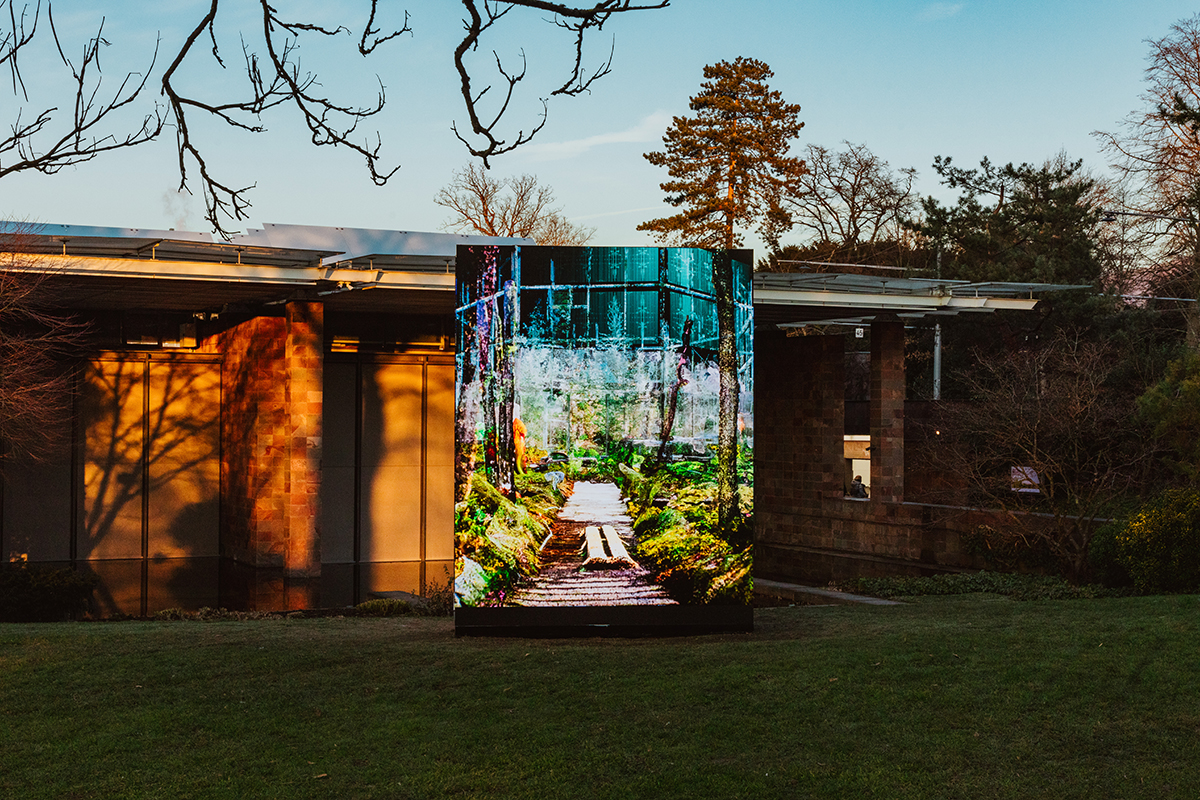
Jakob Kudsk Steensen, Boreal Dreams, 2024-25: Live simulation. In collaboration with Northern Research Station of the USDA Forest Service. Commissioned by the Fondation Beyeler, Riehen/Basel. Installation view: Fondation Beyeler 2025. Photograph by: Mark Niedermann. Courtesy the artist.
The title refers on the one hand to the boreal forest, and on the other to the work’s narrative strategy: bringing together the transformations driven by the climate crisis with the motif of the dream. In a video produced for the website of the Fondation Beyeler, the artist outlines the project’s theme, his intentions, the collaborating partners, and the physical location from which the digitized material originates.[23] Additionally, the Boreal Dreams website includes an information section that provides background on the artwork.
The starting point of the work is the Marcell Experimental Forest (MEF), a research site located in northern Minnesota. Situated within the Chippewa National Forest, the MEF allows scientists to conduct climate research under real-world ecological conditions in line with Earth system science.[24] Glass octagons are embedded within the coniferous forest and connected by narrow walkways, resembling greenhouses or artificial climate capsules taken from a science fiction film. Researchers at the MEF use these structures to simulate various degrees of temperature rise caused by anthropogenic climate change and to study their effects on the boreal forest ecosystem.
Kudsk Steensen appropriated the architecture of the research site and translated both its structures and testing conditions into a virtual world. Together with his team, he conducted fieldwork within these artificially constructed environments, which anticipate future scenarios based on current climate developments. Inside the octagons, plant life and species were digitally recorded, and sound material was collected. For the latter, he once again collaborated with sound artist Matt McCorkle.
When exploring the web-based version of the artwork, we are first greeted by a brief intro, followed by a map of Boreal Dreams. The map features five stations, each marked with a simulated temperature increase and a title that reads like a subtitle of the artwork: +0° The Boreal Forest, +2.5° The Marcell Experiment, +4.5° Chronobiology, +6.5° Circadian Architecture, and +9° Dream. Upon selecting a station, we are prompted to either begin exploring it or to first learn more about it. If we choose to explore, subtitles begin to appear on screen as we enter the environment. These texts, written by dream researcher Adam Haar Horowitz, read as a hybrid of factual insights into the climate resilience of the boreal forest, speculative nature writing, and cutting-edge findings from dream research — a blend of information and poetry.
Inside the octagons, viewers can move freely, though each station transforms into a spherical environment suspended in a black, boundless space. Even more than in Berl-Berl, the virtual world of Boreal Dreams is composed of coloured points that coalesce into ghostly surfaces of objects and plants. Certain elements within each station light up; when clicked, they trigger an automated movement around the object accompanied by subtitles that unfold a fragmented, associative narrative — at times, the boreal forest itself seems to speak directly to us through these lines. With the exception of the final station, Dream, each station offers three clickable elements. These, however, must be activated in a predetermined order, which limits the freedom of choice. The stations themselves can be accessed in any sequence, and we can return to the map at any time. Navigation within the stations is generally smooth, though at one point — in +2.5° The Marcell Experiment — I found myself deep in the thawing permafrost, unable to resurface.
The higher the temperature levels indicated in each station, the more irreversible the ecological damage becomes. At +4.5° Chronobiology, the tipping points for the boreal forest have already been crossed. In the final station, +9° Dream, the forest has disappeared entirely. Instead, we enter a speculative architecture composed of points and fields of light. At its centre is a single clickable element — a plant or blossom that also appeared in earlier stations, now rendered as a spectral presence in an uninhabitable environment. In +9° Dream, the composed soundscape moves to the forefront. As the introductory text suggests, the ideal experience is to let it play during sleep, inviting us to dream of the boreal forest. At this point, dreaming of what has been lost becomes the only way to draw it into the present. The live simulation’s soundscape begins with sustained ambient tones, which gradually give way to natural sounds.
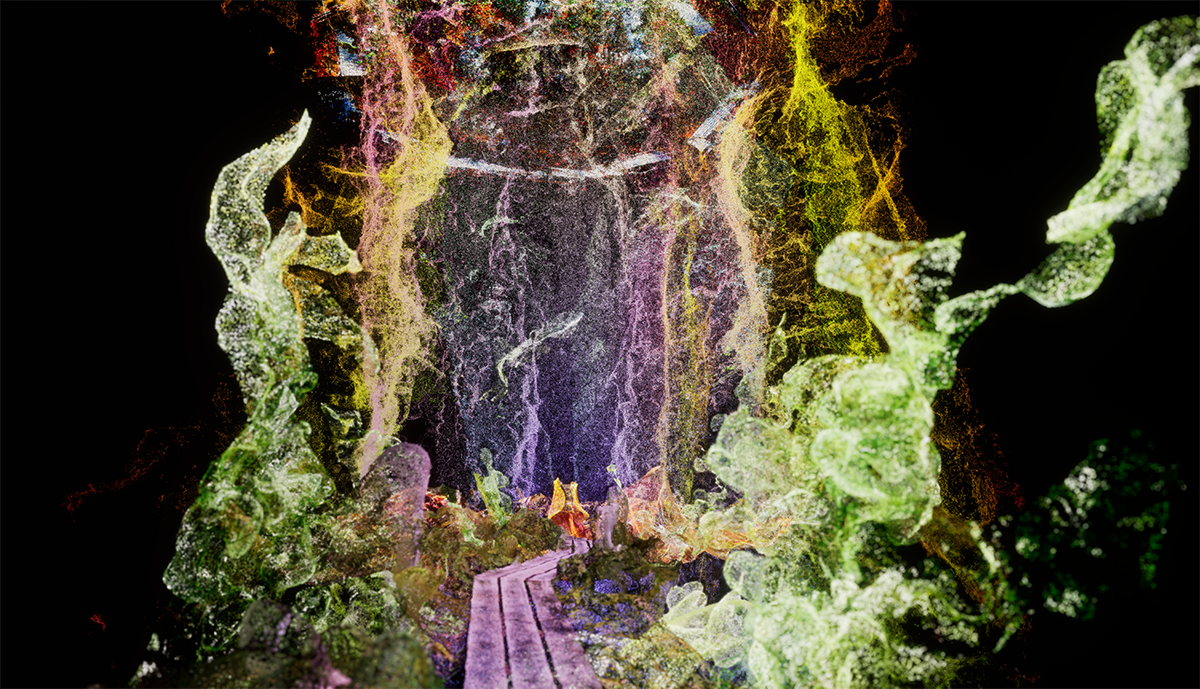
Jakob Kudsk Steensen, Boreal Dreams, 2024-25: Live simulation (still). Commissioned by the Fondation Beyeler, Riehen/Basel. Courtesy the artist.
An especially compelling station is +6.5° Circadian Architecture, which introduces a self-reflexive, technology-critical narrative: the scenario depicts an artificial world saturated with technical applications, in which we can only watch the forest die. According to the narrative, this happens through our screens, whose blue light continues to stimulate melatonin production: our eyes remain wide open while the world fades away. This invites a connection to Crary’s critique, in which the technological products he associates with the internet complex trap us in a maelstrom of surveillance and interaction. The effect echoes the argument he developed in his earlier book 24/7, where he analyzes the suppression of sleep as the final frontier capitalism seeks to colonize — transforming even rest into a profit-generating resource.[25]
That this critique of technology — when linked to ecological concerns — must itself be critically examined within the context of a virtual world seems self-evident, given that such worlds rely on digital technologies, server infrastructure, energy consumption, and resource extraction.[26] Extended reality technologies enable new forms of artistic expression and expand global access to cultural experiences, yet they also entail considerable ecological challenges.[27] In this regard, both Berl-Berl and Boreal Dreams occupy an ambivalent position: without the technical infrastructures that contribute to climate change, these works would not exist; at the same time, both virtual worlds seek to foster ecological awareness and, by extension, reduce environmentally harmful behaviour. The paradox of artworks that aim to raise ecological consciousness while simultaneously generating ecological collateral damage has been a subject of debate at least since the critique of Olafur Eliasson’s Ice Watch in 2014.[28]
One might argue that Kudsk Steensen does not extract physical materials to transform them into artworks, as is often the case with non-digital practices. Nevertheless, server and computing power, hardware, logistics, and travel remain essential to the creation of these virtual environments in the paraverse. If one shifts the focus to these variables, the question of delineation quickly arises — after all, every human action is entangled with extraction.[29] Even the research, reception of the artworks, and writing of this text depend on the internet complex, to borrow Crary’s terminology. A more troubling issue arises when the ecological footprint of an artist working on environmental themes is equated with systemic power structures, such as the global lobbying apparatuses of fossil industries under neoliberalism.[30]
This ambivalence resonates with a recurring topos in the literature on Kudsk Steensen: his artworks challenge ecological issues precisely by generating new experiential worlds. As noted in relation to his 2019 work The Deep Listener, his practice fosters “new sensibilities that are more tangible,” leading to “alternative ways of thinking and caring for the more-than-human world.”[31] Similarly, Re-Animated (2019) has been described as a work that “shifts users’ perspectives and generates a wider range of affective responses to species loss and revival.”[32] This shift in perspective is also reflected in the viewer’s position: “In his works it is indeed the environment that takes over by making the viewer become part of it.”[33]
Whether virtual artworks that engage with ecological questions actually influence the environmental awareness of their viewers can be examined through the lens of research on digital nature experiences. Studies on this topic speak with notable clarity: digital technologies not only shape how we interact with the environment, but also contribute to a fundamental redefinition of what “nature” means.[34] Moreover, virtual nature experiences have been shown to support ecological education and even enhance psychological well-being.[35] To connect these findings with artistic practices, the term “eco-digital“ has been introduced — referring to a heightened awareness of environmental issues, often facilitated through interactive engagement.[36] How these insights apply to Berl-Berl and Boreal Dreams is one of several aspects explored in the final section.
Digital Ecology in the Internet Complex
As one might expect from Crary’s sweeping critique of the internet, his book offers no hopeful conclusion. Community and solidarity, he argues, cannot emerge within the internet complex, as it is rooted in neoliberal strategies of market-based individualism. Instead, he opts for sketch-like proposals and a final appeal.[37] What he sees as essential is the reinvention of sociality — above all through the recovery of lost or marginalized forms of knowledge — yet this knowledge, he insists, cannot be found online.[38] Screens, he writes, lead only to absorption “to an immaterial architecture of separation,” resulting in the “dissipation of curiosity about otherness or about the wondrous plenitude of non-human life.”[39] In light of Kudsk Steensen’s works, one must ask: what forms of “curiosity” do these two virtual worlds — operating from within the internet complex — manage to evoke?
As outlined in the introduction, it is precisely the connection between the internet complex and ecological concerns that opens up the possibility of moving beyond the limitations Crary describes. Both Berl-Berl and Boreal Dreams offer insights into ecological processes — insights that are made possible only through digital technologies. The aesthetics of these works play a decisive role: the hyperreal swamp and coniferous forest environments invite exploration and create the impression that we are able to perceive more than the human sensory spectrum — on a molecular level, for instance, or beyond the visible colour scale. To achieve this effect, Kudsk Steensen integrates the various stages of photogrammetric processing, as previously described, into the aesthetic structure of his works. Equally significant is the use of sound, which introduces frequencies that lie outside the bounds of human hearing.
What matters is not just the interactivity of these virtual environments, but the fact that vision and sound are embedded within a live simulation — one that we actively move through. These immersive worlds address the stream of consciousness, a central component of human experience. The live simulation carries a latent promise: the potential to perceive something continuously anew, without beginning or end — even if it is ultimately driven by the complex computational processing of predetermined variables.
Of course, not all dimensions of life can be replicated — especially when it comes to notions of community, which Crary sees as essential. The kind of communal experience possible in a factory hall or museum garden cannot simply be transferred to the solitary situation in front of a desktop screen. But to expect this would be misleading, as these virtual worlds are not intended to be perfect replicas of analogue life. What is more productive is to acknowledge the limitations of these digital environments while fully exploring their potential — namely, their ability to show us things we could not perceive in a physical swamp or boreal forest.
This includes the complex entanglement of pasts, presents, and futures that both works explore. In the live simulation perceived as present, Berl-Berl layers the historical wetlands of Berlin — not as an act of revival, but as a performative speculation — with a speculative future scenario: the simulation of a dried-out wetland, desiccated by the climate crisis. To understand this, several features of the work must be considered: the digitally recreated and modified animal calls, the mythological references, the precise documentation based on photogrammetry of real swamps in the Berlin region, and their histories — marked by a long trajectory of drainage since the onset of industrialization. Added to this is the projection of their potential disappearance as a result of accelerating climate change.
In Boreal Dreams, this entanglement of temporalities is structured in a similar way and appears more explicit. The focus lies primarily on the relationship between present and future. The historical responsibility of the Global North — particularly its massive contribution to greenhouse gas emissions — must also be acknowledged, as it forms the very premise for the MEF simulations. In terms of the artwork, it is the present of the live simulation through which we move, interwoven with a range of speculative futures, each shaped by a different degree of global warming. As previously noted, the work is not a documentary representation of the situation in Minnesota, but a distinct artistic speculation. The audio-visual phenomena encountered within the octagons can only unfold within the virtual world. Without the digital technologies of the internet complex, this experience would remain inaccessible.
As Manuel DeLanda already demonstrated in A Thousand Years of Nonlinear History (1997), history unfolds through a series of nonlinear processes.[40] Emergent feedback loops are the rule rather than the exception. While DeLanda focused on geological, biological, and semiotic dynamics, the digital can now be understood as an additional force driving nonlinearity. Past, present, and future are intricately entangled: layers of the past intersect with the fluctuating conditions of the present and are simultaneously linked to emergent futures.[41] The temporal structures within Berl-Berl and Boreal Dreams are highly compatible with DeLanda’s theory. As viewers, we find ourselves suddenly immersed in this vortex — deprived of stable constants such as cause and effect that typically anchor our perception.
Just as central as the temporal dimension in Berl-Berl and Boreal Dreams are the immersive qualities of these works. Here, it is important to preempt potential misunderstandings: artworks that generate virtual worlds should not automatically be equated with immersive art experiences.[42] However, one can argue that works based on virtual techniques actively foster interaction and reflection on the part of viewers, precisely because they invite an exploration of the boundary between virtual and physical everyday life — an engagement that opens up epistemic dimensions.[43]
Felix Stadler has addressed the interrelation of immersion and aesthetics in the context of two defining forces of our time: digitalization and the climate crisis. He, too, begins by emphasizing that immersion is a normal part of everyday experience.[44] In contrast, the aesthetic contemplation of artworks — the traditional opposition between subject and object—is an artificial construct. Digitalization and climate change collapse this distance entirely: “There is no outside, but only specific positions within a complex, dynamic system, and multiple relationships of exchange and interdependency characterize these positions.”[45] As a result, “the classic task of aesthetics” is redefined: to make perceptible that we are immersed in a world where agencies unfold on nonhuman scales —“too small, too large, too quick, or too slow to perceive without technological aids.”[46]
Immersion in the virtual worlds of Berl-Berl and Boreal Dreams brings digitality and the climate crisis into a shared experiential space. Both works participate in what Dane Sutherland has described as the “eco-logic of the swamp.”[47] Understood as a metaphor, the swamp’s processual and relational logic continually dissolves binaries such as organic and synthetic, real and virtual, past and present.[48]
The works by Kudsk Steensen analyzed here demonstrate that digital media hold potentials that go beyond the mere documentation of environments. These artworks function as technopolitically embedded agents that, through their modes of mediation, open up new possibilities for perception, relation, and articulation between human and more-than-human worlds. In the sense of the concept of “digital ecologies,” these virtual worlds do not operate as neutral interfaces, but as “situated, political, and affective mediators” that exert ambivalent effects on existing ecological and societal conditions.[49]
Berl-Berl and Boreal Dreams do more than create new spaces of virtual experience — they negotiate the conditions of a digital ecology within the “technonatural present,” a state in which digital infrastructures and more-than-human life-worlds are inextricably intertwined.[50] The potential of these artworks does not lie in a technodeterministic hope for “green digital solutions,” but rather in their capacity to produce “glitches”— productive disruptions within the digital mediation process.[51] Precisely in moments when the immersive simulations unsettle, provoke disorientation, or introduce breaks and a loss of control, epistemic cracks emerge — cracks through which an expanded perception of the ecological crisis can begin to surface.
Rather than affirming Crary’s view of the digital as a wholly destructive system, Kudsk Steensen’s works open up alternative perspectives from within the internet complex itself. While Crary presents the digital as a closed and corrosive force that undermines creativity, community, and ecology, Berl-Berl and Boreal Dreams reveal that it is precisely within this sphere that new forms of relational thinking, aesthetic experience, and ecological reflection can emerge. In this context, both virtual worlds function as more-than-human (web)sites within the eco-digital: they generate complex entanglements of real and virtual entities, bringing together multiple temporalities and modes of existence in digital space. Within the framework of the paraverse and the migration of artworks into the digital sphere, these works assert their presence as self-contained virtual environments that must navigate the conditions of the internet complex. In contrast to the disruptive dynamics Crary outlines, these virtual exhibition spaces propose an alternative world. The internet complex is not merely a wasteland, but also a contested site — and co-creator — of ecological counter-narratives and future imaginaries.
Hauke Ohls is a postdoctoral researcher with the Chair of Contemporary Art and Digital Image Cultures at the University of Bonn, Germany. His research focuses on theoretical, sociological, and philosophical questions of modern and contemporary art with particular emphasis on eco-relational art and ecological aesthetics,neo-extractivism, ecofeminist, pluriversal, posthuman theory, the discourse on objects, materiality and images, as well as the relationship between art, economy, and neoliberalism. Additional areas of interest include the intersection of art and music, artists’ writings, media art, and transcultural art history. Recent book publications include: Kritik des Neo-Extraktivismus in der Gegenwartskunst (ed. with Birgit Mersmann, Lüneburg 2024); Many-Valued Aesthetics. Interconnections in the Work of Mary Bauermeister (Bielefeld 2024); Okzidentalismen. Projektionen und Reflexionen des Westens in Kunst, Kultur und Ästhetik (ed. with Birgit Mersmann, Bielefeld 2022); Objektorientierte Kunsttheorie. Graham Harmans spekulative Philosophie im Kontext einer (nicht-)relationalen Ästhetik (Hamburg 2019).
Notes
[1] Jonathan Crary, Scorched Earth: Beyond the Digital Age to a Post-Capitalist World (London: Verso, 2022), 3.
[3] Crary, Scorched Earth, 59.
[4] In his 2022 book, Crary repeatedly addresses the accumulation of power by billionaires who control parts of internet-based services, which seems particularly topical given the current political climate, especially in the United States.
[5] Crary, Scorched Earth, 42.
[6] Crary, Scorched Earth, 86.
[7] Philipp Staab, Markets and Power in Digital Capitalism (Manchester: Manchester University Press, 2024).
[8] Gabriella Coleman, Coding Freedom: The Ethics and Aesthetics of Hacking (Princeton, NJ: Princeton University Press, 2013)
[9] Alenda Y. Chang, Playing Nature: The Virtual Ecology of Game Environments (Minneapolis: University of Minnesota Press, 2019).
[10] Alenda Y. Chang, “In Technology, Nature?,” in Jakob Kudsk Steensen: Berl-Berl, ed. Emma Enderby (Berlin: Light Art Space; Cologne: Koenig Books, 2021), 126.
[11] The artwork Boreal Dreams can be accessed via this link: https://borealdreams.live (accessed May 12, 2025). The Berl-Berl website https://www.berlberl.world is currently inaccessible (last access May 12, 2025). During my research for this text, I visited the virtual world hosted on the site several times; it is maintained by the commissioning institution, the LAS Art Foundation. This creates an intriguing situation: at present, the artwork exists only hypothetically in the digital space, since the simulation fails to load. This temporary disappearance points to a broader condition of digital art within the paraverse: its dependence on fragile infrastructures, institutional hosting, and maintenance cycles.
[12]Jakob Kudsk Steensen, Berl-Berl, https://www.jakobsteensen.com/berlberl (last access May 12, 2025).
[13] Barbara London, “Navigating the Ineffable,” in Jakob Kudsk Steensen: Berl-Berl, ed. Emma Enderby (Berlin: Light Art Space; Cologne: Koenig Books, 2021), 156.
[14] Emma Enderby, “Real Fantasy,” in Jakob Kudsk Steensen: Berl-Berl, ed. Emma Enderby (Berlin: Light Art Space; Cologne: Koenig Books, 2021), 68.
[15]> Kim Mortega, “Retracing Berlin’s Wetlands,” in Jakob Kudsk Steensen: Berl-Berl, ed. Emma Enderby (Berlin: Light Art Space; Cologne: Koenig Books, 2021), 160.
[16] Jakob Kudsk Steensen and Johannes Vogel, “Cataloguing the Natural World,” in Jakob Kudsk Steensen: Berl-Berl, ed. Emma Enderby (Berlin: Light Art Space; Cologne: Koenig Books, 2021), 39.
[17] Enderby, “Real Fantasy,” 69.
[18] Triglav is a deity from Slavic mythology, particularly venerated in West Slavic regions, whose name means “three-headed.” The figure is associated with ancient pagan cosmologies and was worshipped as a powerful guardian of equilibrium between divine, terrestrial, and chthonic forces.
[19] London, “Navigating the Ineffable,” 159.
[20] Cristina Baldacci, “Re-Enacting Ecosystems: Jakob Kudsk Steensen’s Environmental Storytelling in Virtual and Augmented Reality,” Piano B. Arti e Culture Visive 6, no. 1 (2021): 73.
[21] Enderby, “Real Fantasy,” 69.
[22] Jakob Kudsk Steensen, Boreal Dreams, accessed May 13, 2025, https://www.jakobsteensen.com/boreal-dreams
[23] Jakob Kudsk Steensen, Boreal Dreams, video, 5:04, produced for Fondation Beyeler, published by Berlin Art Link, February 2025, accessed May 13, 2025, https://youtu.be/VgBafZQyzUQ.
[24] U.S. Forest Service, Marcell Experimental Forest, accessed May 13, 2025,
https://research.fs.usda.gov/nrs/forestsandranges/locations/marcell.
[25] Jonathan Crary, 24/7: Late Capitalism and the Ends of Sleep (London/New York: Verso, 2013).
[26] Stephen Rust, Salma Monani, and Sean Cubitt, eds., Ecomedia: Key Issues (New York: Routledge, 2016); Jussi Parikka, The Geology of Media (Minneapolis: University of Minnesota Press, 2015).
[27] James Hutson, Art and Culture in the Multiverse of Metaverses: Immersion, Presence, and Interactivity in the Digital Age (Cham: Springer, 2024).
[28] Nicole Hall, “Virtue Appreciation and Sustainability in Olafur Eliasson’s Ice Watch,” Contemporary Aesthetics 11 (2024), https://contempaesthetics.org/2024/07/13/virtue-appreciation-and-sustainability-in-olafur-eliassons-ice-watch/.
[29] Anna J. Willow, Understanding ExtrACTIVISM: Culture and Power in Natural Resource Disputes (London: Routledge, 2018), 2.
[30] Timothy Mitchell, Carbon Democracy: Political Power in the Age of Oil (London: Verso, 2011).
[31] Justyna Stępień, “Augmented (Re)wilding of Urban Entanglements in Jakob Kudsk Steensen’s AR Project The Deep Listener,” Arts & Cultural Studies Review 58, no. 4 (2023): 518–19, https://doi.org/10.4467/20843860PK.23.033.19182.
[32] Sarah Bezan, “The Species Revivalist Sublime: Encountering the Kaua‘i ‘Ō‘ō Bird in Jakob Kudsk Steensen’s Re-Animated,” in Animals, Plants and Afterimages: The Art and Science of Representing Extinction, eds. Valérie Bienvenue and Nicholas Chare (New York/Oxford: Berghahn Books, 2022), 227.
[33] Baldacci, “Re-Enacting Ecosystems,” 79.
[34] Andrés Luque-Ayala, Ruth Machen, and Eric Nost, “Digital natures: New ontologies, new politics?”, Digital Geography and Society 6 (2024): 100081, https://doi.org/10.1016/j.diggeo.2024.100081.
[35] Simone Grassini and Eleanor Ratcliffe, “The Virtual Wild: Exploring the Intersection of Virtual Reality and Natural Environments,” in Managing Protected Areas, ed. N. Finneran et al. (Cham: Springer, 2023), 327–351, https://doi.org/10.1007/978-3-031-40783-3_17.
[36] Rewa Wright, Simon Howden, and Mereana Wright-Osborne, “Towards the Eco-Digital: Real-Time Animation with Plants, Data and Sound,” in Expanded 2024 – Conference on Animation and Interactive Art, 2024, https://doi.org/10.5281/zenodo.12792864.
[37] Crary, Scorched Earth, 123–24.
[38] “There are enormous reserves of knowledge and insight, from all eras, about techniques of subsistence and fostering of community that need to be recovered and adapted for present needs, especially from cultures in the Global South and indigenous peoples.” Crary, Scorched Earth, 122. Although Crary does not elaborate further on this statement, the context is clear: he is invoking theories of the pluriverse, in which the pursuit of intersectional justice is grounded in the inclusion of marginalized groups and Indigenous communities as a central condition for creating viable worlds: Arturo Escobar, Pluriversal Politics: The Real and the Possible (Durham: Duke University Press, 2020); Marisol de la Cadena and Mario Blaser, eds., A World of Many Worlds (Durham: Duke University Press, 2018).
[39] Crary, Scorched Earth, 119, 121.
[40] Manuel DeLanda, A Thousand Years of Nonlinear History (New York: Zone Books, 1997).
[41] DeLanda, A Thousand Years of Nonlinear History, 3–4.
[42] Miriam López-Rodríguez, Vicente Rodríguez-Pérez, and Ana Felicitas López Rodríguez, “Immersive and Virtual Exhibitions: A Reflection on… Art?,” Arts & Communication. A New Dimension of Art, volume 3, no. 1 (2025), https://doi.org/10.36922/ac.3688.
[43] Annette Urban, “Mutual Transformations: Unstable Relations between VR-Works, Environments and Exhibitions,” AN-ICON. Studies in Environmental Images 2, no. 1 (2023): 112–138, https://doi.org/10.54103/ai/19773.
[44] Felix Stalder, “Immersion: Between Simulation and Re-Entanglement,” View: Theories and Practices of Visual Culture 38 (2024): 3, https://doi.org/10.36854/widok/2024.38.2872.
[46] Stalder, “Immersion,” 13.
[47] Dane Sutherland, “View from the Swamp,” in Jakob Kudsk Steensen: Berl-Berl, ed. Emma Enderby (Berlin: Light Art Space; Cologne: Koenig Books, 2021), 99.
[48] Sutherland, “View from the Swamp,” 101.
[49] Adam Searle, Eva Haifa Giraud, Jonathon Turnbull, and Henry Anderson-Elliott, “Introduction: What Is Digital Ecologies?” in Digital Ecologies: Mediating More-than-human Worlds, ed. Jonathon Turnbull, Adam Searle, Henry Anderson-Elliott, and Eva Haifa Giraud (Manchester: Manchester University Press, 2024), 2.