
- Download Issue 63 (US Letter, 7 mb)
- Buy as Book on Demand here (US) and here (DE)

by Lucas Burkart
Cultural Heritage in the Digital Age—Some Considerations and a Use Case
Like many seemingly transformative moments in media history, the digital turn has inspired both exaggerated hopes and bleak doomsday prophecies in equal measure. Shifting the discussion beyond these equally unrealistic expectations requires a candid assessment of the opportunities digital technologies can offer to cultural heritage alongside a critical reflection on their use and wider impact. While GLAM institutions[1] must fulfil a number of requirements to successfully realise the potential of digital technologies, they also need to take a political stance when making their holdings digitally accessible.
This article advocates for a digitally informed, but not technologically driven approach to cultural heritage as data. The goal is less to bring digital technologies to the GLAM sector — this has been happening for at least thirty years — than to highlight ways of transferring curatorial expertise to the digital sphere. Hence, the ‘mantra’ is: technology follows application. Above all, it is essential that the digitisation of cultural heritage follows internationally acknowledged standards such as FAIR, LOUD, and CARE. This involves at least three steps: the process of digitisation as such, the parallel application of accepted metadata schemes and formats, and the creation of open interfaces (APIs) for the reuse of data and metadata. In most cases, this goes far beyond what many GLAM institutions currently offer as their online collection.
The Disenchantment of Digital Technologies
In the world of start-ups, the view has long since been established that the most exciting and influential innovations arise from the merging of ‘fuzzy’ and ‘techie’ expertise, referring to the Social Sciences and Humanities on the one hand, and technology development on the other. By contrast, the GLAM sector is still defensive about the potential of digital technologies and hence largely misses out on the opportunity to adequately exploit them for its own purposes. Therefore, a change of attitude is needed.
First of all, the idea that ‘techies’ control better and more relevant knowledge has to be abandoned, as they are equally unable to solve GLAM-specific problems with codes and algorithms alone. Techies are only marginally concerned with the challenges of the GLAM sector, often lack a proper understanding of the complexities of cultural heritage, and thus are unlikely to propose the most fitting applications of their own technologies. The advent of analytical and generative AI will not change that.
The merging of skillsets from technology and GLAM professionals therefore appears as promising endeavours, yet its implementation must be achieved by means of a true collaboration between equals. This would not only allow for workflows and processes to become more efficient and comprehensive, but also for digital technologies to be used adequately for content-related and creative work in the GLAM sector. In the same way as tools have enhanced human capabilities throughout history, digital technologies can advance the societal importance of GLAM institutions. Here, too, humans and machines best work together, as Scott Hartley puts it.[2]
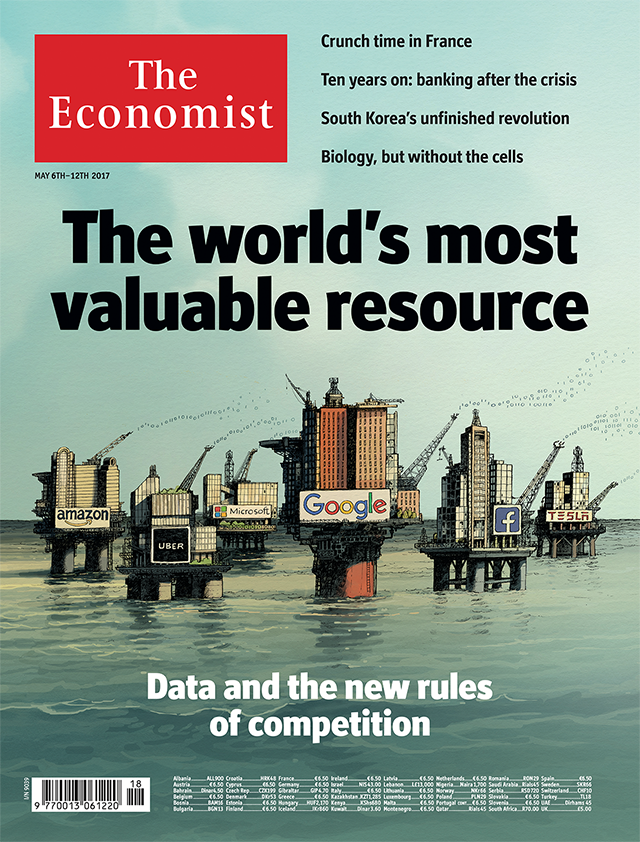
Cover of The Economist, May 6, 2017 © The Economist Group Limited 2024. All rights reserved.
Cultural Heritage as Data
The metaphor of data as the new oil has been widely established since the May 2017 issue of the Economist. While the liberal magazine was primarily concerned with the need for legislative regulation, the metaphor itself emphasises two aspects of digital technology development that are relevant here.[3] First, it reveals a shift in the understanding of data from an item of personal property to an extractable and potentially marketable resource. Second, and consequently, it hints towards a specific value creation cycle. The media scholar David Buckingham got to the heart of this notion when proclaiming that “data is the new oil, we need to find it, extract it, refine it, distribute it and monetize it.” [4]
This view, of course, does not encapsulate a neutral description of the data life cycle. Rather, it describes the business model of Big Tech and private industries.[5] The preservation and curation of cultural heritage, however, has always been an act of knowledge creation and dissemination rather than an investment yielding immediate financial returns. An understanding of cultural heritage as data does not change that, but it can advance the mission of GLAM institutions by introducing new, digital formats of communication and participation.
In short, the GLAM sector must not fall into the trap of copying business models from the IT industry. Instead, it should aim to create its own, independent value creation cycle. The most basic prerequisite for this endeavour is the careful curation of data, in accordance with internationally acknowledged standards tailored to the needs of cultural heritage preservation and research. The goal is to exploit data and the ensuing technologies for the benefit of cultural heritage as a public good; challenging and reversing Buckingham’s claim, it is about the public capitalisation of data and digital technologies rather than about their monetisation for private gain.
Preventing Data (Ab-)Use
The fact that public and private interests are sometimes at odds and require the balancing mediation of governance is a truism of liberal societies. In the given context, the conflict between private and public value creation cycles is rooted primarily in the former’s use (or rather, abuse) of publicly available — and hence publicly-owned — digital data. While the benefits of Open Access (OA) and Open Research Data (ORD), by now the dominant paradigms for the dissemination of publicly-funded research, are rightly undisputed, both principles were first conceived in the 1990s and thus largely predate the more recent advancements in digital technology. However, this undoubtedly contradicts their original intentions, as they are actively contributing to publicly funded research feeding the value creation cycle of private IT companies for free. This by now deplorably frequent practice results in the absurdity of private companies using publicly-owned data free of charge, only to develop products that they then sell back at a profit to the public sector and individual taxpayers.
A fairly simple solution to this problem — pending some basic strategic coordination between public funding agencies and the GLAM sector — would be the insistence on a condition that the private sector routinely attaches to its own products and services with considerable eagerness: ‘not for commercial (re-)use.’ This measure — which, for example, could be communicated by means of a label, watermarks or tailored creative common licenses for all data not only digital visual content — is all the more urgent as private companies increasingly and proactively seek to collaborate with GLAM institutions with the (typically unstated) agenda of expanding their data pools. Lately, this thirst for data is often driven by a desire to train so-called Large Language Models (LLMs) that form the basis of various artificial intelligence applications.[6] The deal companies strike is simple: they cover the costs of digitisation, then use the generated data for their own purposes. From a GLAM perspective, however, it is a worryingly bad deal because the interests underlying the respective value creation cycles are diametrically opposed to each other. While publicly-funded holding institutions have an interest in Open Access and Open Research Data, companies aim to reserve the same data for their exclusive profit-oriented use. Claiming the right to freely use the data themselves, they deny the equivalent right to their partners and thus to the public as a whole.
Where such contracts have already been signed, not much can be done to change them. However, wherever new data is made openly accessible, it is indispensable to learn from private industry and label such data as ‘not for commercial use.’[7] This does not mean that GLAM institutions should compete with the private sector in a market setting; yet, they should protect cultural heritage from private monetisation by ensuring that public goods remain public even in the form of data, that is, accessible and (re-)usable free of charge. This policy should guide all future digitisation initiatives in the GLAM sector.
All these considerations are ultimately based on the fact that global cultural heritage represents an enormous treasure trove whose digital availability is constantly growing. However, the rapid development of generative AI in particular poses a challenge not only in economic and democratic terms, but also with regard to the ownership and interpretation of cultural heritage. Besides their commercial interests, AI applications routinely use publicly-owned research data in probabilistic and non-transparent ways. From the perspective of cultural heritage, historical studies, and academic research in general, this is tantamount to the annulation of all scientific and methodological standards and, therefore, to total surrender. New research agendas to increase data transparency and trustworthiness are desperately needed.
Curiositas 5.0—First Steps Towards a Bigger Vision
In the following, I will discuss a digital exhibition project (online since 2023) as a use case to illustrate the experiences, opportunities, and challenges of the digital expansion of the GLAM sector. At the centre of the project lies a cabinet of curiosities that was founded in the mid-seventeenth century: the Museum Faesch.[8] This collection has been managed by the family of its initiator for a good 150 years, and eventually transferred to the collection of the University of Basel at the beginning of the nineteenth century. Shortly afterwards, owing to the increasing specialisation of academic disciplines, the holdings of said cabinet were divided into three special collections. Such was the fate of many historical cabinets of curiosities all across Europe, whose original context as a research tool and a place for the production and preservation of knowledge was thus irretrievably destroyed. In the case of the Museum Faesch, however, the collection's holdings remained entirely in the possession of the city of Basel. Today, they are preserved in the university library, the historical museum, and the art museum. In a certain sense, the Museum Faesch therefore still exists, albeit only as a collection of disjoint and largely inaccessible artefacts.
Against this backdrop, I will focus on four facets that were relevant for the implementation of the digital project Curiositas 5.0.[9]
1. From Visibility to Reusability
It is well known that only about five percent of the cultural heritage held in museums and collections is actually being displayed, and hence a significant proportion of the holdings remains largely invisible to the public. As a result, they are also only partially available for research. It has been repeatedly suggested that digital technologies provide a potential solution to this problem by massively increasing the visibility and availability of cultural heritage.[10]
The Curiositas project reunites more than a thousand artefacts that were originally held in the Museum Faesch. In a ‘gallery’ section, they are presented as a tapestry and can be searched by author, title, year, and other criteria.[11] Metadata provide the basis for all forms of organisation in this ‘gallery,’ and the structuring and normalising of the metadata was therefore a mandatory prerequisite for ensuring the interoperability of the digitised artefacts. This step, however, proved particularly challenging as all of the involved institutions use different systems to generate and store (meta-)data. This is due to disciplinary traditions and the gradual conversion from analogue to digital work processes, which has been increasingly taking place in GLAM institutions since the 1990s.
Thus, the project’s ‘gallery’ provides access to, and ensures the visibility of many of the artefacts that originally formed the Museum Faesch. However, access to and visibility of a collection are not enough. Both the viewing public and the scholarly community increasingly requires cultural heritage to be made available and accessible as reusable data. Labelled ‘not for commercial use,’ this data must be made available by GLAM institutions free of charge.
2. Curatorial Intention
In contrast to the purposefully uncurated gallery, a completely different presentation was needed to convey an understanding of the cabinet of curiosity as a historical site of knowledge production. The project actively applies the eponymous concept of curiosity for this very purpose, thus highlighting curiosity as a general driving force for scientific endeavours since the early modern period. In addition, curiosity is understood as the principal curatorial concept as it captures the essence of an early modern cabinet of curiosities in a paradigmatic way.
In a section entitled ‘object constellations,’ a diverse range of objects, such as paintings, naturalia, coins, drawings, and books are brought together to create unexpected connections across different genres and media. Taken out of their collection furniture and gathered in an assemblage, they represent the dynamic framework in which established knowledge was confronted with previously unknown objects and new observations. From the discovery of previously invisible connections between different items, new ideas could arise. As Frans Francken reveals in his 1617 painting, a variety of different items were often presented and thus made accessible to collectors and visitors, who studied and arrayed them, discussed, replaced, and rearranged them over and over again.
The dynamics of these scientific practices also had to be conveyed in the digital project. Thus, the screen turns into a virtual collection table, the likes of which often were the centrepiece of a cabinet of curiosities, as the well-known 1655 depiction of the Museum Wormianum suggests.
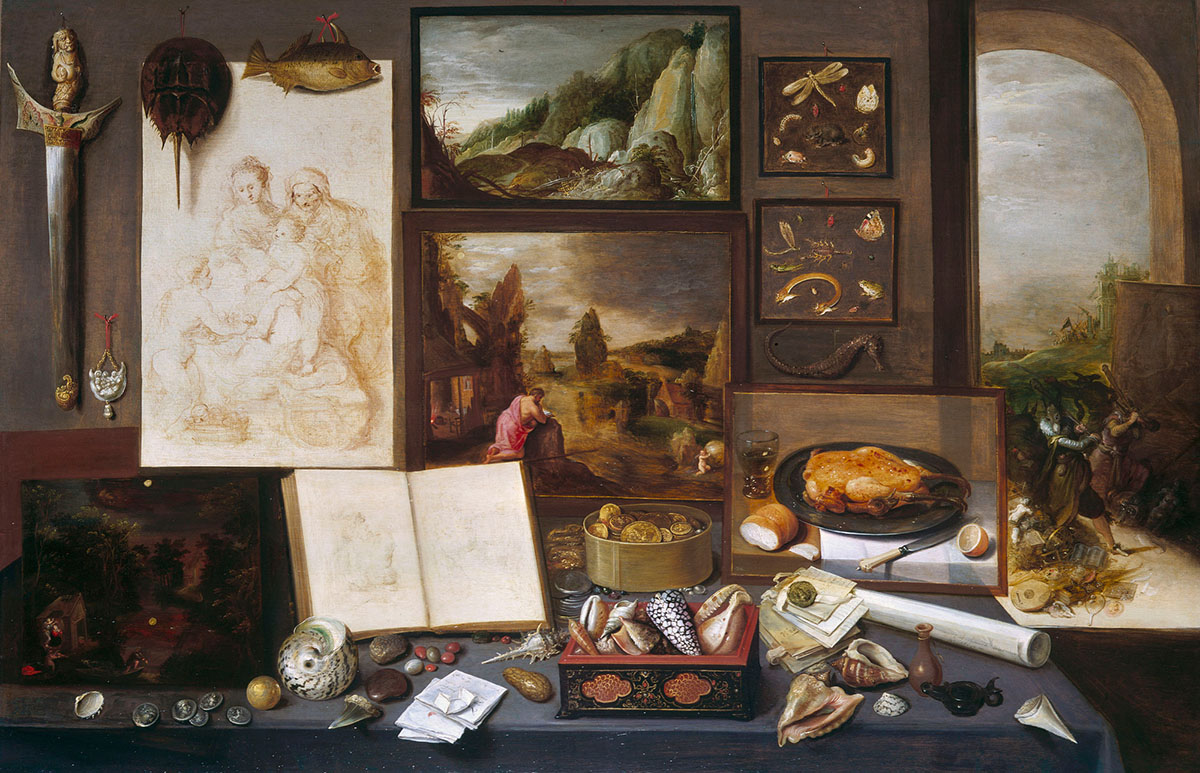
Frans Francken the Younger (1581–1642), The Cabinet of a Collector, 1617, Oil on panel, 76.7 x 119.1 cm, Royal Collection Trust (RCIN 405781).
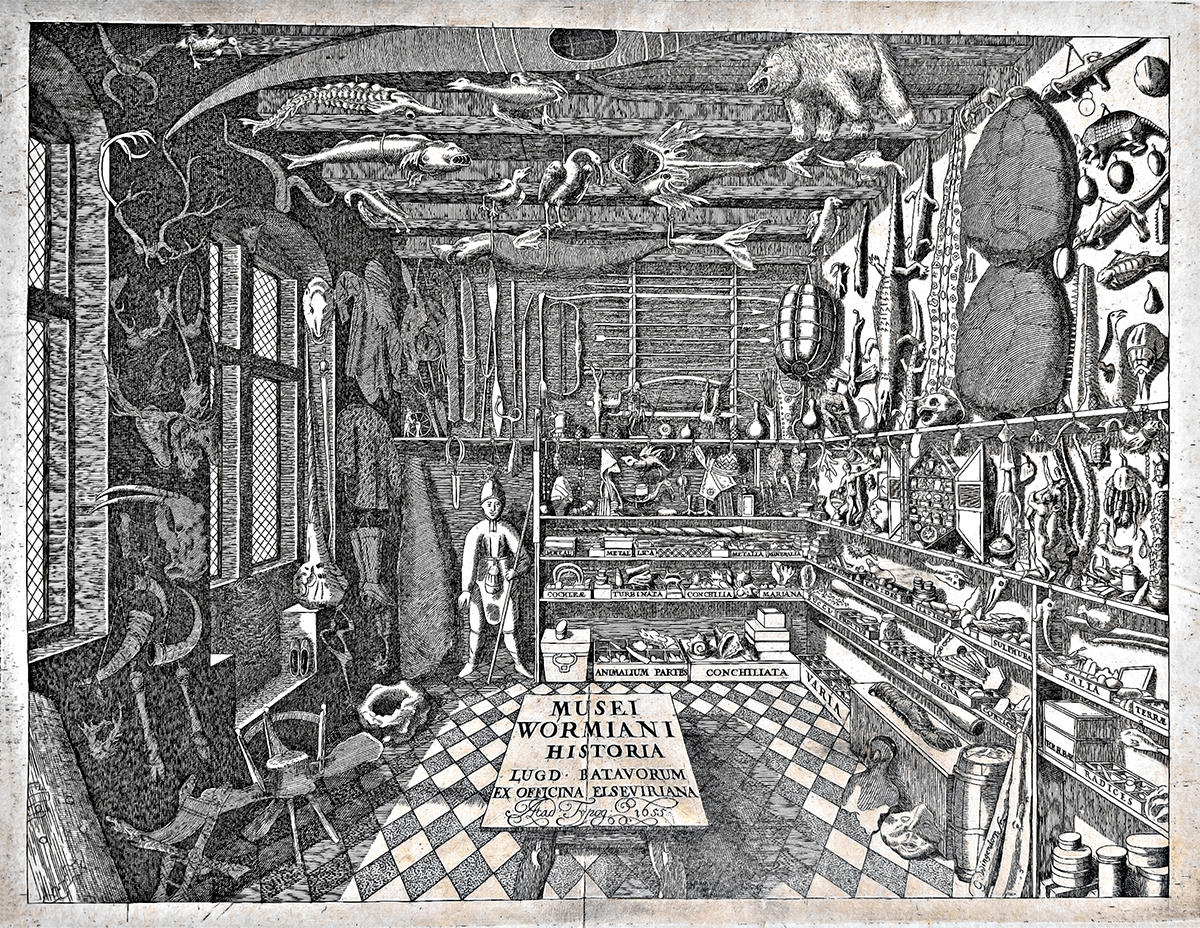
Ole Worm, Museum Wormianum, 1655, Frontispiece, Amsterdam, print by Ludwig and Daniel Elzevir.
The digitisation of the GLAM sector cannot and must not be limited to the accessibility and visibility of collection holdings. Digital initiatives should also pursue curatorial intentions, which must be clearly stated. As with analogue exhibitions in museums, many aspects must be considered when developing a workable curatorial position. It is crucial, however, that the use of technological solutions serves the curatorial idea — and not the other way around. In this sense, the whole exercise is less concerned with bringing digital solutions to the museum than with exemplifying the transfer of curatorial expertise into the digital domain.
3. Storytelling
Unlike museum spaces, digital exhibitions are not subject to the restrictions of the space-time continuum. Travelling from one continent to another, from one century to another, is possible with the same ease as turning a page in a book: all it needs is a click. This opens up a virtually endless range of opportunities, yet it also carries the risk of users getting lost in the technology.
In addition to accessibility/visibility and a curatorial intention, the project uses digital storytelling to guide users through the eventful history of the museum. The collector's excitement when he, for the first time, saw his Yucca palm blossoming in his garden; the circulation of ancient coins between Basel and Lyon; the social capital the family drew from its ties with Napoleon; the visit of an imposter prince from Egypt who left his tughra in the visitors’ book — these are just a few episodes from the long history of the Museum Faesch. Alongside many similarly peculiar and intriguing narrative strands, they can be experienced in a separate ‘storylines’ section.[12]
This approach presents the Museum Faesch, its artefacts, as well as its owners and visitors, within a context of local urban history, the history of knowledge in Europe, and its interconnectedness in a République des Lettres. Supplemented by additional artefacts from other museums and using a variety of different media formats, the ‘storylines’ convey the wider historical background of various transformations the Museum Faesch underwent from the Renaissance to the Restoration of the early nineteenth century.
While storytelling is an essential method for the museological communication of (historical content, such stories must be carefully conceived, developed, and presented. Put differently, visitors must be guided through the digital materials, which cannot responsibly be delegated to technology. Clicking alone does neither generate stories nor history.
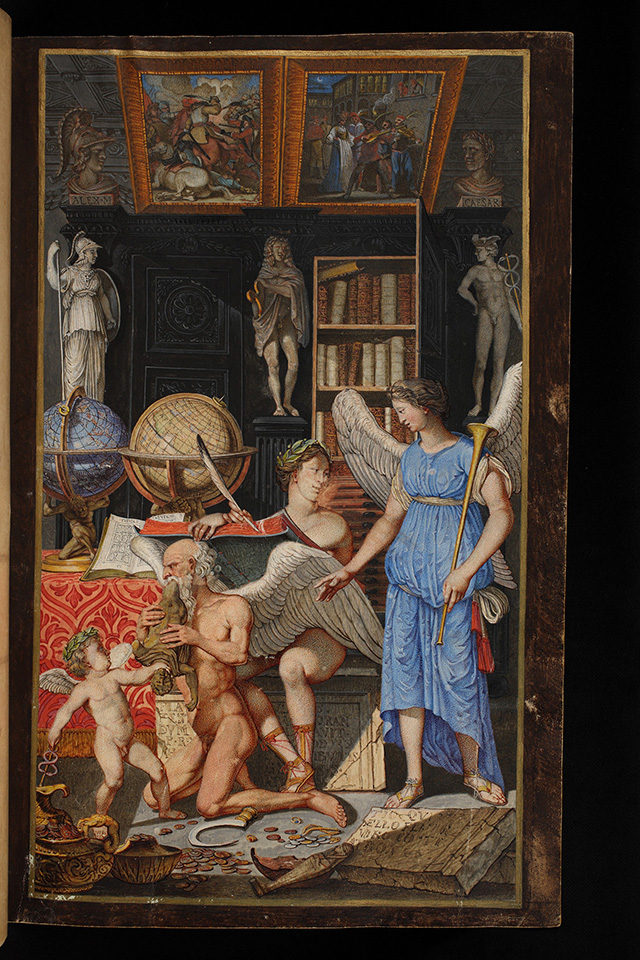
Allegorical representation of the Faesch Collection in the rector's register of the University of Basel for the year 1672 and the Rectorate of Christoph Faesch, the brother of the collection’s founder. Rektoratsmatrikel vol. 3 (1654–1764), UBH AN II 4a, fol. 47r.
4. User experience
Digital applications have great potential to enhance user experience with respect to cultural heritage. The spectrum of technical possibilities is very broad, ranging from simple functionalities such as zooming to the gamification of content. It is, however, essential that the choice of technologies is motivated and determined by curatorial objectives, as it is not expedient to use technical possibilities for their own sake.
In the Curiositas project, we decided to assign a specified but limited number of technical features to each of the four conceptual entry points, so that the curatorial intention is continuously supported and strengthened by user interaction. In the ‘object constellations,’ where attention is directed to the collection as a network of artefacts, users can themselves select relations between objects and thus learn more about specific connectivities. By contrast, the ‘gallery’ presents every item in its own right, applying different digital formats (high-res photography, photogrammetry) and features (zoom, 3D-handling) to support closer inspection, and allows for the downloading of data and metadata. The ‘storylines’ section, on the other hand, combines different media formats (text, images, video, audio) for the purpose of attractive storytelling. It involves the user in the narration by crossing textual and visual narratives, inviting them to consciously select between text and image.
A final section labelled ‘datastories’ exploits digital tools for the visualisation of aggregated data relevant to the Museum Faesch, such as a geo-referenced representation of the books’ publication sites, or the family ties as reflected in the marriage members of the Faesch family contracted in the seventeenth century. Finally, a machine learning tool exploits Remigius Faesch’s handwritten library catalogue, which can be searched by author, title, year, and place of publication. Here, the intention was to playfully introduce the user to machine learning systems and, at the same time, to explain these technologies and their limitations, for instance by highlighting character error rates in handwritten text recognition applications (HTR).
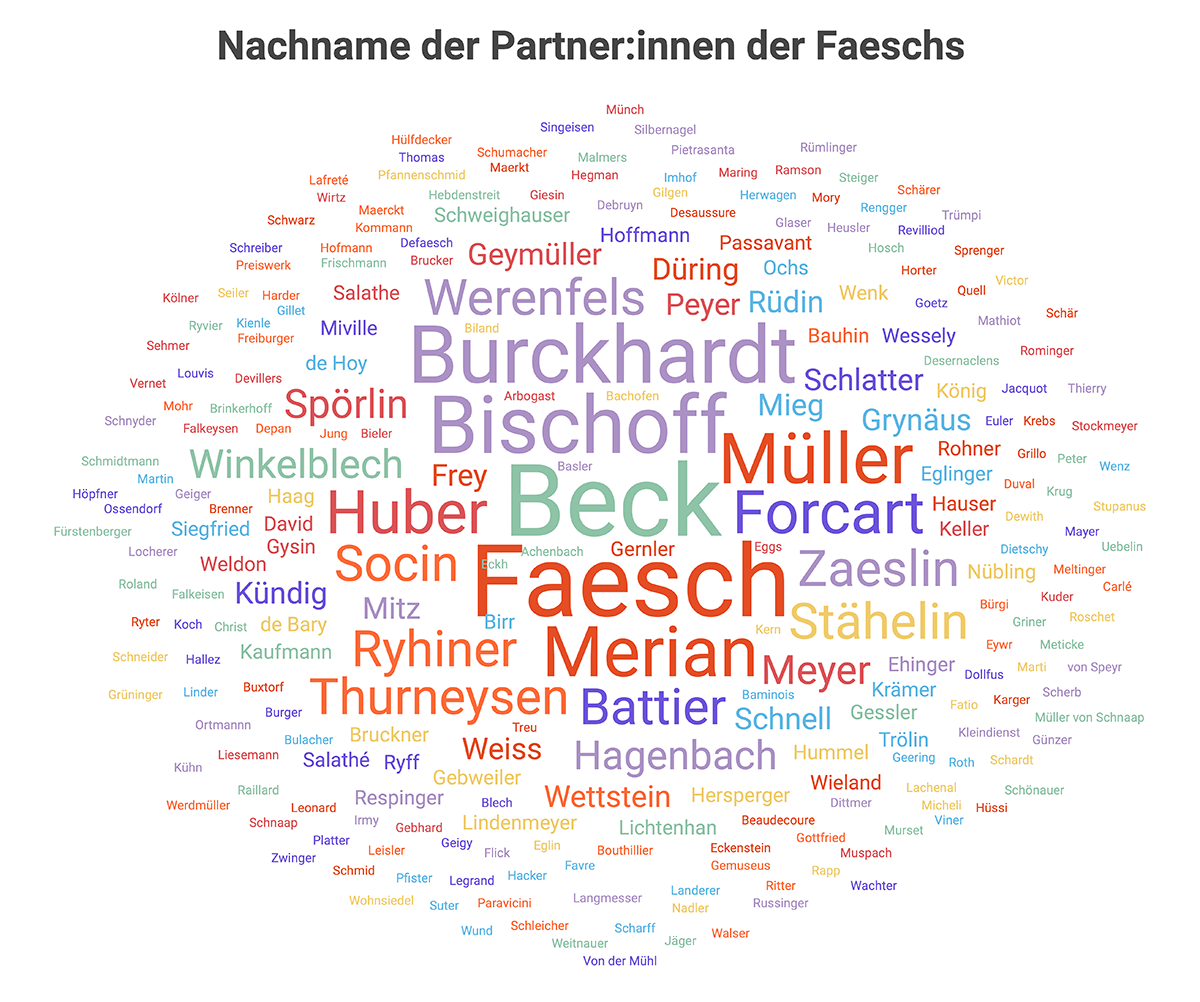
Faesch Family Names, Wordcloud of names as reflected in the marriages, members of the Faesch family contracted during the 17th century. Accessed October 30, 2024, https://curiositas.digitalesschaudepot.ch/en/datastories/kleio:set_9005a8a4-1f03-4635-949b-23d32cb47026/.
Conclusion
The Curiositas project is a paradigmatic use case because its implementation entailed many of the structural challenges GLAM institutions face when treading the path of digital transformation; from data curation and issues of interoperability between disjointed holdings to questions of copyright and the selection of appropriate digital tools. None of these challenges are new in the context of cultural heritage. The digital transformation, therefore, is impactful with respect to the practices and formats that deal with cultural heritage rather than fundamentally changing its substance or essence.[13] As mere toolkits, digital technologies offer numerous opportunities for added value. To benefit from this, several aspects must be kept in mind:
– Cultural heritage must be digitized, sustainably stored, and made accessible for free reuse according to internationally acknowledged standards.
– The use of cultural heritage as data can make holdings more accessible and inclusive; in this way, digital technologies contribute to shape identities and, therefore, empower the societal relevance of cultural heritage as a whole.
– When thinking of cultural heritage as data, the principal focus must still lie on curatorial intentions and storytelling rather than technology. Even the most advanced technological solution quickly loses its fascination if it is not used to convey an encompassing intention or message.
– The encounter with cultural heritage seeks to negotiate present-day interests and (research) questions with the past. Technology alone is not able to provide satisfying answers, but it can enhance our understanding and thus contribute to communicating and transmitting new discoveries and knowledge.
Lucas Burkart has been professor of Medieval and Renaissance History at the University of Basel since 2012. His research interests include the cultural history of the Middle Ages and the Renaissance, their global interconnectedness, and the history of historiography. He is currently supervising the critical edition of the works of Jacob Burckhardt. Furthermore, he runs the ongoing research project “Economies of Space. Practices, Discourses and Actors in the Basel Real Estate Market (1400–1700)” that is based on digital technologies, AI-based methods to access data, and computer-assisted evaluation methods. Finally, with the initiative “Digitales Schaudepot”, he drives his vision of open cultural heritage in the digital age. His latest publications include: Materialized Identities. Objects, Affects and Effects in Early Modern Culture,1450-1750 (Amsterdam: Amsterdam University Press, 2021) and Burckhardt. Renaissance. Explorations and Re-readings of a Classic (Göttingen: Wallstein Verlag, 2021), and Stadt in Verhandlung. Basel 1250–1530 (Basel: Christoph Merian Verlag, 2024).
Notes
[1] GLAM is the acronym for galleries, libraries, archives, and museums. When referring to GLAM institutions this article intends public sector institutions.
[2] Scot Hartley, The Fuzzy and the Techie. Why the Liberal Arts will Rule the Digital World (Houghton Mifflin Harcourt) 2017.
[3] Luke Stark and Anna Lauren Hoffmann, “Data Is the New What? Popular Metaphors & Professional Ethics in Emerging Data Culture,” Journal of Cultural Analytics 4, no. 1 (2019), https://doi.org/10.22148/16.036.
[4] The metaphor goes back to a quote by mathematician and data scientist Clive Humby from 2006. Buckingham and others expanded it by the idea of the value creation cycle. See: Charles Arthur, “Tech giants may be huge, but nothing matches big data,” The Guardian, 23 August 2013.
[5] In recent years, criticism has grown louder that large IT companies — legally secured by TOCs hardly anybody reads — find and extract data from their users without appropriately compensating them in order to transform those users into customers that buy their own data back, once “refined.” See for instance: Martin Andree, Big Tech muss weg! Die Digitalkonzerne zerstören Demokratie und Wirtschaft. Wir werden sie stoppen (Frankfurt a.M.: Campus Verlag, 2023).
[6] A relevant example that is indicative of the scenario described is the Google Books project, in which four leading Swiss public libraries are working together with the Californian tech giant.
[7] This claim must be maintained, even though it is still unclear how proof of misuse of data labelled in this way can be legally established. So far, this has not bee7n successfully implemented anywhere.
[8] Originally from southern Germany, the Faesch family acquired Basel citizenship in 1409 and soon became part of Basel's upper class. As merchants, tradesmen and members of the university, they amassed considerable wealth and held continuously high offices in the city council and government from around 1500. Through clever marriage, they joined forces with other patrician families in the city. In Basel, the family still exists today. See: Samuel Schüpbach-Guggenbühl, “Faesch," Historisches Lexikon der Schweiz, accessed February 10, 2025, https://hls-dhs-dss.ch/de/articles/020960/2024-08-22/.
[9] “CURIOSITAS 5.0—Museum Faesch. A cabinet of curiosities as a site for digital amazement,” accessed February 10, 2025, https://curiositas.digitalesschaudepot.ch/en/.
[10] See for instance the “European Commission report on Cultural Heritage: Digitisation, Online Accessibility and Digital Preservation from June 12, 2019,” accessed February 10, 2025, https://digital-strategy.ec.europa.eu/en/library/european-commission-report-cultural-heritage-digitisation-online-accessibility-and-digital.
[11] “CURIOSITAS 5.0—Gallery,” accessed February 10, 2025, https://curiositas.digitalesschaudepot.ch/en/gallery/.
[12] “CURIOSITAS 5.0—Storyline,” accessed February 10, 2025, https://curiositas.digitalesschaudepot.ch/en/storylines/kleio:set_209d6ce8-0aab-45dd-aa58-74d79fb34378/.
[13] Andreas Fickers, “What the D does to history: Das digitale Zeitalter als neues historisches Zeitregime?,” Digital History: Konzepte, Methoden und Kritiken Digitaler Geschichtswissenschaft, ed. K.D. Döring et al. (Berlin: De Gruyter, 2022), 45-64. Fickers argues that the ‘D’ also implies a shift on an epistemic level; new data driven practices and formats also transform the way we think about history. Accordingly, he calls for digital hermeneutics that is aware of these effects, understands their technological underpinnings and enables us at the same time to critically reflect them. This aspect is rapidly gaining in importance with analytical and generative AI; it opens up a new field of research that is in great need of critical reflection from the Social Sciences and Humanities.