
- Download Issue 63 (US Letter, 7 mb)
- Buy as Book on Demand here (US) and here (DE)

by Lívia Nolasco-Rózsás
Beyond Matter. An Inquiry into the Modes of Exhibition Practices in the Virtual Condition
Beyond Matter. Cultural Heritage on the Verge of Virtual Reality (2019-23) was an international, collaborative, practice-based research project engaged with a contemporary shift in the production and mediation of visual art within institutional frameworks. The context of the project is largely attributable to the rapid development and ubiquitous presence and use of computation and information technology, specifically augmented and virtual reality alongside artificial intelligence.
Logo of the project Beyond Matter, 2020. Design by AKU Collective
The shift is seismic and it is leading to a condition that may be summarized as “the virtual.” If the postmodern condition was a “crisis of narratives,” as Jean-François Lyotard put it,[1] then the virtual condition reveals a crisis of dichotomies. Its analysis suggests that dichotomies are losing their validity: presence and absence, physical and computer-generated, real and simulated. The algorithmically-generated actuality increasingly dominates our reality, intertwines the physical with the virtual, and skews the linearity of time. This has extensive implications for the spatial aspects of the curation and mediation of visual arts, as well as their reception by a public whose affinity for technology is ever-increasing. The museum transmogrifies into a hybrid entity whose geographical location is extended by various digital platforms; instead of one there is a confluence of exhibition spaces, an extended but also porous system of multiple dimensions.
The virtual condition is thus a tendency in cultural spheres toward the interdependence of physical and digital spaces, as well as the coexistence of multiple exhibition temporalities for art’s mediation and reception. It is based on an ontological perspective of virtual realism, which considers the virtual to be as real as the physical. It relates to and results from a dynamic genealogy of culture-related general conditions, such as Jean-François Lyotard’s postmodern condition (1979), in which the metanarratives that were a quintessential feature of modernism became generally untenable. These include the post-medium condition described two decades later by Rosalind Krauss (1999), or Peter Weibel’s post-media condition (2012) as new technologies and tele-communications infiltrating the arts. It overlaps with various other contemporary conditions, such as the digital condition identified by Felix Stalder (2017), the planetary condition by Yuk Hui (2020), and the curatorial condition by Beatrice von Bismarck (2022). [2] The Beyond Matter project scrutinized the virtual condition in art production and mediation by means of practice-based research, resulting in a plurality of media that includes virtual and augmented realities, digital models and digital artworks, presented in a network of computer-based and physical exhibition spaces that generated hybrid experiences.
The creation of generative networked spaces to display art and produce knowledge is not a novelty; it has unfolded hand in hand with the development of computation’s ability to visualize simulated or generated spaces that may or may not resemble our observable surroundings and the ways in which we perceive them.
Throughout the Beyond Matter project, various activities took place as a result of the practice-based research on the virtual condition undertaken by the partner institutions. Through our common endeavor, the partners aimed to produce a “pool of tools”[3] and related knowledge to help arts practitioners, curators, and museum professionals understand the shift described above and then plan and implement best practices. Putting an emphasis on the spatial aspects of art production, curation, and mediation, the project included the digital revival of selected past landmark exhibitions, the curation of new art and archival exhibitions, conferences, artist residency programs, an online platform, and publications. These multiple actions were based on the virtual condition but also reflected on it.
Beyond Matter was led by ZKM | Center for Art and Media Karlsruhe, and the collaborators comprised of researchers and curators at: Aalto University, Espoo; Centre Georges Pompidou, Paris; Ludwig Múzeum – Kortárs Művészeti Múzeum (Ludwig Museum – Museum of Contemporary Art), Budapest; Tallinna Kunstihoone (Tallinn Art Hall); Tirana Art Lab – Center for Contemporary Art; and the associated partners EPFL Pavilions, Lausanne; HAWK – University of Applied Sciences and Arts, Hildesheim, GIM Gesellschaft für Innovative Marktforschung GmbH, Heidelberg and Bio Design Lab at Karlsruhe University of Arts and Design (HfG). These are institutions of varied scales and profiles with a shared interest in the innovative use of digital technologies to reach non-local audiences, to expand their exhibition spaces digitally, and to create hybrid access to the content they wish to mediate. With this project they each ventured into new territory.
At the heart of Beyond Matter was an exploration of the potential harbored in computer- generated exhibition spaces. The key focus areas, examined through an array of approaches, were formed by notions of space and their meaning in the context of artistic and exhibition practice, as well as by perceptions of the reciprocal relationship between computer-generated virtual and physical spaces — and the immersive features in them — from the points of view of all actors of the constellation within an exhibition.[4] This exploration manifested in various ways throughout the projects; for example in the modeling of two historical exhibitions or through inviting artists to elaborate their take on the virtual from diverse angles.
In the context of art production and mediation, the word “virtual” often appears together with “reality.” Virtual reality is predominantly understood as a term for computer-aided interactive and immersive environments accessed via screened images and in many cases additional devices (such as head-mounted displays). Dissecting the term “virtual reality,” including its etymology, aids in understanding the condition brought about by the technological opportunity to create relatively sophisticated representations of anything we can perceive and calculate digitally. Indeed, deconstruction serves as a basis for constructing new terms, which in turn serves to contextualize art production and mediation. Donna Haraway came up with an apparently deconstructive yet genuinely constructive method to evolve the abbreviation SF into versatile pairings of words.[5] Generally standing for science fiction, SF was subjected to a word game as Haraway formulated other terms that it could stand for, all of which relate in meaning to science fiction or offer an alternative to it, such as “speculative fabulation” and “string figures.” Inspired by how all these new SF terms joined Haraway’s arsenal of methodologies, we applied her formula to VR and found that it could stand for a variety of terms beyond virtual reality: viral radiation, valid readings, vaporous restoration, variable relations, visible revision, visionary ramblings, and many more.
The final publication that summarized the project under the title Beyond Matter. Within Space. Curatorial and Art Mediation Techniques on the Verge of Virtual Reality[6] took these envelopments of VR as an initial set of points to frame the Beyond Matter endeavor. Each chapter took one enfoldment as its departure point to elaborate on the newly coined term through commissioned essays and descriptions of the outputs of the practice-based research conducted throughout the project, or, in the case of the last chapter, through interviews with the artists and scholars who participated in the Beyond Matter residency program.
The first large-scale exhibition organized in the framework of Beyond Matter: Spatial Affairs took place in 2021, in the midst of the Covid-19 pandemic. The various waves of lockdowns made planning of public events, travel, and workflows challenging. Throughout this time art institutions largely relied on online formats. Spatial online art mediation formats had constituted the main focus of Beyond Matter before the pandemic-related lockdowns accelerated this process of digital expansion.
Along with the physical international group show Spatial Affairs, presented at Ludwig Museum / Museum of Contemporary Art in Budapest in 2021 and the online environment that enhanced it under the title Spatial Affairs. Worlding—A tér világlása[7], the Hybrid Museum Experience Symposium (HyMEx)[8] laid the groundwork for long-term collaborative research regarding the complex dichotomy between the virtual and actual exhibition space. Pre- and post-computational approaches from the interwar avant-garde period through Conceptualism to very recent works of art were selected for Spatial Affairs, and they point at the mutual dependence between the algorithmically created and the palpably real. At its conceptual core, the exhibition investigated the binary relationship between the actual and the virtual, the real and the possible, as it evaporates into a multidimensionality in which dualism is undermined, leading to an exploded axes of complex and multiplied notions of space.
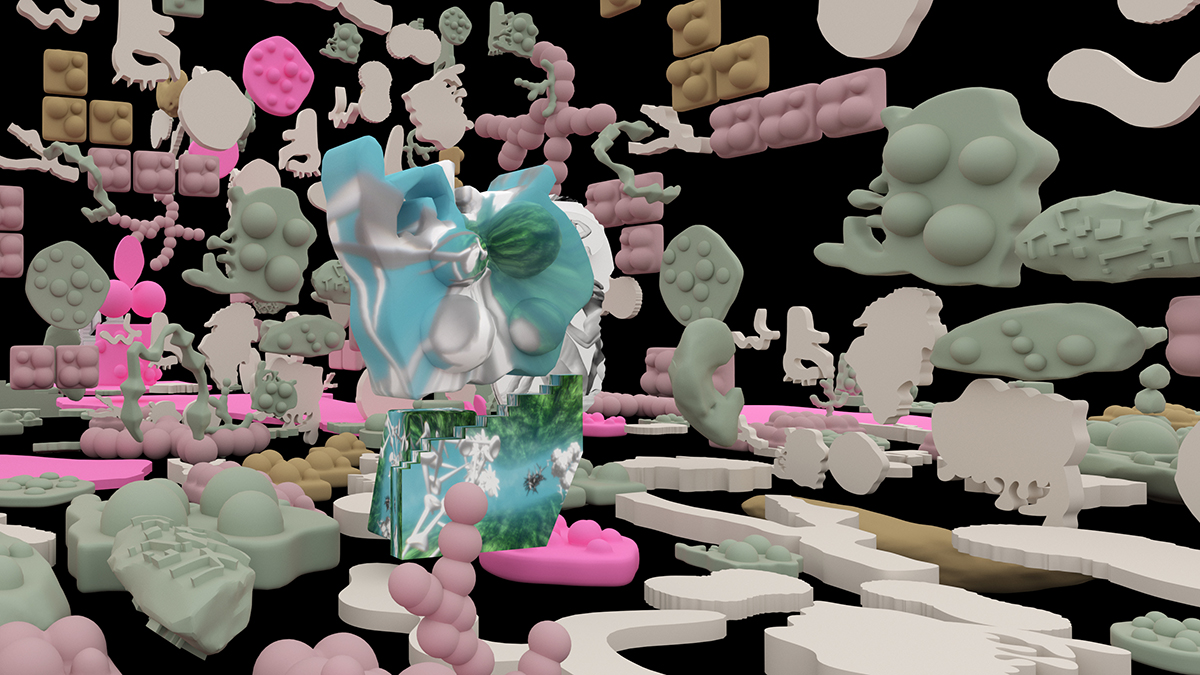
Screenshot of the online exhibition Spatial Affairs. Worlding – A tér világlása (2021), https://spatialaffairs.beyondmatter.eu/en. Design and programming by The Rodina. Curated by Giulia Bini and Lívia Nolasco-Rózsás.
Beside Spatial Affairs, the Tirana Floating Archive[9] was conceived as a virtual space that mediates curated artistic knowledge and aesthetic components unbound from where their physical carrier is actually situated, or where their exhibition takes place. These spaces offer answers to queries about the significance of the space of the exhibition after the post-digital turn, and how art institutions can react to this paradigmatic shift.
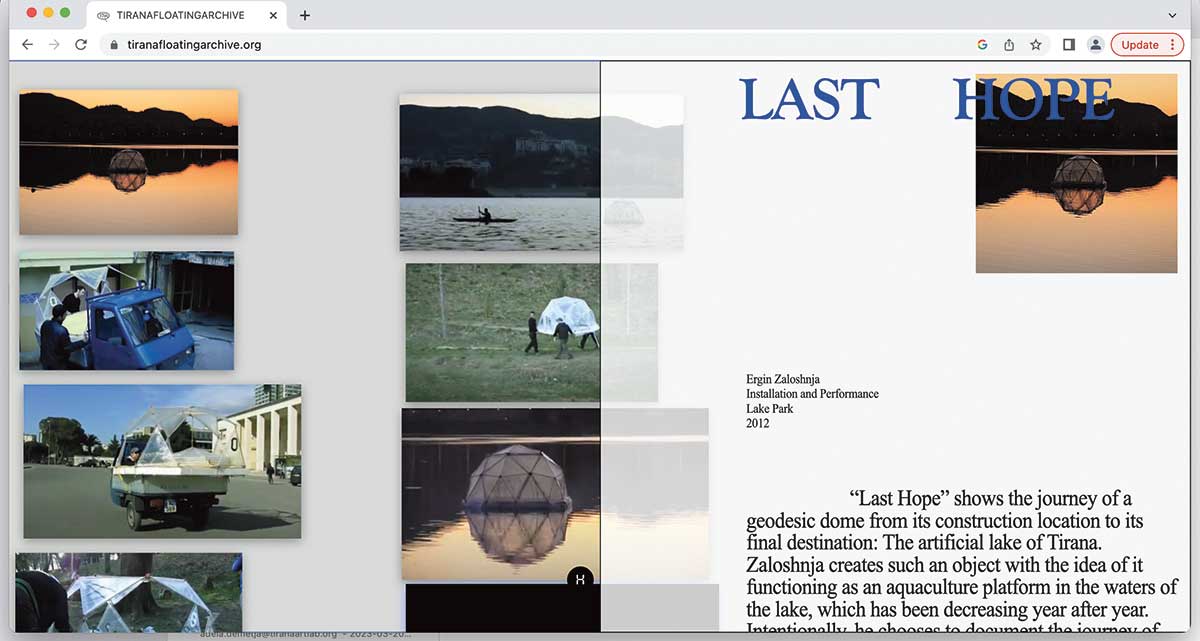
Screenshot from the Tirana Floating Archive (2022), https://tiranafloatingarchive.org/. Curated by Adela Demetja, design by Denislav Golemanov.
Furthermore, on the verge of the physical and digital was also the traveling exhibition Matter. Non-Matter. Anti-Matter[10] with a specific focus on its extended iteration at ZKM | Karlsruhe. Each presentation of this exhibition, varying in size and context, had the same element at its core: The Immaterial Display, a hardware installation developed to present digital exhibition spaces. The two digital exhibition models shown in the display engaged with Iconoclash and Les Immatériaux. Based on those two paradigmatic exhibitions, the exhibition and its accompanying program explored the possibilities of virtual exhibition histories.
Taking up the case studies of Les Immatériaux (Centre Pompidou, 1985) and Iconoclash. Beyond the Image Wars in Science, Religion, and Art (ZKM | Karlsruhe, 2002), Centre Pompidou and ZKM | Karlsruhe committed themselves to examining the possibilities of exhibition revival through experiential methods of digital and spatial modeling. Both past exhibitions constituted complex thought experiments deployed through and manifested in space. Both also experimented with innovative ways of juxtaposing scientific, technological, and artistic practices. In their respective ways, Les Immatériaux and Iconoclash proposed the exhibition as both a medium and an interface with a different level of reflection and creativity.
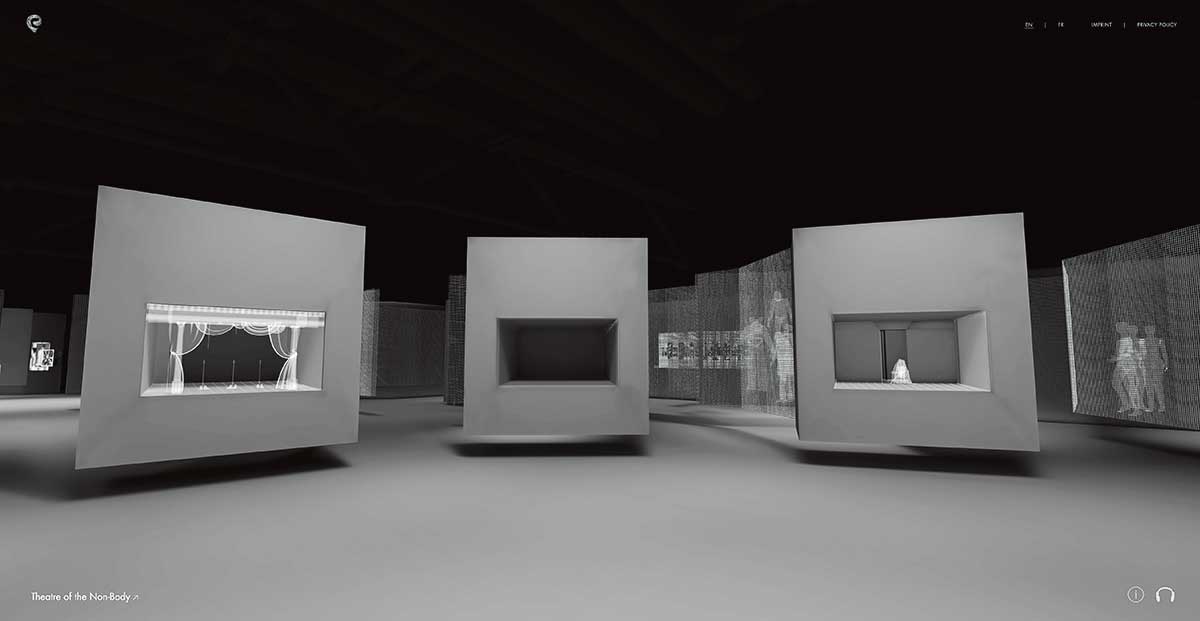
Screenshot Les Immatériaux: A Virtual Exhibition (2022) https://lesimmateriaux.beyondmatter.eu/. Concept by the New Media Department of the Musée national d’art moderne—centre de création industrielle, design concept by Aalto University, project management by Matthias Heckel, software development by Netzbewegung GmbH, archival research by Andreas Broeckmann and Marie Vicet.
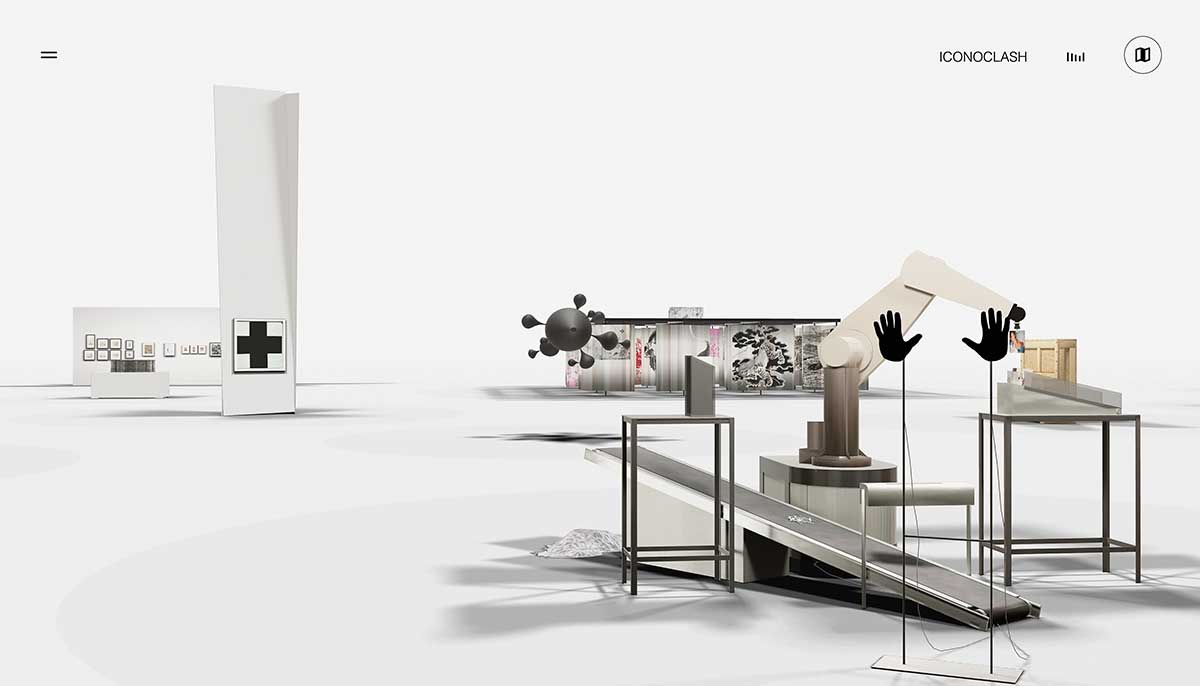
Screenshot from Iconoclash as a Digital Experience (2022), https://iconoclash.beyondmatter.eu/. Concept by Lívia Nolasco-Rózsás, UI / UX and motion design by Matthias Heckel, software development by Netzbewegung GmbH, archival research by Felix Koberstein. © ZKM | Zentrum für Kunst und Medien Karlsruhe
The models were created with a non-physical and non-reconstructive approach, denoted as “Vaporous Restoration” aiming at the emulation, modeling, or proxy-creation of the two selected past spatial assemblies of artworks. These virtual exhibition models[11] are based on extensive archival research, interviews with experts and the curators, and an iterative design process among a large interdisciplinary group. The chosen exhibitions were well-known, complex, self-reflexive instantiations of the medium that outlined escape routes from modernity while elaborating on notions of representation and materiality. The digital models inevitably prompt the question of whether the aura of an artwork, or even of the entire exhibition, can be migrated into the digital realm.
Inspired by a quote from Walter Benjamin,[12] one of the main objectives of Matter. Non-Matter. Anti-Matter was to revisit, restore, and re-present these past exhibitions in our spaces using digital technology. The exhibition presented digital models of the two past exhibitions on The Immaterial Display, alongside a novel hardware apparatus that was developed specifically for explorations of virtual exhibitions. The models’ online launch took place in conjunction with the exhibition opening on December 2, 2022. A selection of artworks and artifacts attested to art’s conceptual dematerialization and digital rematerialization. Some artworks were specially commissioned for the exhibition, while others largely came from the collections of Centre Pompidou and ZKM | Karlsruhe, many of which were exhibited in Les Immatériaux or Iconoclash or both.[13]
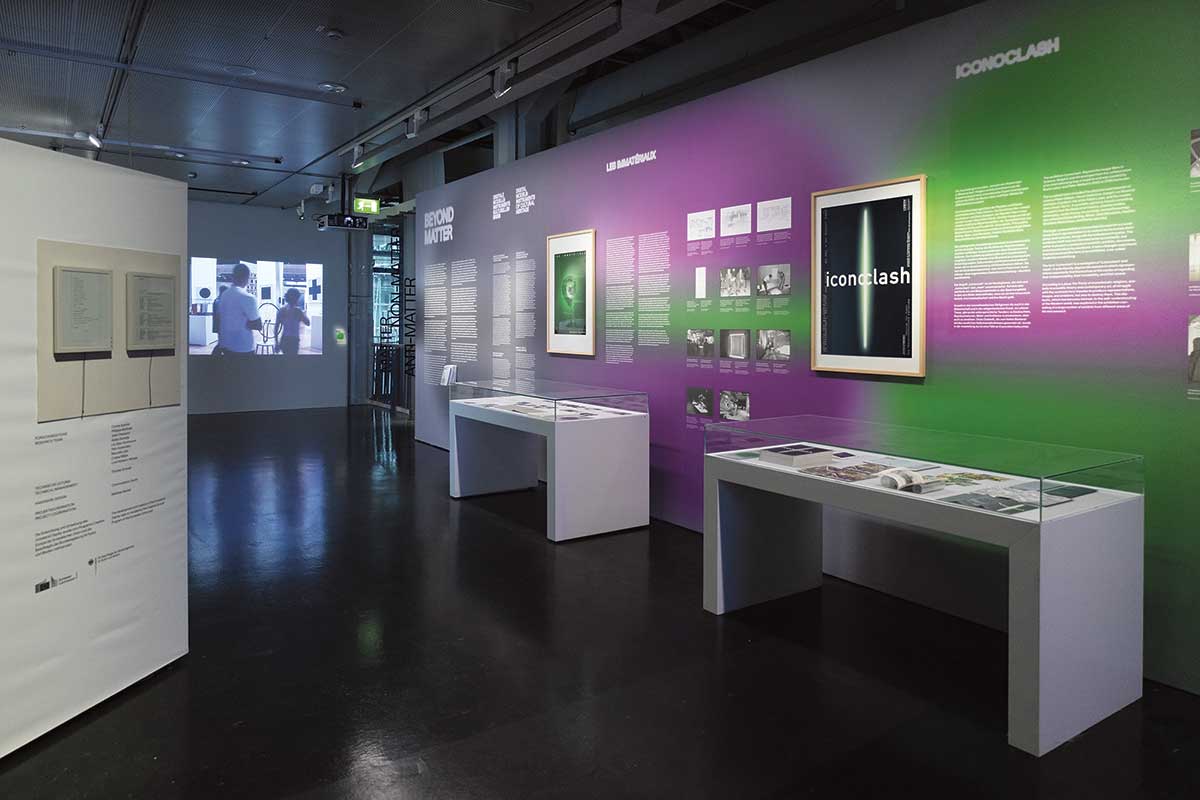
Exhibition view of Matter. Non-Matter. Anti-Matter. Past Exhibitions as Digital Experiences (2022-2023) at ZKM | Center for Art and Media Karlsruhe. Photo: Esteban Gutierrez Gimenez. © ZKM | Zentrum für Kunst und Medien Karlsruhe
The tension between presence and absence and the digital dissolution of the dichotomy between the two phrased as “Variable Relations” throughout the project, which connotes the multiplicity of connections between visitors, artworks, artifacts, scenographies, curatorial concepts, artists, scholars, museum professionals, objects, and subjects. These new relations across virtual and physical spaces give rise to an epistemological shift that manifests in the Beyond Matter VIEW Platform,[14] or in the virtual exhibition platform of Tallinn Art Hall.[15]
The evaluation methods were part of the project. Performance-oriented research and audience and community studies[16] were conducted and followed The Immaterial Display on its journey through Europe, while an evaluation automaton was developed and used to evaluate the digital content and interfaces in a hybrid exhibition qualitatively and quantitatively.
Parallel to practice-based research, Beyond Matter enabled artistic research and creation. A residency program[17] enabled fourteen artists to join one of three participating institutions and ramble—in their minds at least. Due to pandemic travel restrictions, not all resident artists and researchers could be present at the host institution and some had to develop and/or exhibit their residency project online. The Beyond Matter VIEW Platform contains the entirely online environments and the online parts of larger projects by some of the artists. Despite these logistical challenges, all the results of the residencies could be exhibited or performed in one or more of the frameworks provided by the Beyond Matter project—in the Matter. Non-Matter. Anti-Matter exhibition in Tirana, at ZKM, or as part of the group show Immerse! at Tallinn Art Hall.[18]
Beyond Matter entangled and intertwined formats, actions, processes, and results and had a complex project architecture. Each partner contributed a layer of research and was involved with different activities. Beyond Matter has also engendered new content — through exhibitions, symposia, discussions, and publications. It also facilitated professional exchange between art institutions, mainly within European countries, and contributed to cultural professionals’ skillsets around digital mediation formats by fostering a transnational mobility of artworks and arts professionals. The project also contributed to the digital commons through digitized archival materials and the development of open-source software that is available online and usable by any other cultural organization wishing to provide online access to the cultural heritage in its guardianship.
A further outcome of the Beyond Matter project is the Generic Exhibition Platform. Primarily developed for the digital emulation of Iconoclash, it is an AI-based software tool that facilitates the generation of digital exhibition spaces. An exemplary online environment demonstrates the features of the software which seeks to encourage museums, art organizations, and cultural professionals to benefit from the open-source tool for the creation of digital exhibitions of their own. In the interest of the participatory and democratic sharing of resources, the software is freely available on the GitHub account of ZKM | Karlsruhe.
For the creation of a new digital exhibition, digital objects (in the form of digital 3D assets) must be uploaded into the respective Content Management System of the generic exhibition platform, alongside information on the assets (author, title, description, etc.), and keywords. Without the digital objects, the exhibition space is an uninterrupted plane. The space is defined by the objects and the user, and the ever-evolving relation between these two agents.
The algorithm developed for the generic exhibition platform determines the position of the digital 3D objects within the digital exhibition space. The profile of an exhibition piece is described by the values of predefined tags. By observing an exhibition piece over a certain period of time and spending time in its activity zone, the user profile of the visitor is defined. The similarity between all exhibits and the visitor is calculated continuously. The visitor attracts exhibits that share coinciding levels of similarity as their user profile.
As the examples show, the project put forward possible directions for practice-based research and creation in non-academic environments such as art centres, museums, art halls, or art labs in the hope that not only the outcomes but the devised methodologies will prevail, and that art institutions will carry on with digital world-making and create online platforms that function as assemblies, so that hybrid experiences in art mediation will soon be widely accepted, and AI-based construction of digital platforms for sharing knowledge will become ubiquitous.[19]
Tackling the dichotomy between virtual and physical exhibition spaces has been the central tenet of Beyond Matter, directly resonating with the concept behind ParaVerse. The examples and case studies above aptly illustrate a tendency that the project refers to as the formation of a multiverse composed of various parallel universes. The potential existence of computer-generated realities enables such parallelisms, positioning curatorial work as an act of world-building.
This text is a reprint. It is based on the publication Beyond Matter. Within Space. Curatorial and Art Mediation Techniques on the Verge of Virtual Reality, edited by Lívia Nolasco-Rózsás and Marianne Schädler, Berlin: Hatje Cantz, 2024,
(https://withinspace.beyondmatter.eu/) and was published in Curating Superintelligences: A Reader on AI and Future Curating, Data browser, vol. 10, edited by Joasia Krysa and Magdalena Tyzlik-Carver, London: Open Humanities Press, 2025. (http://www.data-browser.net; http://www.openhumanitiespress.org/books/series/data-browser/)
Peggy Schoenegge is an independent curator, writer and project manager at peer to space, as well as the head of the board of the Media Art Association in Berlin. Her work focuses on the conditions and challenges of the post-digital age and its impact on our everyday life, culture and society. Specifically, she addresses topics such as gender, performance, and artificial intelligence in the context of current technological developments. By curating digital art, internet art and art created with new media such as VR or AR, she realizes international group exhibitions in both physical and virtual spaces. In this framework, she explores strategies for contemporary and media-based forms of presentation. In addition, she lectures and participates in panel discussions at international conferences, symposia and events. She teaches at the University of Applied Sciences Darmstadt and HTW—University of Applied Sciences Berlin. Currently, Peggy Schoenegge is pursuing a PhD on the theoretical and practical implications of web-based art spaces and their development from the initial stages of the internet until today at the Institute of Art History at the University of Bonn.
Notes
[1] Jean-François Lyotard, La condition postmoderne: rapport sur le savoir (Paris: Éditions de Minuit, 1979).
[2] These terms reoccur in the texts of the authors, and are elaborated on in the following texts:
– Rosalind Krauss, A Voyage on the North Sea: Art in the Age of the Post-Medium Condition (London: Thames & Hudson, 1999), 53.
– Peter Weibel, "The Post-Media Condition," Mute, March 19, 2012, https://www.metamute.org/editorial/lab/post-media-condition.
– Felix Stalder, The Digital Condition (Cambridge: Polity Press, 2017).
– Yuk Hui, "For a Planetary Thinking," e-flux, no. 114 (2020), https://www.e-flux.com/journal/114/.
–Beatrice von Bismarck, The Curatorial Condition (London: Sternberg Press, 2022).
[3] The expression “pool of tools” was used by Peter Weibel in the context of the exhibition Renaissance 3.0 (2023–2024, ZKM | Karlsruhe).
[4] The term “constellation” is used here in the sense Beatrice von Bismarck used it in The Curatorial Condition (Berlin: Sternberg Press, 2022).
[5] See Donna Haraway, SF: Speculative Fabulation and String Figures / SF: spekulative Fabulation und String-Figuren, So Far, 100 Notes—100 Thoughts / 100 Notizen—100 Gedanken, documenta (13) (Ostfildern: Hatje Cantz, 2011).
[6] Lívia Nolasco-Rózsás, Marianne Schädler, eds., Beyond Matter, Within Space. Curatorial and Art Mediation Techniques on the Verge of Virtual Reality (Berlin: Hatje Cantz, 2023). The online version of the book is available open access: https://withinspace.beyondmatter.eu
[7] Spatial Affairs was curated by Giulia Bini and Lívia Nolasco-Rózsás. The catalog of the exhibition includes texts by Sven Lütticken, Ádám Lovász, Ceci Moss and the curators. Giulia Bini, Lívia Nolasco-Rózsás, Jan Elantkowski, Fruzsina Feigl, Borbála Kálmán, eds., Spatial Affairs (Berlin: Hatje Cantz, 2021).
[8] The Hymex Symposium was convened by Borbála Kálmán and Lívia Nolasco-Rózsás. The proceedings of the symposium are available online: http://hymex2021.ludwigmuseum.hu/.
[9] Adela Demetja, the director of Tirana Art Lab.
[10] The exhibition travelled to Tallin Art Hall (2021), Tirana Art Lab (2022), Oodi Library Helsinki, Design Museum Helsinki, Aalto University. Its extended version includes a large selection of artworks based on both past exhibitions that was presented at ZKM | Karlsruhe (2022-2023). Another selection with the focus on Les Immatériaux was on display at the Centre Pompidou, Paris (2023-2024)
[11] Both can be visited online: https://iconoclash.beyondmatter.eu and https://lesimmateriaux.beyondmatter.eu.
[12] “The true method of making things present is to represent them in our space (not to represent ourselves in their space).” Walter Benjamin, The Arcades Project, trans. Howard Eiland and Kevin Mc Laughlin (Cambridge, MA: The Bellknapp Press, 1999), 206. First published as Das Passagen-Werk, in Gesammelte Schriften, vol. 5.1, ed. by Rolf Tiedemann and Hermann Schweppenhäuser (Frankfurt/Main: Suhrkamp, 1982).
[13] Creation of the exhibition models was the collaborative effort of many researchers. They couldn’t have been realized without the MA Fellowship Program of the Aalto University, coordinated by Cvijeta Miljak.
[14] https://beyondmatter.eu/projects
[15] https://kunstihoone.virtualexhibition.eu
[16] Lily Díaz-Kommonen and Cvijeta Miljak, affiliated with Aalto University conceived and conducted the evaluation.
[17] The residency program took place in three institutions: Tallinn Art Hall (curated by Corina Apostol), Tirana Art Lab (curated by Adela Demetja), ZKM | Karlsruhe (coordinated by Felix Koberstein).
[18] The exhibition Immerse! (2023) was curated by Corina Apostol and Lívia Nolasco-Rózsás. Its catalog was published with texts by Matthew Fuller, Helen Kaplinsky, Lukáš Likavčan, Zsolt Miklósvölgyi, Márió Z. Nemes, and the curators. Corina L. Apostol, Lívia Nolasco-Rózsás, eds., Immerse! (Berlin: Hatje Cantz, 2023).
[19] This text is largely based on the introduction to the project in the publication Beyond Matter. Within Space.